


Persistent organic pollutants and type 2 diabetes: a prospective analysis in the nurses' health study and meta-analysis
- PMID: 23131992
- PMCID: PMC3569682
- DOI: 10.1289/ehp.1205248
Persistent organic pollutants and type 2 diabetes: a prospective analysis in the nurses' health study and meta-analysis
Abstract
Background: Prospective data regarding persistent organic pollutants (POPs) and risk of type 2 diabetes (T2D) are limited, and the results for individual POPs are not entirely consistent across studies.
Objectives: We prospectively examined plasma POP concentrations in relation to incident T2D and summarized existing evidence in a meta-analysis.
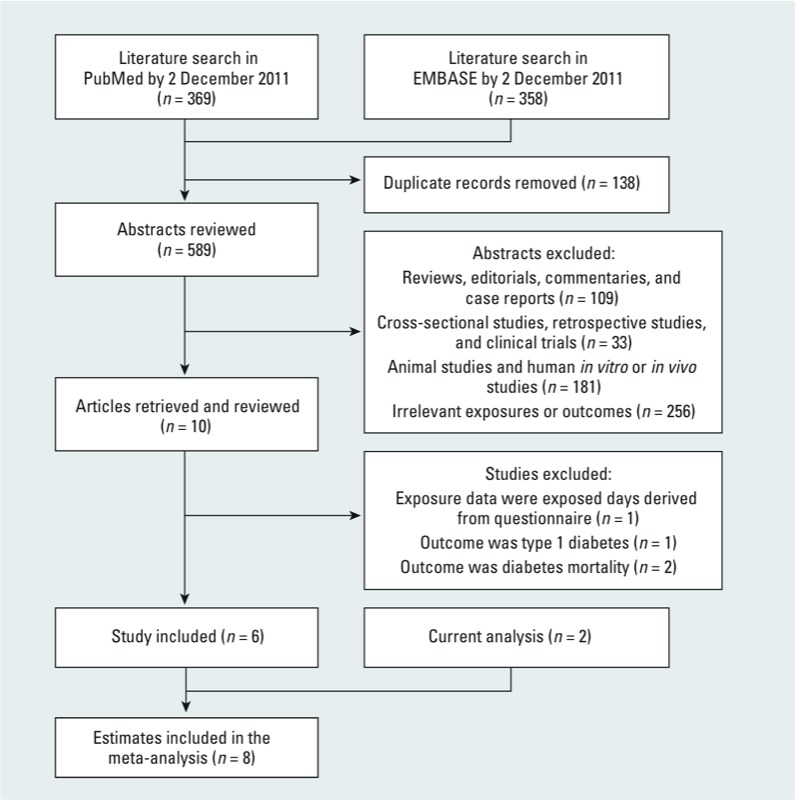
Methods: Plasma polychlorinated biphenyls (PCBs), dichlorodiphenyltrichloroethane (DDT), dichlorodiphenyldichloroethylene (DDE), and hexachlorobenzene (HCB) concentrations were measured in 1,095 women who were free of diabetes at blood draw in 1989-1990 and participated in two case-control studies in the Nurses' Health Study. We identified 48 incident T2D cases through 30 June 2008. We conducted a literature search in PubMed and EMBASE through December 2011 to identify prospective studies on POPs in relation to diabetes. We used a fixed-effects model to summarize results.
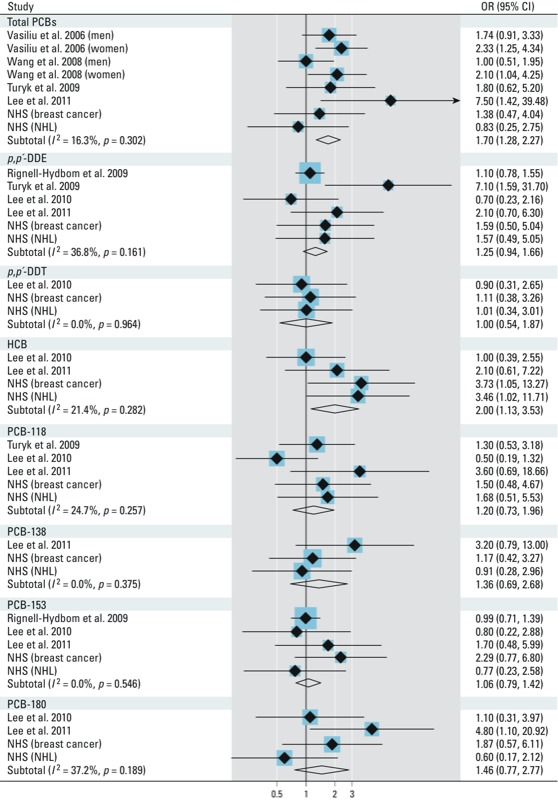
Results: After multivariable adjustment, plasma HCB concentration was positively associated with incident T2D [pooled odds ratio (OR) 3.59 (95% CI: 1.49, 8.64, ptrend = 0.003) comparing extreme tertiles]. Other POPs were not significantly associated with diabetes. After pooling our results with those of six published prospective studies that included 842 diabetes cases in total, we found that HCB and total PCBs both were associated with diabetes: the pooled ORs were 2.00 (95% CI: 1.13, 3.53; I2 = 21.4%, pheterogeneity = 0.28) and 1.70 (95% CI: 1.28, 2.27; I2 = 16.3%, pheterogeneity = 0.30) for HCB and total PCBs, respectively.
Conclusions: These findings support an association between POP exposure and the risk of T2D.
Conflict of interest statement
The authors declare they have no actual or potential competing financial interests.
Figures
References
-
- American Diabetes Association Report of the Expert Committee on the Diagnosis and Classification of Diabetes Mellitus. Diabetes Care. 1997;20(7):1183–1197. - PubMed
-
- Barber JL, Sweetman AJ, van Wijk D, Jones KC. Hexachlorobenzene in the global environment: emissions, levels, distribution, trends and processes. Sci Total Environ. 2005;349(1–3):1–44. - PubMed
Publication types
MeSH terms
Substances
Grants and funding
- R01 DK058845/DK/NIDDK NIH HHS/United States
- R01 CA098122/CA/NCI NIH HHS/United States
- P01 CA087969/CA/NCI NIH HHS/United States
- R00HL098459/HL/NHLBI NIH HHS/United States
- R00 HL098459/HL/NHLBI NIH HHS/United States
- CA49449/CA/NCI NIH HHS/United States
- CA098122/CA/NCI NIH HHS/United States
- DK46200/DK/NIDDK NIH HHS/United States
- CA87969/CA/NCI NIH HHS/United States
- DK58845/DK/NIDDK NIH HHS/United States
- P30 DK046200/DK/NIDDK NIH HHS/United States
- R25 CA098566/CA/NCI NIH HHS/United States
- R01 CA049449/CA/NCI NIH HHS/United States
- ES013692/ES/NIEHS NIH HHS/United States
- T32 ES007155/ES/NIEHS NIH HHS/United States
- R01 ES013692/ES/NIEHS NIH HHS/United States
- U01 CA049449/CA/NCI NIH HHS/United States
LinkOut - more resources
Full Text Sources
Other Literature Sources
Medical
Miscellaneous