


Fine-scale linkage mapping reveals a small set of candidate genes influencing honey bee grooming behavior in response to Varroa mites
- PMID: 23133594
- PMCID: PMC3487723
- DOI: 10.1371/journal.pone.0047269
Fine-scale linkage mapping reveals a small set of candidate genes influencing honey bee grooming behavior in response to Varroa mites
Abstract
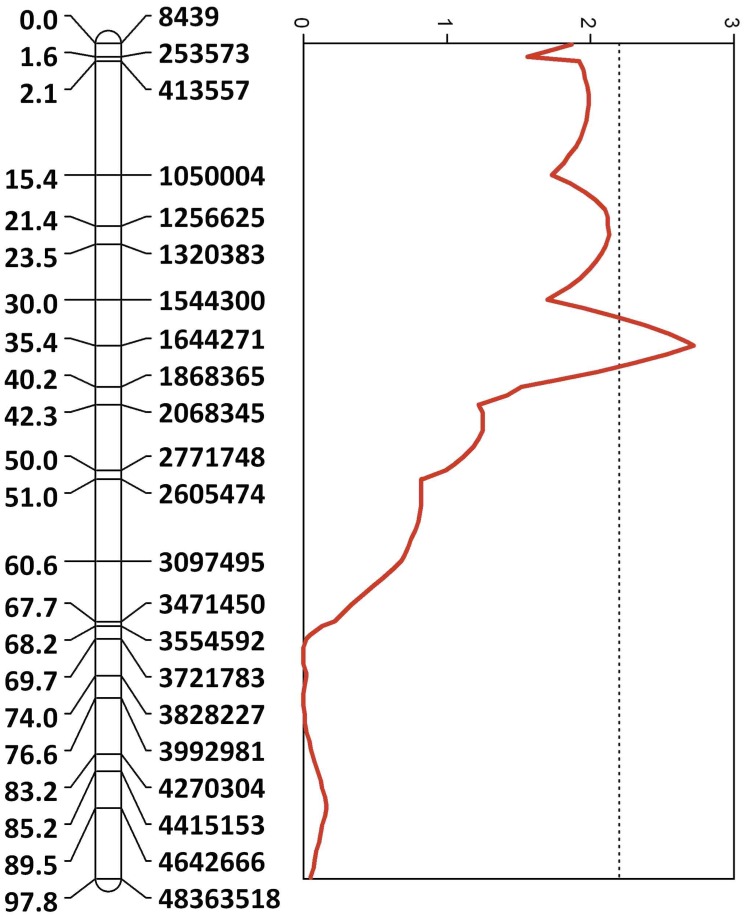
Populations of honey bees in North America have been experiencing high annual colony mortality for 15-20 years. Many apicultural researchers believe that introduced parasites called Varroa mites (V. destructor) are the most important factor in colony deaths. One important resistance mechanism that limits mite population growth in colonies is the ability of some lines of honey bees to groom mites from their bodies. To search for genes influencing this trait, we used an Illumina Bead Station genotyping array to determine the genotypes of several hundred worker bees at over a thousand single-nucleotide polymorphisms in a family that was apparently segregating for alleles influencing this behavior. Linkage analyses provided a genetic map with 1,313 markers anchored to genome sequence. Genotypes were analyzed for association with grooming behavior, measured as the time that individual bees took to initiate grooming after mites were placed on their thoraces. Quantitative-trait-locus interval mapping identified a single chromosomal region that was significant at the chromosome-wide level (p<0.05) on chromosome 5 with a LOD score of 2.72. The 95% confidence interval for quantitative trait locus location contained only 27 genes (honey bee official gene annotation set 2) including Atlastin, Ataxin and Neurexin-1 (AmNrx1), which have potential neurodevelopmental and behavioral effects. Atlastin and Ataxin homologs are associated with neurological diseases in humans. AmNrx1 codes for a presynaptic protein with many alternatively spliced isoforms. Neurexin-1 influences the growth, maintenance and maturation of synapses in the brain, as well as the type of receptors most prominent within synapses. Neurexin-1 has also been associated with autism spectrum disorder and schizophrenia in humans, and self-grooming behavior in mice.
Conflict of interest statement
Figures
References
-
- Sanford MT (2001) Introduction, spread and economic impact of Varroa mites in North America. In: Webster TC, Delaplane KS (Eds.), Mites of the Honey Bee. Dadant & Sons, Mansfield OH, 149–162.
-
- Genersch E (2010) Honey bee pathology: current threats to honey bees and beekeeping. Appl Microbiol Biotechnol 87: 87–97. DOI 10.1007/s00253-010-2573-8. - DOI - PubMed
-
- Danka RG (2001) Resistance of honey bees to tracheal mites. Mites of the Honey Bee (T.C. Webster, K.S. Delaplane, eds) Dadant & Sons, 117–129.
-
- Schäfer MO, Ritter W, Pettis J (2010) Winter losses of honeybee colonies (Hymenoptera: Apidae): The role of infestations with Aethina tumida (Coleoptera: Nitidulidae) and Varroa destructor (Parasitiformes: Varroidae). J Econ Entomol 103 10–16: 2010. - PubMed
-
- Dainat B, Evans JD, Chen YP, Gauthier L, Neumann P (2012) Predictive markers of honey bee colony collapse. PLoS ONE 7: e32151 doi:10.1371/journal.pone.0032151 - DOI - PMC - PubMed
Publication types
MeSH terms
Substances
LinkOut - more resources
Full Text Sources
