


Predicting daily physical activity in patients with chronic obstructive pulmonary disease
- PMID: 23133612
- PMCID: PMC3487905
- DOI: 10.1371/journal.pone.0048081
Predicting daily physical activity in patients with chronic obstructive pulmonary disease
Abstract
Background: Objectively measuring daily physical activity (PA) using an accelerometer is a relatively expensive and time-consuming undertaking. In routine clinical practice it would be useful to estimate PA in patients with chronic obstructive pulmonary disease (COPD) with more simple methods.
Objectives: To evaluate whether PA can be estimated by simple tests commonly used in clinical practice in patients with COPD.
Methods: The average number of steps per day was measured for 7 days with a SenseWear Pro™ accelerometer and used as gold standard for PA. A physical activity level (PAL) of <1.4 was considered very inactive. Univariate and multivariate analyses were used to examine the relationship between the 6-minute walking distance (6MWD), the number of stands in the Sit-to-Stand Test (STST), hand-grip strength and the total energy expenditure as assessed by the Zutphen Physical Activity Questionnaire (TEE(ZPAQ)). ROC curve analysis was used to identify patients with an extremely inactive lifestyle (PAL<1.4).
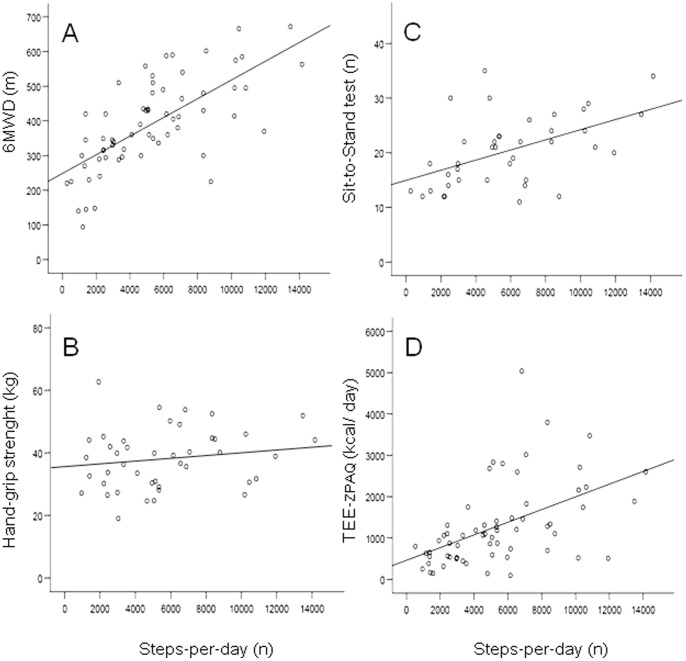
Results: In 70 patients with COPD (21 females) with a mean [SD] FEV(1) of 43.0 [22.0] %predicted, PA was found to be significantly and independently associated with the 6MWD (r = 0.69, 95% CI 0.54 to 0.80, p<0.001), STST (r = 0.51, 95% CI 0.31 to 0.66, p = 0.001) and TEEZPAQ (r = 0.50, 95% CI 0.30 to 0.66, p<0.001) but not with hand-grip strength. However, ROC curve analysis demonstrated that these tests cannot be used to reliably identify patients with an extremely inactive lifestyle.
Conclusions: In patients with COPD simple tests such as the 6-Minute Walk Test, the Sit-to-Stand Test and the Zutphen Physical Activity Questionnaire cannot be used to reliably predict physical inactivity.
Conflict of interest statement
Figures

References
-
- Kapella MC, Larson JL, PatelMK CoveyMK, Berry JK (2006) Subjective fatigue, influencing variables, and consequences in chronic obstructive pulmonary disease. Nurs Res 55(1): 10–17. - PubMed
-
- Donaldson GC, Wilkinson TMA, Hurst JR, Perera WR, Wedzicha JA (2005) Exacerbations and time spent outdoors in chronic obstructive pulmonary disease. Am J Respir Crit Care Med 171: 446–452. - PubMed
-
- Decramer M, Gosselink R, Troosters T (1997) Muscle weakness is related to utilization of health care resources in COPD patients. Eur Respir J 10: 417–423. - PubMed
-
- Bourbeau J (2009) Activities of life: the COPD patient. COPD 6(3): 192–200. - PubMed
MeSH terms
LinkOut - more resources
Full Text Sources
Other Literature Sources
Medical
