Integrated community case management of fever in children under five using rapid diagnostic tests and respiratory rate counting: a multi-country cluster randomized trial
- PMID: 23136274
- PMCID: PMC3748518
- DOI: 10.4269/ajtmh.2012.11-0816
Integrated community case management of fever in children under five using rapid diagnostic tests and respiratory rate counting: a multi-country cluster randomized trial
Abstract
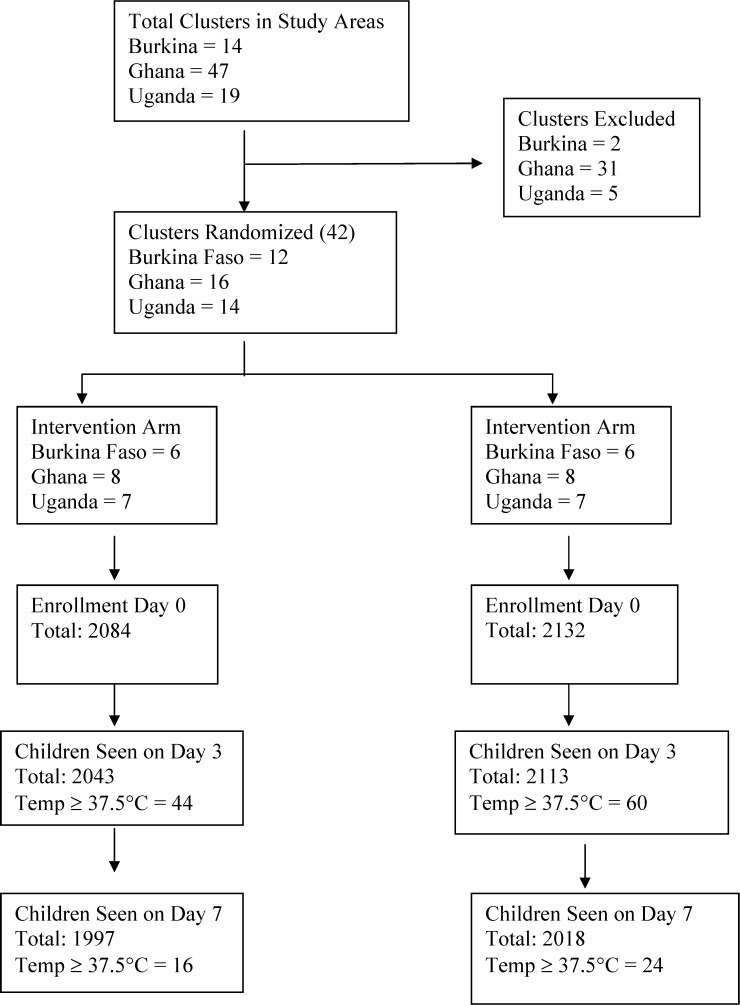
Evidence on the impact of using diagnostic tests in community case management of febrile children is limited. This effectiveness trial conducted in Burkina Faso, Ghana, and Uganda, compared a diagnostic and treatment package for malaria and pneumonia with presumptive treatment with anti-malarial drugs; artemisinin combination therapy (ACT). We enrolled 4,216 febrile children between 4 and 59 months of age in 2009-2010. Compliance with the malaria rapid diagnostic test (RDT) results was high in the intervention arm across the three countries, with only 4.9% (17 of 344) of RDT-negative children prescribed an ACT. Antibiotic overuse was more common: 0.9% (4 of 446) in Uganda, 38.5% (114 of 296) in Burkina Faso, and 44.6% (197 of 442) in Ghana. Fever clearance was high in both intervention and control arms at both Day 3 (97.8% versus 96.9%, P = 0.17) and Day 7 (99.2% versus 98.8%, P = 0.17). The use of diagnostic tests limits overuse of ACTs. Its impact on antibiotic overuse and on fever clearance is uncertain.
References
-
- Black RE, Morris SS, Bryce J. Where and why are 10 million children dying every year? Lancet. 2003;361:2226–2234. - PubMed
-
- Black RE, Cousens S, Johnson HL, Lawn JE, Rudan I, Bassani DG, Jha P, Campbell H, Walker CF, Cibulskis R, Eisele T, Liu L, Mathers C. Global, regional, and national causes of child mortality in 2008: a systematic analysis. Lancet. 2010;375:1969–1987. - PubMed
-
- Kidane G, Morrow RH. Teaching mothers to provide home treatment of malaria in Tigray, Ethiopia: a randomized trial. Lancet. 2000;356:550–555. - PubMed
-
- Sazawal S, Black RE. Effect of pneumonia case management on mortality in neonates, infants, and preschool children: a meta-analysis of community-based trials. Lancet Infect Dis. 2003;3:547–556. - PubMed
Publication types
MeSH terms
Substances
LinkOut - more resources
Full Text Sources
Other Literature Sources
Medical