


Effective treatment of perinatal depression for women in debt and lacking financial empowerment in a low-income country
- PMID: 23137731
- PMCID: PMC3964866
- DOI: 10.1192/bjp.bp.112.109207
Effective treatment of perinatal depression for women in debt and lacking financial empowerment in a low-income country
Abstract
Background: Poverty may moderate the effect of treatment of depression in low-income countries.
Aims: To assess poverty and lack of empowerment as moderators of a cognitive-behavioural therapy (CBT)-based intervention for perinatal depression in rural Pakistan.
Method: Using secondary analysis of data from a randomised controlled trial (trial registration: ISRCTN65316374) we identified predictors of depression at 1-year follow-up and moderators of the intervention (n = 791).
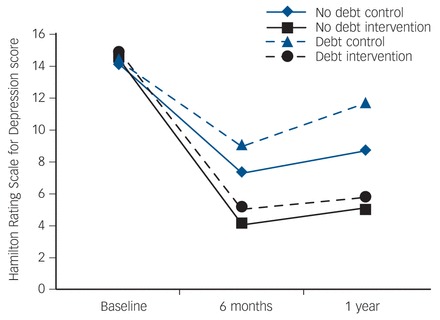
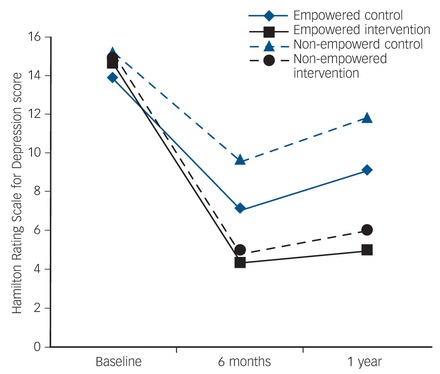
Results: Predictors of follow-up depression included household debt, the participant not being empowered to manage household finance and the interaction terms for these variables with the trial arm. Effect sizes for women with and without household debt were 0.80 and 0.55 respectively. The effect size for women in debt and not empowered financially was 0.94 compared with 0.50 for women with neither of these factors.
Conclusions: Our findings demonstrate the importance of household debt and lack of financial empowerment of women as important maintaining factors of depression in low-income countries and our locally developed intervention tackled these problems successfully.
Conflict of interest statement
None.
Figures

References
-
- Patel V, Rodrigues M, DeSouza N. Gender, poverty, and postnatal depression: a study of mothers in Goa, India. Am J Psychiatry 2002; 159: 43–7 - PubMed
-
- Rahman A, Iqbal Z, Harrington R. Life events, social support and depression in childbirth: perspectives from a rural community in the developing world. Psychol Med 2003; 33: 1161–7 - PubMed
