


Chemopreventive and anti-angiogenic effects of dietary phenethyl isothiocyanate in an N-methyl nitrosourea-induced breast cancer animal model
- PMID: 23138465
- PMCID: PMC3705647
- DOI: 10.1002/bdd.1826
Chemopreventive and anti-angiogenic effects of dietary phenethyl isothiocyanate in an N-methyl nitrosourea-induced breast cancer animal model
Abstract
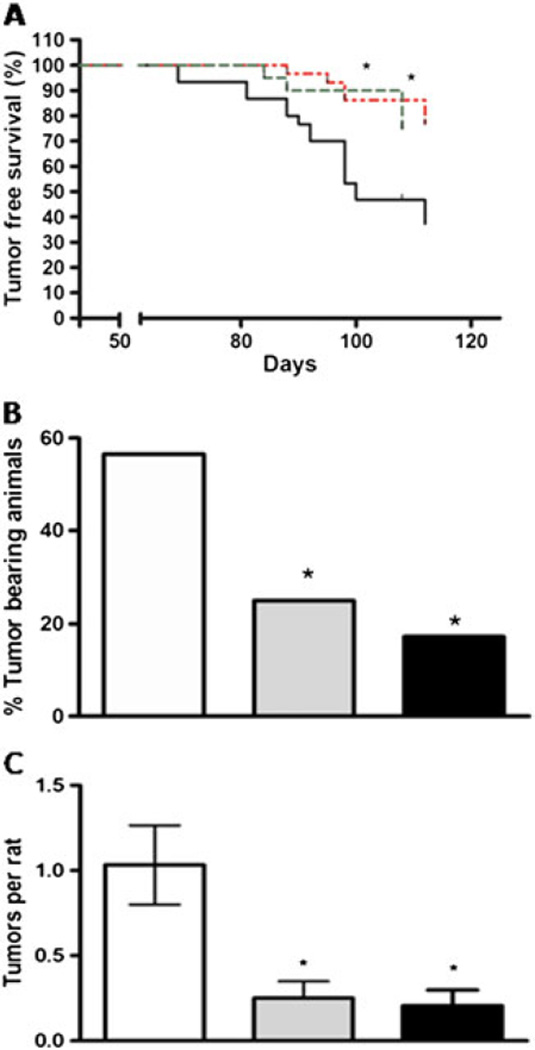
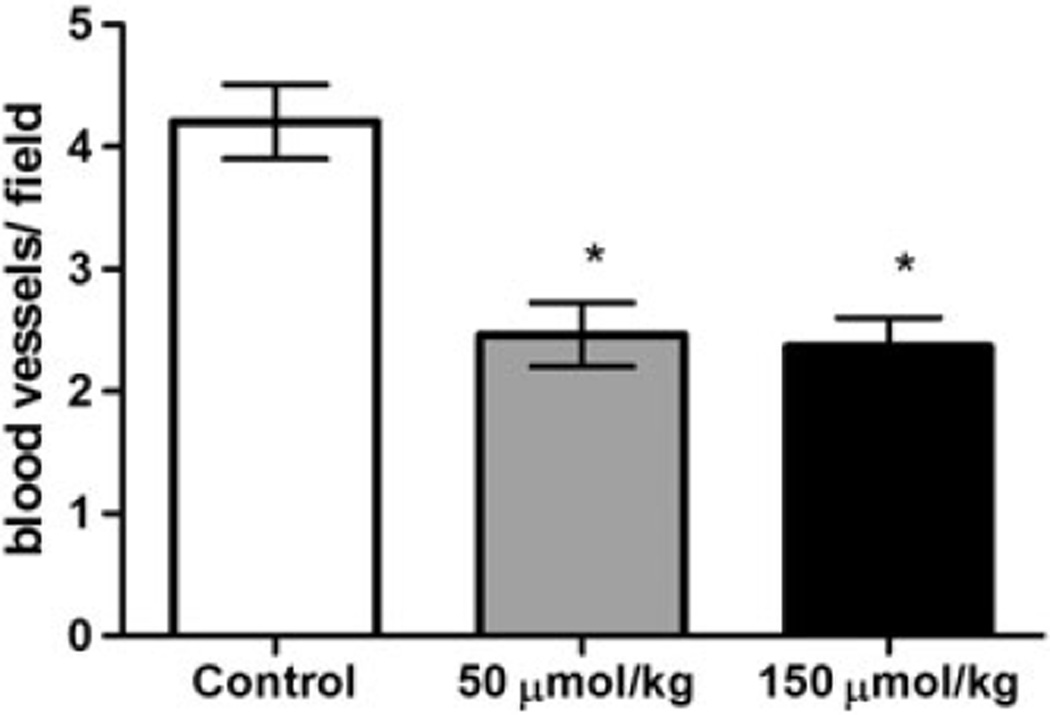
The effect of phenethyl isothiocyanate (PEITC), a component of cruciferous vegetables, on the initiation and progression of cancer was investigated in a chemically induced estrogen-dependent breast cancer model. Breast cancer was induced in female Sprague Dawley rats (8 weeks old) by the administration of N-methyl nitrosourea (NMU). Animals were administered 50 or 150 µmol/kg oral PEITC and monitored for tumor appearance for 18 weeks. The PEITC treatment prolonged the tumor-free survival time and decreased the tumor incidence and multiplicity. The time to the first palpable tumor was prolonged from 69 days in the control, to 84 and 88 days in the 50 and 150 µmol/kg PEITC-treated groups. The tumor incidence in the control, 50 µmol/kg, and 150 µmol/kg PEITC-treated groups was 56.6%, 25.0% and 17.2%, while the tumor multiplicity was 1.03, 0.25 and 0.21, respectively. Differences were statistically significant (p < 0.05) from the control, but there were no significant differences between the two dose levels. The intratumoral capillary density decreased from 4.21 ± 0.30 vessels per field in the controls to 2.46 ± 0.25 in the 50 µmol/kg and 2.36 ± 0.23 in the 150 µmol/kg PEITC-treated animals. These studies indicate that supplementation with PEITC prolongs the tumor-free survival, reduces tumor incidence and burden, and is chemoprotective in NMU-induced estrogen-dependent breast cancer in rats. For the first time, it is reported that PEITC has anti-angiogenic effects in a chemically induced breast cancer animal model, representing a potentially significant mechanism contributing to its chemopreventive activity.
Copyright © 2012 John Wiley & Sons, Ltd.
Conflict of interest statement
The authors declare no conflicts of interest.
Figures
References
-
- Zhao BSA, Lee EJ, Poh WT, et al. Dietary isothiocyanates, glutathione S-transferase -M1, -T1 polymorphisms and lung cancer risk among Chinese women in Singapore. Cancer Epidemiol Biomarkers Prevention. 2001;10:1063–1067. - PubMed
-
- Ji Y, Morris ME. Determination of phenethyl isothiocyanate in human plasma and urine by ammonia derivatization and liquid chromatography-tandem mass spectrometry. Anal Biochem. 2003;323:39–47. - PubMed
-
- Rouzaud G, Young SA, Duncan AJ. Hydrolysis of glucosinolates to isothiocyanates after ingestion of raw or microwaved cabbage by human volunteers. Cancer Epidemiol Biomarkers Prev. 2004;13:125–131. - PubMed
-
- Huang C, Ma WY, Li J, Hecht SS, Dong Z. Essential role of p53 in phenethyl isothiocyanate-induced apoptosis. Cancer Res. 1998;58:4102–4106. - PubMed
Publication types
MeSH terms
Substances
Grants and funding
LinkOut - more resources
Full Text Sources
Medical
Molecular Biology Databases
