Multicenter Study
. 2012 Dec;23(12):2051-9.
doi: 10.1681/ASN.2012030302. Epub 2012 Nov 8.

Circulating suPAR in two cohorts of primary FSGS

Affiliations
Multicenter Study

Circulating suPAR in two cohorts of primary FSGS

Changli Wei et al. J Am Soc Nephrol. 2012 Dec.

Abstract

Overexpression of soluble urokinase receptor (suPAR) causes pathology in animal models similar to primary FSGS, and one recent study demonstrated elevated levels of serum suPAR in patients with the disease. Here, we analyzed circulating suPAR levels in two cohorts of children and adults with biopsy-proven primary FSGS: 70 patients from the North America-based FSGS clinical trial (CT) and 94 patients from PodoNet, the Europe-based consortium studying steroid-resistant nephrotic syndrome. Circulating suPAR levels were elevated in 84.3% and 55.3% of patients with FSGS patients in the CT and PodoNet cohorts, respectively, compared with 6% of controls (P<0.0001); inflammation did not account for this difference. Multiple regression analysis suggested that lower suPAR levels associated with higher estimated GFR, male sex, and treatment with mycophenolate mofetil. In the CT cohort, there was a positive association between the relative reduction of suPAR after 26 weeks of treatment and reduction of proteinuria, with higher odds for complete remission (P=0.04). In the PodoNet cohort, patients with an NPHS2 mutation had higher suPAR levels than those without a mutation. In conclusion, suPAR levels are elevated in geographically and ethnically diverse patients with FSGS and do not reflect a nonspecific proinflammatory milieu. The associations between a change in circulating suPAR with different therapeutic regimens and with remission support the role of suPAR in the pathogenesis of FSGS.


Figures
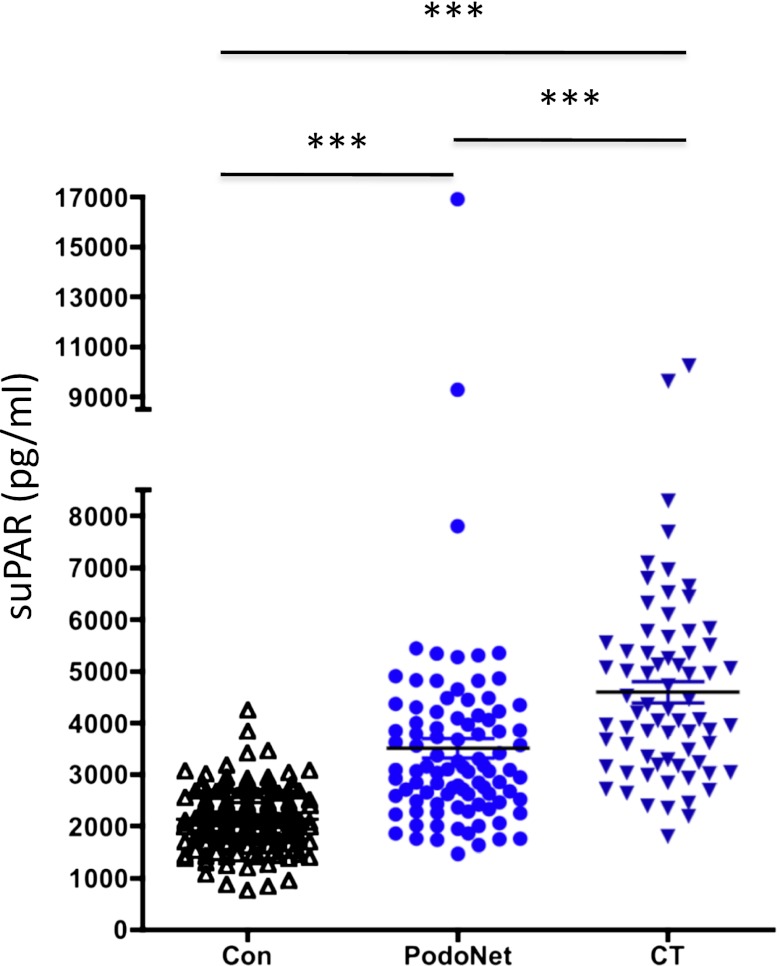
Figure 1.
Figure 1.
Serum suPAR levels in distinct primary FSGS cohorts and control participants. ***P<0.001 for CT FSGS cohort versus control, PodoNet FSGS cohort versus control, and CT versus PodoNet. Con, control.
Figure 2.
Figure 2.
Serum CRP and its respective suPAR in FSGS patients and controls. (A) Serum CRP levels in FSGS patients. Control and FSGS patients from CT and PodoNet were determined for serum CRP concentration. Mean CRP was at low risk for inflammation and there was no difference between FSGS patients and controls. (B) Serum CRP did not correlate to its respective serum suPAR level in controls. (C) Serum CRP did not correlate to its respective suPAR in FSGS patients. (D) Patients with mild infection had high serum CRP level but presented with low suPAR concentration (n=11). Con, control.
Figure 3.
Figure 3.
Characteristics of serum suPAR in the CT FSGS cohort. (A) Circulating suPAR levels at baseline and 26 weeks after treatment (**P<0.01). (B) Therapy-associated changes of suPAR levels (*P<0.05). (C) suPAR levels in patients who achieved complete remission at 26 weeks, and stabilized for at least 6 months (n=5). (D) suPAR levels in patients who achieved complete remission at 26 weeks, but proteinuria came back at 52 weeks (n=4). (E) suPAR responders were associated with a substantial decrease in Up/c. Responders were FSGS patients with high suPAR at baseline, but dropped to <3000 pg/ml after 26-week therapy, whereas nonresponders were patients whose suPAR levels remained high (P<0.05 for responders versus nonresponders).
Figure 4.
Figure 4.
Characteristics of serum suPAR in PodoNet FSGS cohort. (A) Female FSGS patients had higher levels of suPAR compared with male FSGS patients. (B) Familial FSGS patients and/or FSGS patients who had NHPS2 mutation were associated with higher suPAR levels as indicated by univariate analysis. (C) MMF treatment was associated with lower suPAR levels. (D) Patients received MMF plus prednisone possessed lower suPAR levels compared with those received calcineurin inhibitor and prednisone (*P<0.05). NM, therapy other than MMF; MP, MMF plus prednisone; CP, calcineurin inhibitor plus prednisone.

Comment in

References

    1. Benchimol C: Focal segmental glomerulosclerosis: Pathogenesis and treatment. Curr Opin Pediatr 15: 171–180, 2003 - PubMed
    1. Korbet SM: Treatment of primary focal segmental glomerulosclerosis. Kidney Int 62: 2301–2310, 2002 - PubMed
    1. Boyer O, Moulder JK, Somers MJ: Focal and segmental glomerulosclerosis in children: A longitudinal assessment. Pediatr Nephrol 22: 1159–1166, 2007 - PubMed
    1. Barisoni L, Schnaper HW, Kopp JB: Advances in the biology and genetics of the podocytopathies: Implications for diagnosis and therapy. Arch Pathol Lab Med 133: 201–216, 2009 - PMC - PubMed
    1. Santín S, Bullich G, Tazón-Vega B, García-Maset R, Giménez I, Silva I, Ruíz P, Ballarín J, Torra R, Ars E: Clinical utility of genetic testing in children and adults with steroid-resistant nephrotic syndrome. Clin J Am Soc Nephrol 6: 1139–1148, 2011 - PMC - PubMed

Publication types

Substances