. 2012;7(11):e48599.
doi: 10.1371/journal.pone.0048599. Epub 2012 Nov 6.

Impact of Xpert MTB/RIF testing on tuberculosis management and outcomes in hospitalized patients in Uganda

Affiliations

Impact of Xpert MTB/RIF testing on tuberculosis management and outcomes in hospitalized patients in Uganda

Christina Yoon et al. PLoS One. 2012.

Abstract

Rationale: The clinical impact of Xpert MTB/RIF for tuberculosis (TB) diagnosis in high HIV-prevalence settings is unknown.

Objective: To determine the diagnostic accuracy and impact of Xpert MTB/RIF among high-risk TB suspects.

Methods: WE PROSPECTIVELY ENROLLED CONSECUTIVE, HOSPITALIZED, UGANDAN TB SUSPECTS IN TWO PHASES: baseline phase in which Xpert MTB/RIF results were not reported to clinicians and an implementation phase in which results were reported. We determined the diagnostic accuracy of Xpert MTB/RIF in reference to culture (solid and liquid) and compared patient outcomes by study phase.

Results: 477 patients were included (baseline phase 287, implementation phase 190). Xpert MTB/RIF had high sensitivity (187/237, 79%, 95% CI: 73-84%) and specificity (190/199, 96%, 95% CI: 92-98%) for culture-positive TB overall, but sensitivity was lower (34/81, 42%, 95% CI: 31-54%) among smear-negative TB cases. Xpert MTB/RIF reduced median days-to-TB detection for all TB cases (1 [IQR 0-26] vs. 0 [IQR 0-1], p<0.001), and for smear-negative TB (35 [IQR 22-55] vs. 22 [IQR 0-33], p=0.001). However, median days-to-TB treatment was similar for all TB cases (1 [IQR 0-5] vs. 0 [IQR 0-2], p=0.06) and for smear-negative TB (7 [IQR 3-53] vs. 6 [IQR 1-61], p=0.78). Two-month mortality was also similar between study phases among 252 TB cases (17% vs. 14%, difference +3%, 95% CI: -21% to +27%, p=0.80), and among 87 smear-negative TB cases (28% vs. 22%, difference +6%, 95% CI: -34 to +46%, p=0.77).

Conclusions: Xpert MTB/RIF facilitated more accurate and earlier TB diagnosis, leading to a higher proportion of TB suspects with a confirmed TB diagnosis prior to hospital discharge in a high HIV/low MDR TB prevalence setting. However, our study did not detect a decrease in two-month mortality following implementation of Xpert MTB/RIF possibly because of insufficient powering, differences in empiric TB treatment rates, and disease severity between study phases.


Conflict of interest statement

Competing Interests: The authors have read the journal’s policy and have the following conflicts: 1) AC is an Academic Editor of PLOS ONE. 2) HA, PN and CG work for the Foundation for Innovative New Diagnostics (FIND), a nonprofit organization whose mission is to drive the development and early implementation of diagnostic tests that have a high impact on patient care in low and middle-resource settings. FIND partnered with Cepheid in the development and initial evaluation of the Xpert MTB/RIF assay. This does not alter the authors’ adherence to all the PLOS ONE policies on sharing data and materials.

Figures

Figure 1
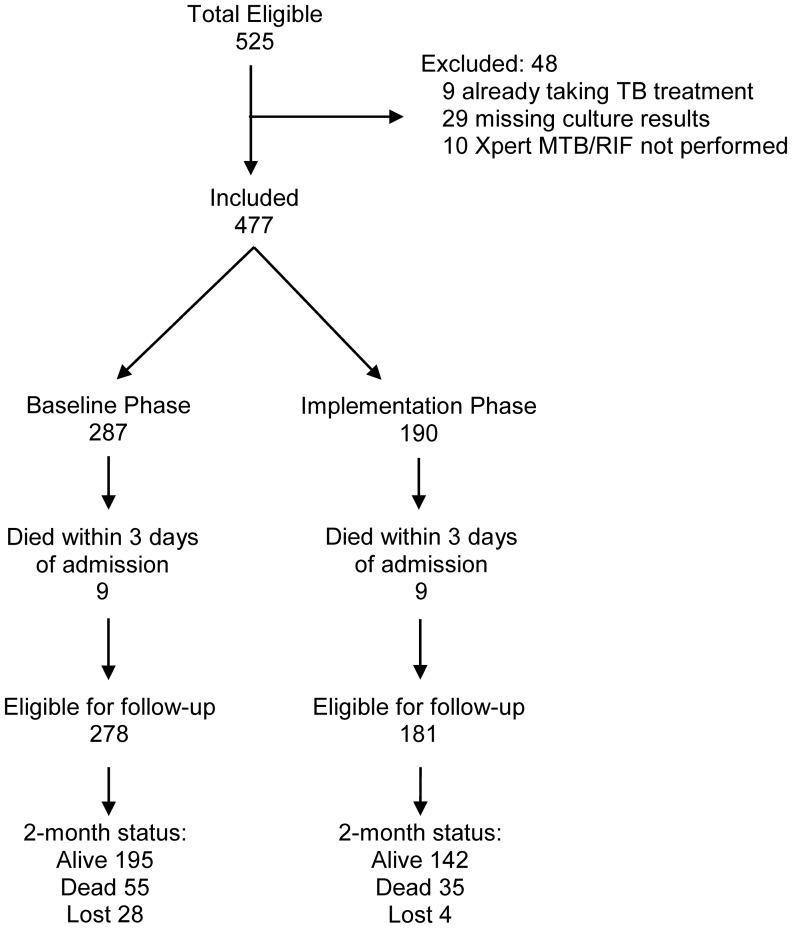
Figure 1. Study enrollment.
Of 525 eligible patients, 477 (91%) were included in the study. 287 patients were enrolled during the initial baseline phase (Xpert MTB/RIF results not provided to clinicians during this validation phase) and 190 were enrolled during the implementation phase (Xpert MTB/RIF results provided to clinicians and used for patient management). Eighteen patients (nine in the baseline phase and nine in the implementation phase) died within three days of admission and were not included in survival analysis.
Figure 2
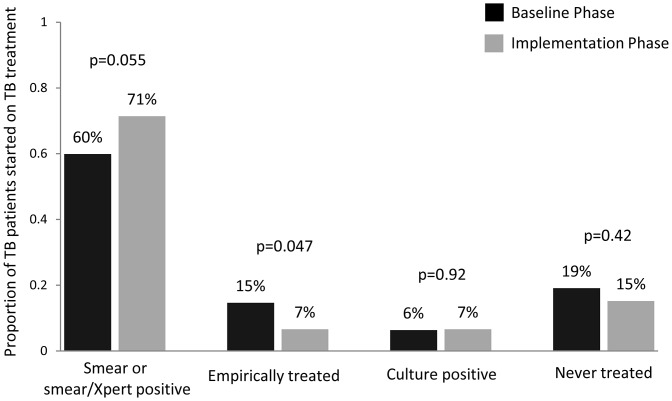
Figure 2. Proportion of TB patients initiated on anti-TB therapy based on test, by study phase.
The bars show the proportion of culture-positive TB patients in the baseline vs. the implementation phase started on anti-TB therapy based on rapid test results (i.e., smear in baseline phase and smear/Xpert in implementation phase; 60% vs. 71%, p = 0.055), empirically prior to hospital discharge (15% vs. 7%, p = 0.047), or based on culture results (6% vs. 7%, p = 0.92). The proportion of patients with culture-confirmed TB who were never treated during this study period was similar (19% vs. 15%, p = 0.42).
Figure 3
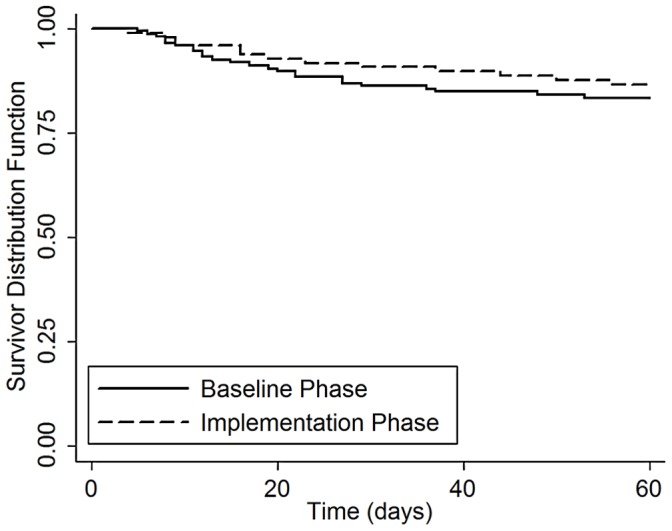
Figure 3. Survival of TB patients with all losses to follow-up censored: Baseline vs. Implementation phase.
Kaplan-Meier survival curves are shown for TB patients enrolled during the baseline and implementation phases. There was no difference in two-month mortality by study phase for the 252 patients with culture-positive TB (17% vs. 14%, difference +3%, 95% CI: −21% to +27%, p = 0.80).
Figure 4
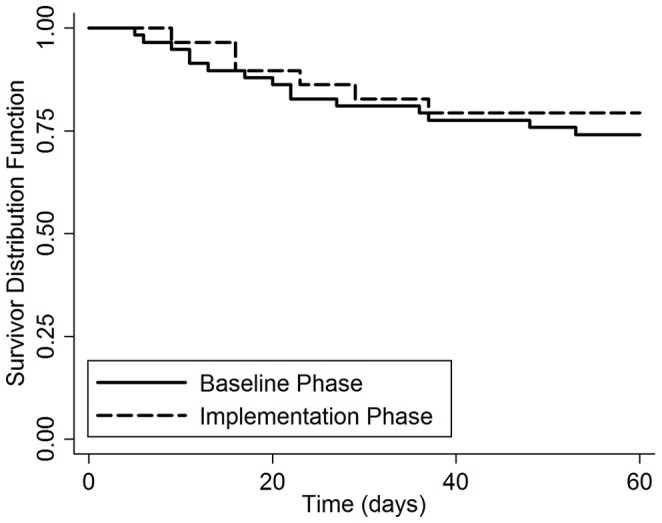
Figure 4. Survival of smear-negative TB patients with all losses to follow-up censored: Baseline vs. Implementation phase.
Kaplan-Meier survival curves are shown for smear-negative TB patients enrolled during the baseline and implementation phases. There was no difference in two-month mortality by study phase for the 87 patients with smear-negative, culture-positive TB (28% vs. 22%, difference +6%, 95% CI: −34 to +46%, p = 0.77).

References

    1. Sreeramareddy CT, Panduru KV, Menten J, Van den Ende J (2009) Time delays in diagnosis of pulmonary tuberculosis: a systematic review of literature. BMC Infect Dis 9: 91. - PMC - PubMed
    1. Storla DG, Yimer S, Bjune GA (2008) A systematic review of delay in the diagnosis and treatment of tuberculosis. BMC Public Health 8: 15. - PMC - PubMed
    1. Millen SJ, Uys PW, Hargrove J, van Helden PD, Williams BG (2008) The effect of diagnostic delays on the drop-out rate and the total delay to diagnosis of tuberculosis. PLoS One 3: e1933. - PMC - PubMed
    1. Golub JE, Bur S, Cronin WA, Gange S, Baruch N, et al. (2006) Delayed tuberculosis diagnosis and tuberculosis transmission. Int J Tuberc Lung Dis 10: 24–30. - PubMed
    1. Greenaway C, Menzies D, Fanning A, Grewal R, Yuan L, et al. (2002) Delay in diagnosis among hospitalized patients with active tuberculosis–predictors and outcomes. Am J Respir Crit Care Med 165: 927–933. - PubMed

Publication types

Substances