Comparative Study
. 2012 Nov 12:9:265.
doi: 10.1186/1743-422X-9-265.

Evaluation of nanoparticle tracking analysis for total virus particle determination

Affiliations
Comparative Study

Evaluation of nanoparticle tracking analysis for total virus particle determination

Petra Kramberger et al. Virol J. .

Abstract

The NanoSight LM10 with Nanoparticle tracking analysis (NTA) software was evaluated for the quantification of latex particles, adenovirus 5, and influenza virus. The inter-day variability was determined by measuring the same sample over several consecutive days and the method's accuracy was demonstrated by using known concentrations of the subject particles. NTA analysis was also used to quantify chromatographic fractions of adenovirus and influenza virus after purification on a CIM monolithic column. NTA results were compared and evaluated against hemagglutination (HA) and end point dilution assay, determining total and infection virus particle number, respectively. The results demonstrated that nanoparticle tracking analysis is a method for fast estimation of virus concentration in different samples. In addition, it can provide a better insight into the sample status, regarding the level of virus aggregation.


Figures
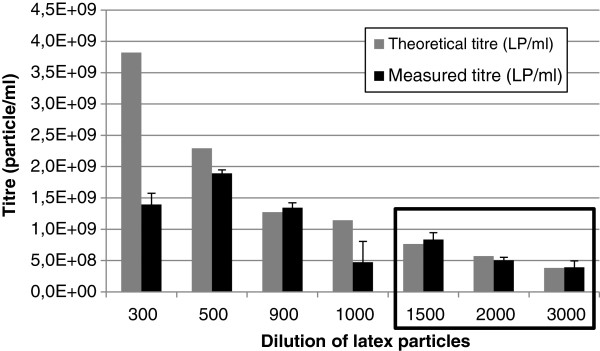
Figure 1
Figure 1
Latex particle analysis: linearity of dilution. Grey columns represent the theoretical titre of latex particles, while the black columns represent the measured titre. Only the last three dilutions measured fulfilled both criteria (average particle number in the range between 20 and 60 and the TF/MF factor between 0.8 and 1.2) and were used to calculate the original concentration of latex particles.
Figure 2
Figure 2
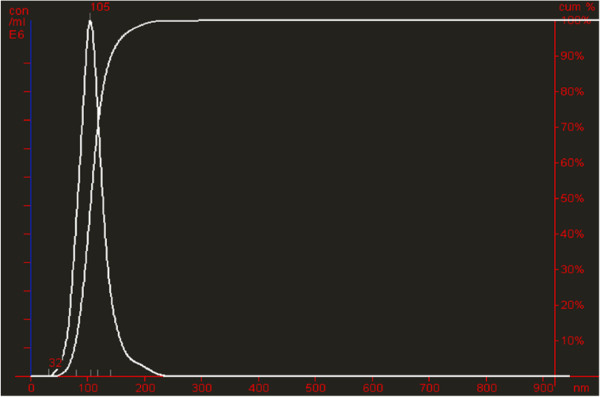
Particle size distribution of latex spiking solution. Particle size distribution of ten-fold (1:9, v/v) diluted original latex solution (spiking solution) added to DPBS (measured latex spiking solution).
Figure 3
Figure 3
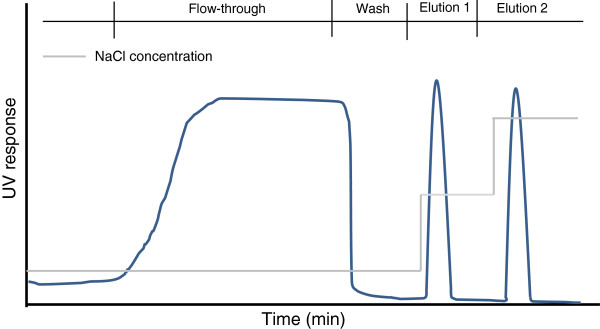
Shematical chromatograph of virus purification. Flow-through fraction (non- bound compounds), wash (weakly bound compounds washed from the column), elution 1 (the main virus fraction), elution 2 (elution of strongly bound impurities-usually host cell DNA). Selective elution in this case is achieved by increasing salt concentration (indicated with the grey line).
Figure 4
Figure 4
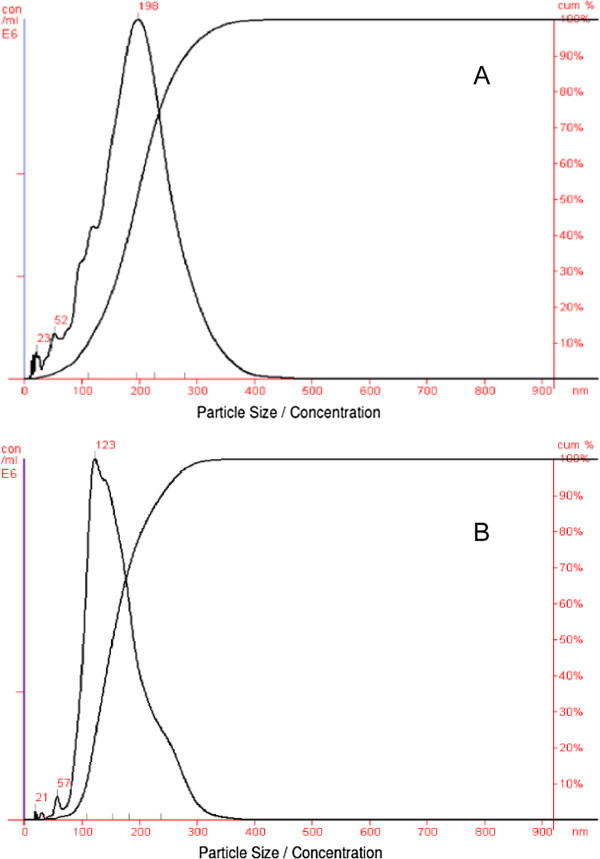
Particle size distribution of influenza virus. Particle size distribution of influenza virus before (A) and after (B) purification on CIM SO3 monolithic column; both samples diluted 1:20 (v/v) with DPBS.

References

    1. Kistner O, Howard MK, Spruth M, Wodal W, Brühl P, Gerencer M, Crowe BA, Savidis-Dacho H, Livey I, Reiter M, Mayerhofer I, Tauer C, Grillberger L, Mundt W, Falkner FG, Barrett PN. Cell culture (Vero) derived whole virus (H5N1) vaccine based on wild-type virus strain induces cross-protective immune responses. Vaccine. 2007;25(32):6028–6036. doi: 10.1016/j.vaccine.2007.05.013. - DOI - PMC - PubMed
    1. Fiers W, Filette MD, Bakkouri KE, Schepens B, Roose K, Schotsaert M, Birkett A, Saelens X. M2e-based universal influenza A vaccine. Vaccine. 2009;27(45):6280–6283. doi: 10.1016/j.vaccine.2009.07.007. - DOI - PubMed
    1. Ru AL, Jacob D, Transfiguracion J, Ansorgea S, Henry O, Kamena AA. Scalable production of influenza virus in HEK-293 cells for efficient vaccine manufacturing. Vaccine. 2010;28:3661–3671. doi: 10.1016/j.vaccine.2010.03.029. - DOI - PubMed
    1. Roitsch C, Achstetter T, Benchaibi M, Bonfils E, Cauet G, Gloeckler R, L’hôte H, Keppi E, Nguyen M, Spehner D, Dorsselaer AV, Malarme D. Characterization and quality control of recombinant adenovirus vectors for gene therapy. J Chromatogr B. 2001;752(2):263–280. doi: 10.1016/S0378-4347(00)00557-0. - DOI - PubMed
    1. Maeda M, Namikawa K, Kobayashi I, Ohba N, Takahara Y, Kadono T, Anaka A, Kiyama H. Targeted gene therapy toward astrocytoma using a Cre/loxP-based adenovirus system. Brain Res. 2006;1081(1):34–43. doi: 10.1016/j.brainres.2006.01.105. - DOI - PubMed

MeSH terms

LinkOut - more resources