


Prevalence, incidence, and classification of chronic fatigue syndrome in Olmsted County, Minnesota, as estimated using the Rochester Epidemiology Project
- PMID: 23140977
- PMCID: PMC3518652
- DOI: 10.1016/j.mayocp.2012.08.015
Prevalence, incidence, and classification of chronic fatigue syndrome in Olmsted County, Minnesota, as estimated using the Rochester Epidemiology Project
Abstract
Objective: To estimate the prevalence and incidence of chronic fatigue syndrome in Olmsted County, Minnesota, using the 1994 case definition and describe exclusionary and comorbid conditions observed in patients who presented for evaluation of long-standing fatigue.
Patients and methods: We conducted a retrospective medical record review of potential cases of chronic fatigue syndrome identified from January 1, 1998, through December 31, 2002, using the Rochester Epidemiology Project, a population-based database. Patients were classified as having chronic fatigue syndrome if the medical record review documented fatigue of 6 months' duration, at least 4 of 8 chronic fatigue syndrome-defining symptoms, and symptoms that interfered with daily work or activities. Patients not meeting all of the criteria were classified as having insufficient/idiopathic fatigue.
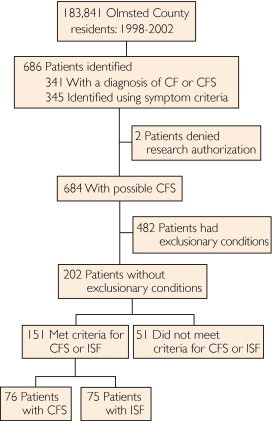
Results: We identified 686 potential patients with chronic fatigue, 2 of whom declined consent for medical record review. Of the remaining 684 patients, 151 (22%) met criteria for chronic fatigue syndrome or insufficient/idiopathic fatigue. The overall prevalence and incidence of chronic fatigue syndrome and insufficient/idiopathic fatigue were 71.34 per 100,000 persons and 13.16 per 100,000 person-years vs 73.70 per 100,000 persons and 13.58 per 100,000 person-years, respectively. The potential cases included 482 patients (70%) who had an exclusionary condition, and almost half the patients who met either criterion had at least one nonexclusionary comorbid condition.
Conclusion: The incidence and prevalence of chronic fatigue syndrome and insufficient/idiopathic fatigue are relatively low in Olmsted County. Careful clinical evaluation to identify whether fatigue could be attributed to exclusionary or comorbid conditions rather than chronic fatigue syndrome itself will ensure appropriate assessment for patients without chronic fatigue syndrome.
Copyright © 2012 Mayo Foundation for Medical Education and Research. Published by Elsevier Inc. All rights reserved.
Figures
References
-
- Fukuda K., Straus S.E., Hickie I., Sharpe M.C., Dobbins J.G., Komaroff A., International Chronic Fatigue Syndrome Study Group The chronic fatigue syndrome: a comprehensive approach to its definition and study. Ann Intern Med. 1994;121(12):953–959. - PubMed
-
- Taylor R.R., Jason L.A., Curie C.J. Prognosis of chronic fatigue in a community-based sample. Psychosom Med. 2002;64(2):319–327. - PubMed
-
- Solomon L., Reeves W.C. Factors influencing the diagnosis of chronic fatigue syndrome. Arch Intern Med. 2004;164(20):2241–2245. - PubMed
Publication types
MeSH terms
Grants and funding
LinkOut - more resources
Full Text Sources
Medical
Miscellaneous
