


On the role of length of stay in healthcare-associated bloodstream infection
- PMID: 23143358
- PMCID: PMC3510977
- DOI: 10.1086/668422
On the role of length of stay in healthcare-associated bloodstream infection
Abstract
Design: We conducted a retrospective cohort study to examine the role played by length of hospital stay in the risk of healthcare-associated bloodstream infection (BSI), independent of demographic and clinical risk factors for BSI.
Patients: We employed data from 113,893 admissions from inpatients discharged between 2006 and 2008.
Setting: Large tertiary healthcare center in New York City.
Methods: We estimated the crude and adjusted hazard of BSI by conducting logistic regression using a person-day data structure. The covariates included in the fully adjusted model included age, sex, Charlson score of comorbidity, renal failure, and malignancy as static variables and central venous catheterization, mechanical ventilation, and intensive care unit stay as time-varying variables.
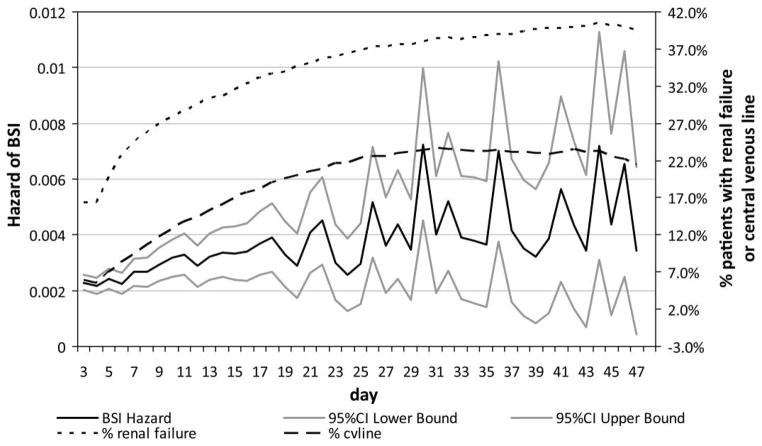
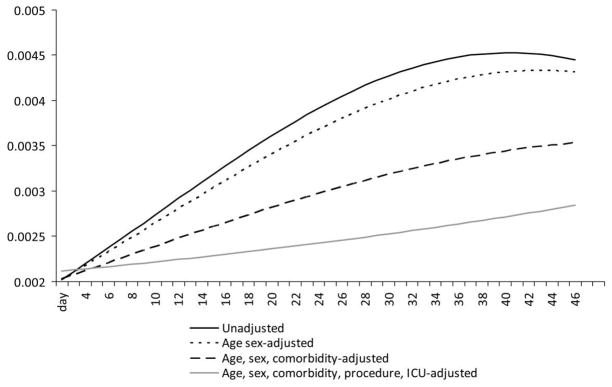
Results: In the crude model, we observed a nonlinear increasing hazard of BSI with increasing hospital stay. This trend was reduced to a constant hazard when fully adjusted for demographic and clinical risk factors for BSI.
Conclusion: The association between longer length of hospital stay and increased risk of infection can largely be explained by the increased duration of stay among those who have underlying morbidity and require invasive procedures. We should take caution in attributing the association between length of stay and BSI to a direct negative impact of the healthcare environment.
Conflict of interest statement
Figures
References
-
- Freeman J, McGowan JE., Jr Methodologic issues in hospital epidemiology. III. Investigating the modifying effects of time and severity of underlying illness on estimates of cost of nosocomial infection. Rev Infect Dis. 1984;6(3):285–300. - PubMed
-
- Nguyen-Van-Tam SE, Nguyen-Van-Tam JS, Myint S, Pearson JC. Risk factors for hospital-acquired urinary tract infection in a large English teaching hospital: a case-control study. Infection. 1999;27(3):192–197. - PubMed
-
- Carr BG, Kaye AJ, Wiebe DJ, Gracias VH, Schwab CW, Reilly PM. Emergency department length of stay: a major risk factor for pneumonia in intubated blunt trauma patients. J Trauma. 2007;63(1):9–12. - PubMed
-
- Weber DJ, Rutala WA, Miller MB, Huslage K, Sickbert-Bennett E. Role of hospital surfaces in the transmission of emerging health care–associated pathogens: norovirus, Clostridium difficile, and Acinetobacter species. Am J Infect Control. 2010;38(5 suppl 1):S25–S33. - PubMed
Publication types
MeSH terms
Grants and funding
LinkOut - more resources
Full Text Sources
Medical
