. 2012 Dec;44(12):1330-5.
doi: 10.1038/ng.2456. Epub 2012 Nov 11.

Genome-wide association analysis identifies new lung cancer susceptibility loci in never-smoking women in Asia

Qing Lan  1 Chao A HsiungKeitaro MatsuoYun-Chul HongAdeline SeowZhaoming WangH Dean Hosgood 3rdKexin ChenJiu-Cun WangNilanjan ChatterjeeWei HuMaria Pik WongWei ZhengNeil CaporasoJae Yong ParkChien-Jen ChenYeul Hong KimYoung Tae KimMaria Teresa LandiHongbing ShenCharles LawrenceLaurie BurdettMeredith YeagerJeffrey YuengerKevin B JacobsI-Shou ChangTetsuya MitsudomiHee Nam KimGee-Chen ChangBryan A BassigMargaret TuckerFusheng WeiZhihua YinChen WuShe-Juan AnBiyun QianVictor Ho Fun LeeDaru LuJianjun LiuHyo-Sung JeonChin-Fu HsiaoJae Sook SungJin Hee KimYu-Tang GaoYing-Huang TsaiYoo Jin JungHuan GuoZhibin HuAmy HutchinsonWen-Chang WangRobert KleinCharles C ChungIn-Jae OhKuan-Yu ChenSonja I BerndtXingzhou HeWei WuJiang ChangXu-Chao ZhangMing-Shyan HuangHong ZhengJunwen WangXueying ZhaoYuqing LiJin Eun ChoiWu-Chou SuKyong Hwa ParkSook Whan SungXiao-Ou ShuYuh-Min ChenLi LiuChang Hyun KangLingmin HuChung-Hsing ChenWilliam PaoYoung-Chul KimTsung-Ying YangJun XuPeng GuanWen TanJian SuChih-Liang WangHaixin LiAlan Dart Loon SihoeZhenhong ZhaoYing ChenYi Young ChoiJen-Yu HungJun Suk KimHo-Il YoonQiuyin CaiChien-Chung LinIn Kyu ParkPing XuJing DongChristopher KimQincheng HeReury-Perng PerngTakashi KohnoSun-Seog KweonChih-Yi ChenRoel VermeulenJunjie WuWei-Yen LimKun-Chieh ChenWong-Ho ChowBu-Tian JiJohn K C ChanMinjie ChuYao-Jen LiJun YokotaJihua LiHongyan ChenYong-Bing XiangChong-Jen YuHideo KunitohGuoping WuLi JinYen-Li LoKouya ShiraishiYing-Hsiang ChenHsien-Chih LinTangchun WuYi-Long WuPan-Chyr YangBaosen ZhouMin-Ho ShinJoseph F Fraumeni JrDongxin LinStephen J ChanockNathaniel Rothman
Affiliations

Genome-wide association analysis identifies new lung cancer susceptibility loci in never-smoking women in Asia

Qing Lan et al. Nat Genet. 2012 Dec.

Abstract

To identify common genetic variants that contribute to lung cancer susceptibility, we conducted a multistage genome-wide association study of lung cancer in Asian women who never smoked. We scanned 5,510 never-smoking female lung cancer cases and 4,544 controls drawn from 14 studies from mainland China, South Korea, Japan, Singapore, Taiwan and Hong Kong. We genotyped the most promising variants (associated at P < 5 × 10(-6)) in an additional 1,099 cases and 2,913 controls. We identified three new susceptibility loci at 10q25.2 (rs7086803, P = 3.54 × 10(-18)), 6q22.2 (rs9387478, P = 4.14 × 10(-10)) and 6p21.32 (rs2395185, P = 9.51 × 10(-9)). We also confirmed associations reported for loci at 5p15.33 and 3q28 and a recently reported finding at 17q24.3. We observed no evidence of association for lung cancer at 15q25 in never-smoking women in Asia, providing strong evidence that this locus is not associated with lung cancer independent of smoking.


Figures
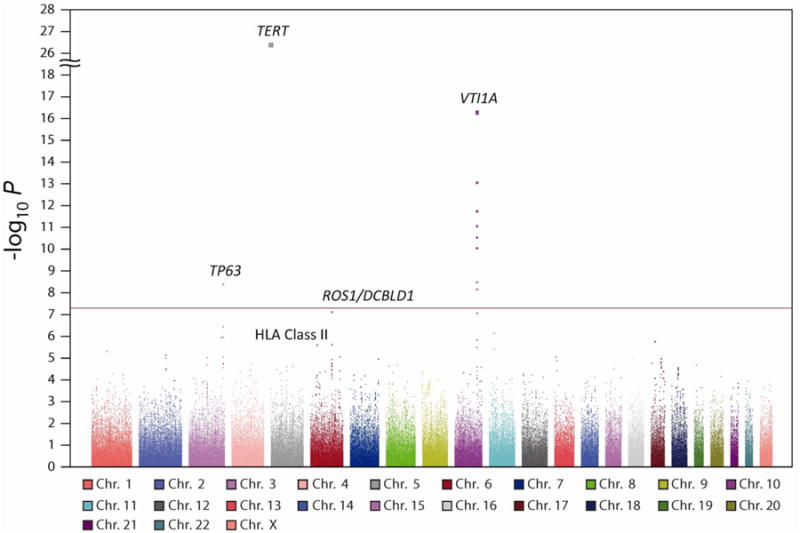
Figure 1
Figure 1. Association results from a GWAS of never-smoking women in Asia
Manhattan plot based on P values derived from 1-degree-of-freedom tests of genotype trend effect in an unconditional logistic regression analysis adjusted for study, age and three eigenvectors in a GWAS of lung cancer in never-smoking Asian females, including 5,510 lung cancer cases and 4,544 controls. The x axis represents chromosomal location, and the y axis shows P values on a negative logarithmic scale. The red horizontal line represents the genome-wide significance threshold of P = 5 × 10⁻⁸. Labeled are two previously associated loci (TERT at 5p15.33 and TP63 at 3q28) together with three newly identified loci (VTI1A on chromosome 10 and ROS1-DCBLD1 and the HLA Class II region on chromosome 6).
Figure 2
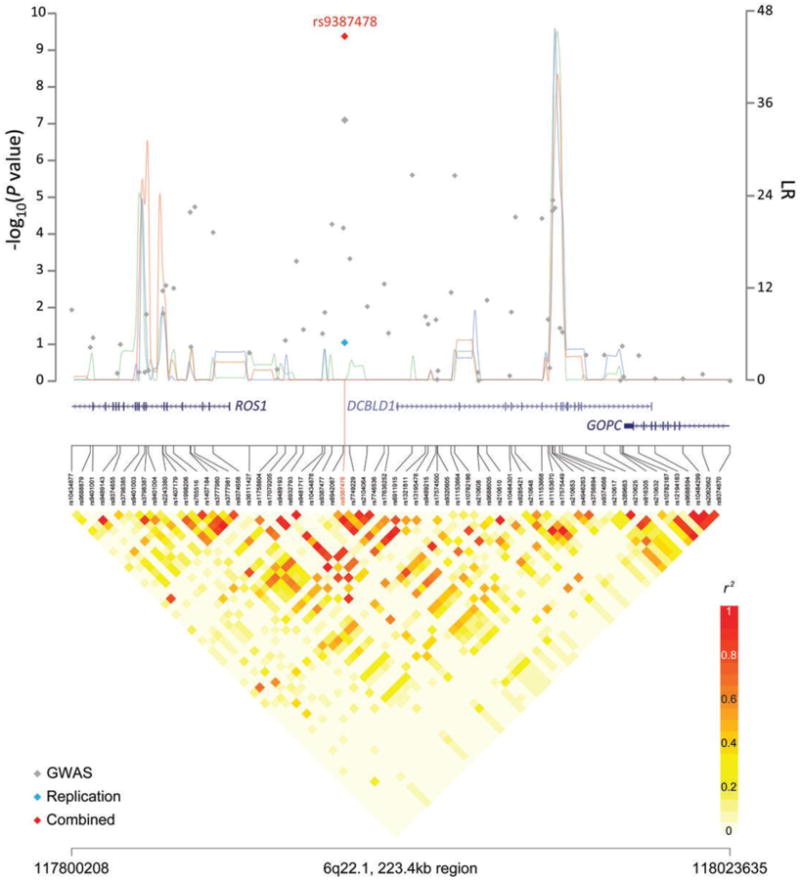
Figure 2. Association results, recombination hot-spots, and linkage disequilibrium plots for the regions newly associated with lung cancer in never-smoking Asian females
Top, association results of GWAS data (grey diamonds), TaqMan data (blue diamonds) and combined data (red diamonds) are shown in the top panel with −log10(P) values (left y axis). Overlaid are the likelihood ratio statistics (right y axis) to estimate putative recombination hotspots across the region on the basis of 3 sets of 100 randomly selected control samples representing Han Chinese, Japanese and Korean (connected lines in green, blue, and red, respectively) individuals. Bottom, LD heatmap based on pairwise r2 values from total control populations for all SNPs included in the GWAS. (a) A 229.7- kb region at 10q25.2 spanning the VTI1A gene. (b) A 223.4- kb region at 6q22.2 spanning the ROS1, DCBLD1 and GOPC genes. (c) A 279.6- kb region at 6p21.32 spanning multiple genes in the HLA class II region. Because a Taqman assay could not be designed for rs2395185, we instead genotyped rs28366298, its perfect surrogate (r2 = 1.0), by TaqMan. The reported P value is based on meta-analysis of the rs2395185 results in the GWAS and the rs28366298 results in the TaqMan set. Genomic coordinates are based on NCBI Human Genome Build 36. Schematic gene structures are taken from the UCSC Genome Browser and are scaled to the x-axis.
Figure 2
Figure 2. Association results, recombination hot-spots, and linkage disequilibrium plots for the regions newly associated with lung cancer in never-smoking Asian females
Top, association results of GWAS data (grey diamonds), TaqMan data (blue diamonds) and combined data (red diamonds) are shown in the top panel with −log10(P) values (left y axis). Overlaid are the likelihood ratio statistics (right y axis) to estimate putative recombination hotspots across the region on the basis of 3 sets of 100 randomly selected control samples representing Han Chinese, Japanese and Korean (connected lines in green, blue, and red, respectively) individuals. Bottom, LD heatmap based on pairwise r2 values from total control populations for all SNPs included in the GWAS. (a) A 229.7- kb region at 10q25.2 spanning the VTI1A gene. (b) A 223.4- kb region at 6q22.2 spanning the ROS1, DCBLD1 and GOPC genes. (c) A 279.6- kb region at 6p21.32 spanning multiple genes in the HLA class II region. Because a Taqman assay could not be designed for rs2395185, we instead genotyped rs28366298, its perfect surrogate (r2 = 1.0), by TaqMan. The reported P value is based on meta-analysis of the rs2395185 results in the GWAS and the rs28366298 results in the TaqMan set. Genomic coordinates are based on NCBI Human Genome Build 36. Schematic gene structures are taken from the UCSC Genome Browser and are scaled to the x-axis.
Figure 2
Figure 2. Association results, recombination hot-spots, and linkage disequilibrium plots for the regions newly associated with lung cancer in never-smoking Asian females
Top, association results of GWAS data (grey diamonds), TaqMan data (blue diamonds) and combined data (red diamonds) are shown in the top panel with −log10(P) values (left y axis). Overlaid are the likelihood ratio statistics (right y axis) to estimate putative recombination hotspots across the region on the basis of 3 sets of 100 randomly selected control samples representing Han Chinese, Japanese and Korean (connected lines in green, blue, and red, respectively) individuals. Bottom, LD heatmap based on pairwise r2 values from total control populations for all SNPs included in the GWAS. (a) A 229.7- kb region at 10q25.2 spanning the VTI1A gene. (b) A 223.4- kb region at 6q22.2 spanning the ROS1, DCBLD1 and GOPC genes. (c) A 279.6- kb region at 6p21.32 spanning multiple genes in the HLA class II region. Because a Taqman assay could not be designed for rs2395185, we instead genotyped rs28366298, its perfect surrogate (r2 = 1.0), by TaqMan. The reported P value is based on meta-analysis of the rs2395185 results in the GWAS and the rs28366298 results in the TaqMan set. Genomic coordinates are based on NCBI Human Genome Build 36. Schematic gene structures are taken from the UCSC Genome Browser and are scaled to the x-axis.

References

    1. Sun S, Schiller JH, Gazdar AF. Lung cancer in never smokers--a different disease. Nat Rev Cancer. 2007;7:778–790. - PubMed
    1. Sun Y, et al. Lung adenocarcinoma from East Asian never-smokers is a disease largely defined by targetable oncogenic mutant kinases. J Clin Oncol. 2010;28:4616–4620. - PMC - PubMed
    1. Rudin CM, et al. Lung cancer in never smokers: molecular profiles and therapeutic implications. Clin Cancer Res. 2009;15:5646–5661. - PMC - PubMed
    1. Thun MJ, et al. Lung cancer occurrence in never-smokers: an analysis of 13 cohorts and 22 cancer registry studies. PLoS Med. 2008;5:e185. - PMC - PubMed
    1. Gao YT, et al. Lung cancer among Chinese women. Int J Cancer. 1987;40:604–609. - PubMed

Publication types

MeSH terms