


Clinically relevant injury patterns after an anterior cruciate ligament injury provide insight into injury mechanisms
- PMID: 23144366
- PMCID: PMC3935824
- DOI: 10.1177/0363546512465167
Clinically relevant injury patterns after an anterior cruciate ligament injury provide insight into injury mechanisms
Abstract
Background: The functional disability and high costs of treating anterior cruciate ligament (ACL) injuries have generated a great deal of interest in understanding the mechanism of noncontact ACL injuries. Secondary bone bruises have been reported in over 80% of partial and complete ACL ruptures.
Purpose: The objectives of this study were (1) to quantify ACL strain under a range of physiologically relevant loading conditions and (2) to evaluate soft tissue and bony injury patterns associated with applied loading conditions thought to be responsible for many noncontact ACL injuries.
Study design: Controlled laboratory study.
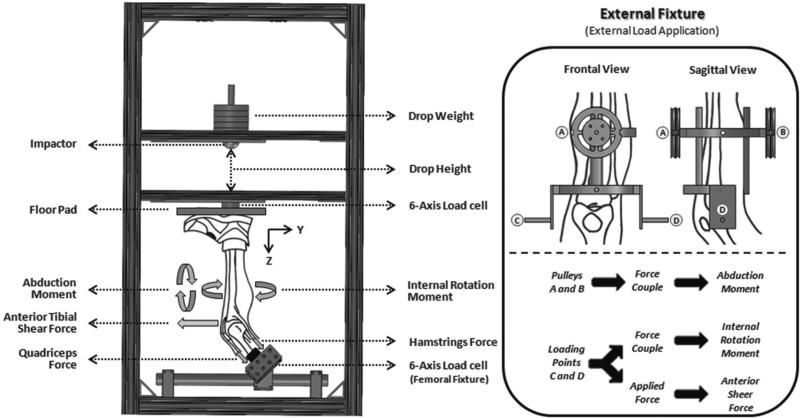
Methods: Seventeen cadaveric legs (age, 45 ± 7 years; 9 female and 8 male) were tested utilizing a custom-designed drop stand to simulate landing. Specimens were randomly assigned between 2 loading groups that evaluated ACL strain under either knee abduction or internal tibial rotation moments. In each group, combinations of anterior tibial shear force, and knee abduction and internal tibial rotation moments under axial impact loading were applied sequentially until failure. Specimens were tested at 25° of flexion under simulated 1200-N quadriceps and 800-N hamstring loads. A differential variable reluctance transducer was used to calculate ACL strain across the anteromedial bundle. A general linear model was used to compare peak ACL strain at failure. Correlations between simulated knee injury patterns and loading conditions were evaluated by the χ2 test for independence.
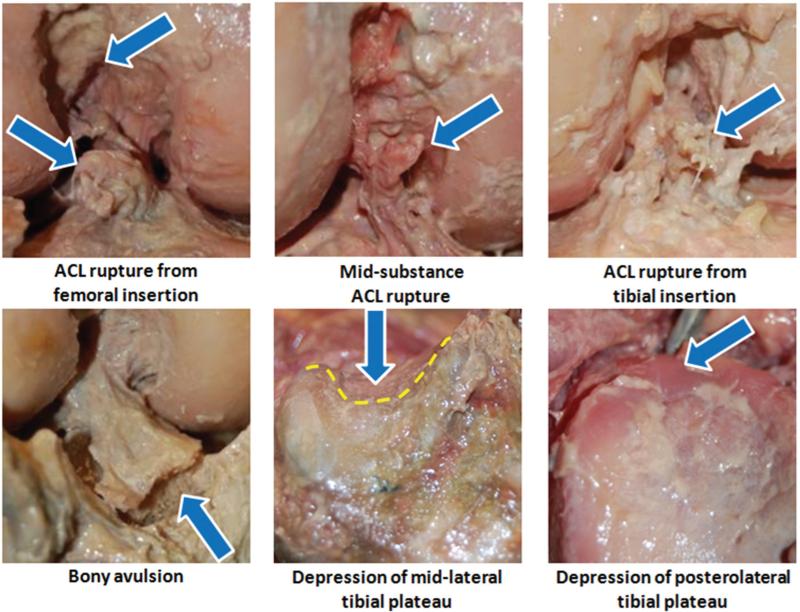
Results: Anterior cruciate ligament failure was generated in 15 of 17 specimens (88%). A clinically relevant distribution of failure patterns was observed including medial collateral ligament tears and damage to the menisci, cartilage, and subchondral bone. Only abduction significantly contributed to calculated peak ACL strain at failure (P = .002). While ACL disruption patterns were independent of the loading mechanism, tibial plateau injury patterns (locations) were significantly (P = .002) dependent on the applied loading conditions. Damage to the articular cartilage along with depression of the midlateral tibial plateau was primarily associated with knee abduction moments, while cartilage damage with depression of the posterolateral tibial plateau was primarily associated with internal tibial rotation moments.
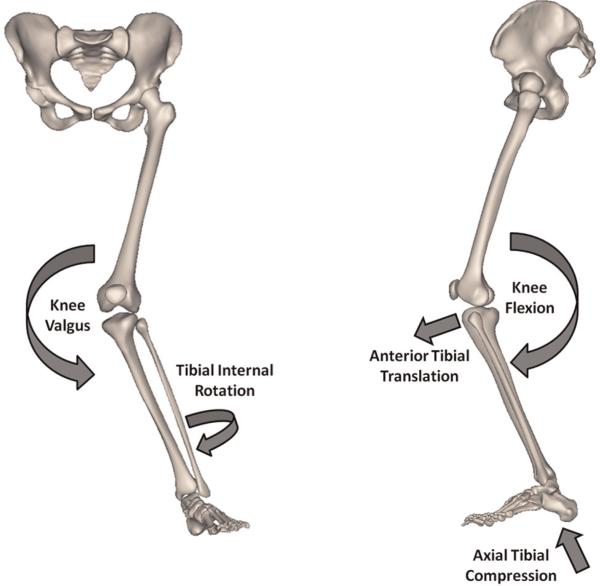
Conclusion: The current findings demonstrate the relationship between the location of the tibial plateau injury and ACL injury mechanisms. The resultant injury locations were similar to the clinically observed bone bruises across the tibial plateau during a noncontact ACL injury. These findings indicate that abduction combined with other modes of loading (multiplanar loading) may act to produce ACL injuries.
Clinical relevance: A better understanding of ACL injury mechanisms and associated risk factors may improve current preventive, surgical, and rehabilitation strategies and limit the risk of ACL and secondary injuries, which may in turn minimize the future development of posttraumatic osteoarthritis of the knee.
Figures
References
-
- Agel J, Arendt EA, Bershadsky B. Anterior cruciate ligament injury in National Collegiate Athletic Association basketball and soccer: a 13-year review. Am J Sports Med. 2005;33(4):524–530. - PubMed
-
- Andriacchi TP, Briant PL, Bevill SL, Koo S. Rotational changes at the knee after ACL injury cause cartilage thinning. Clin Orthop Relat Res. 2006;442:39–44. - PubMed
-
- Arendt E, Dick R. Knee injury patterns among men and women in collegiate basketball and soccer: NCAA data and review of literature. Am J Sports Med. 1995;23(6):694–701. - PubMed
-
- Arnold JA, Coker TP, Heaton LM, Park JP, Harris WD. Natural history of anterior cruciate tears. Am J Sports Med. 1979;7(6):305–313. - PubMed
-
- Boden BP, Dean GS, Feagin JA, Jr, Garrett WE., Jr Mechanisms of anterior cruciate ligament injury. Orthopedics. 2000;23(6):573–578. - PubMed
MeSH terms
Grants and funding
LinkOut - more resources
Full Text Sources
Medical
