Vitamin D status and coronary flow reserve measured by positron emission tomography: a co-twin control study
- PMID: 23144471
- PMCID: PMC3537102
- DOI: 10.1210/jc.2012-3097
Vitamin D status and coronary flow reserve measured by positron emission tomography: a co-twin control study
Abstract
Context: Vitamin D insufficiency is associated with increased cardiovascular events in the general population. Additionally, low serum 25-hydroxyvitamin D [25(OH)D] is associated with endothelial dysfunction and arterial stiffness. However, little is known about the association between serum 25(OH)D level and myocardial blood flow.
Objective: Our objective was to examine the association between serum 25(OH)D levels and coronary flow reserve (CFR) measured by (13)N-positron emission tomography in asymptomatic middle-aged male twins.
Design: The Emory Twin Study is a cross-sectional study of soldiers from the Vietnam Era Registry.
Setting: The study was conducted at the General Clinical Research Center, Emory University, Atlanta, GA.
Participants: A total of 368 middle-aged male twins were enrolled for the study. Serum 25(OH)D levels were measured in all subjects and classified as vitamin D insufficiency [25(OH)D <30 ng/ml] or sufficiency [25(OH)D ≥30 ng/ml]. Positron emission tomography with [(13)N]ammonia was used to evaluate myocardial blood flow at rest and after adenosine stress. CFR was measured as the ratio of maximum to rest myocardial blood flow.
Main outcome measure: Primary outcome was CFR measurement.
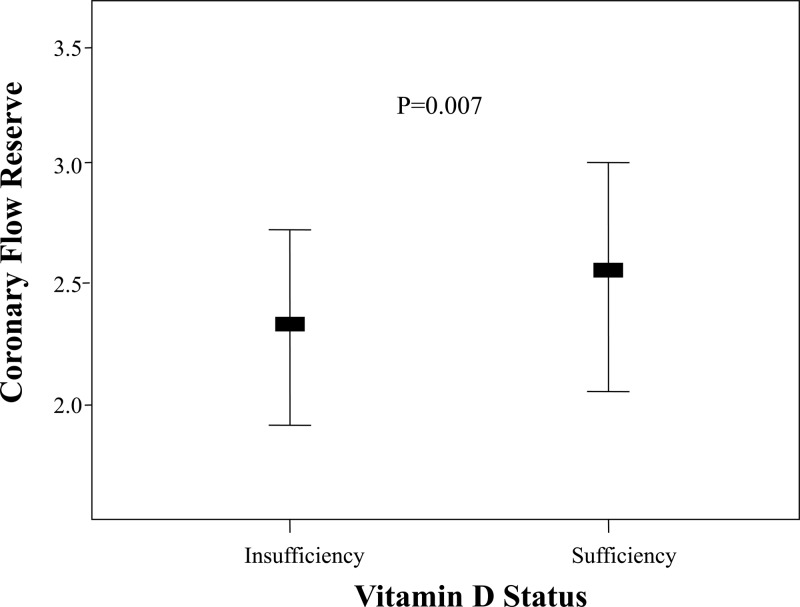
Results: Mean overall serum 25(OH)D concentration was 37.0 ± 21.4 ng/ml; 167 twins (45%) were vitamin D insufficient. CFR was significantly lower in subjects with vitamin D insufficiency compared with subjects with vitamin D sufficiency (2.41 vs. 2.64; P = 0.007), even after adjustment for traditional cardiovascular risk factors, serum PTH, calcium, and phosphorus levels, and season. An abnormal CFR (CFR <2) was more prevalent in subjects with vitamin D insufficiency than with vitamin D sufficiency (31 vs. 20%; P = 0.03). In addition, in vitamin D status-discordant twin pairs, CFR was significantly lower in the vitamin D-insufficient twin than in the vitamin D-sufficient co-twin (2.35 vs. 2.58; P = 0.037).
Conclusion: Vitamin D insufficiency is associated with lower CFR in men. This association may help explain some of the increased cardiovascular risk reported in individuals with vitamin D insufficiency.
Figures
References
-
- Dobnig H, Pilz S, Scharnagl H, Renner W, Seelhorst U, Wellnitz B, Kinkeldei J, Boehm BO, Weihrauch G, Maerz W. 2008. Independent association of low serum 25-hydroxyvitamin d and 1,25-dihydroxyvitamin D levels with all-cause and cardiovascular mortality. Arch Intern Med 168:1340–1349 - PubMed
-
- Pilz S, März W, Wellnitz B, Seelhorst U, Fahrleitner-Pammer A, Dimai HP, Boehm BO, Dobnig H. 2008. Association of vitamin D deficiency with heart failure and sudden cardiac death in a large cross-sectional study of patients referred for coronary angiography. J Clin Endocrinol Metab 93:3927–3935 - PubMed
-
- Kendrick J, Targher G, Smits G, Chonchol M. 2009. 25-Hydroxyvitamin D deficiency is independently associated with cardiovascular disease in the Third National Health and Nutrition Examination Survey. Atherosclerosis 205:255–260 - PubMed
-
- Burgaz A, Orsini N, Larsson SC, Wolk A. 2011. Blood 25-hydroxyvitamin D concentration and hypertension: a meta-analysis. J Hypertens 29:636–645 - PubMed
Publication types
MeSH terms
Substances
Grants and funding
LinkOut - more resources
Full Text Sources
Other Literature Sources
Medical