


Associations of Social Support and 8-Year Follow-Up Depressive Symptoms: Differences in African American and White Caregivers
- PMID: 23144529
- PMCID: PMC3491574
- DOI: 10.1080/07317115.2012.678569
Associations of Social Support and 8-Year Follow-Up Depressive Symptoms: Differences in African American and White Caregivers
Abstract
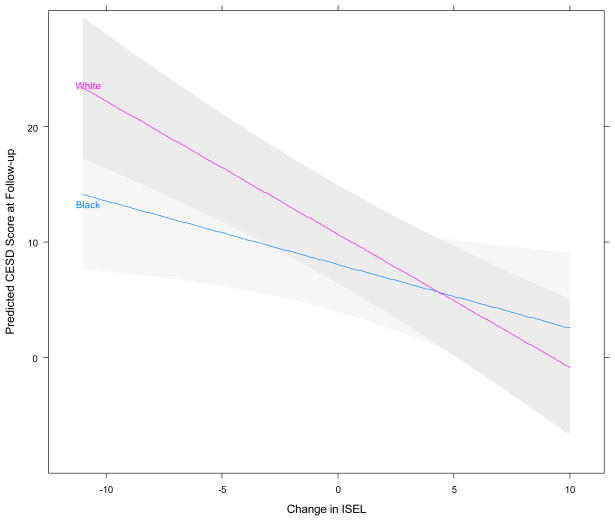
The present study used data from the Alzheimer's Study of Emotions in Caregivers (ASEC) to evaluate perceptions of social support assessed at baseline, as well as changes in social support assessed at a follow-up eight-years later, as predictors of symptoms of change in depression, with a focus on race as a potential moderator of these relationships. Specifically, multiple regression analyses adjusted for age, sex, income, education, race, living arrangement of care recipient at baseline, death of care recipient, the cultural justification for caregiving scale (CJCS), and baseline depressive symptoms were conducted to assess baseline social support ratings, as well as the change in social support over time as a predictor of depression at follow-up-with a focus on moderation by race. Baseline social support (F(1,77) = 7.60, p=.008) was associated with fewer depressive symptoms at follow-up for all participants. The change in social support over time was also related to depressive symptoms, with effects moderated by race (F(1,77) = 7.97, p = .007), such that when support decreased over time depressive symptoms at follow-up were higher for Whites, as compared with African Americans, whereas, when social support increased over time depressive symptoms tended to be similar for both groups. These findings indicate that research designed to plan interventions in caregivers must not ignore potential racial differences with regard to the effects of caregiving on mental health.
Figures
References
-
- Aneshensel CS, Pearlin LI, Mullan JT, Zarit SH, Whitlach CJ. Profiles in caregiving: the unexpected career. San Diego: Academic Press; 1995.
-
- Bernstein KS, Lee JK, Park SY, Jyoung JPP. Symptom manifestations and expression among Korean immigrant women suffering with depression. Journal of Advanced Nursing. 2007;61:393–402. - PubMed
-
- Brummett BH, Babyak MA, Barefoot JC, Bosworth HB, Clapp-Channing NE, Siegler IC, Mark DB. Social support and hostility as predictors of depressive symptoms in cardiac patients one month following hospitalization: A prospective study. Psychosomatic Medicine. 1998;60:707–713. - PubMed
-
- Brummett BH, Babyak MA, Mark DB, Clapp-Channing NE, Siegler IC, Barefoot JC. Prospective study of perceived stress in cardiac patients. Annals of Behavioral Medicine. 2004;27:22–30. - PubMed
-
- Clay OJ, Roth DL, Wadley VG, Haley WE. Changes in social support and their impact on psychosocial outcome over a 5-year period for African American and White dementia caregivers. Int J Geriatr Psychiatry. 2008;23:857–862. - PubMed
Grants and funding
LinkOut - more resources
Full Text Sources
