


Sensitivity to first- and second-order drifting gratings in 3-month-old infants
- PMID: 23145237
- PMCID: PMC3485786
- DOI: 10.1068/i0406
Sensitivity to first- and second-order drifting gratings in 3-month-old infants
Abstract
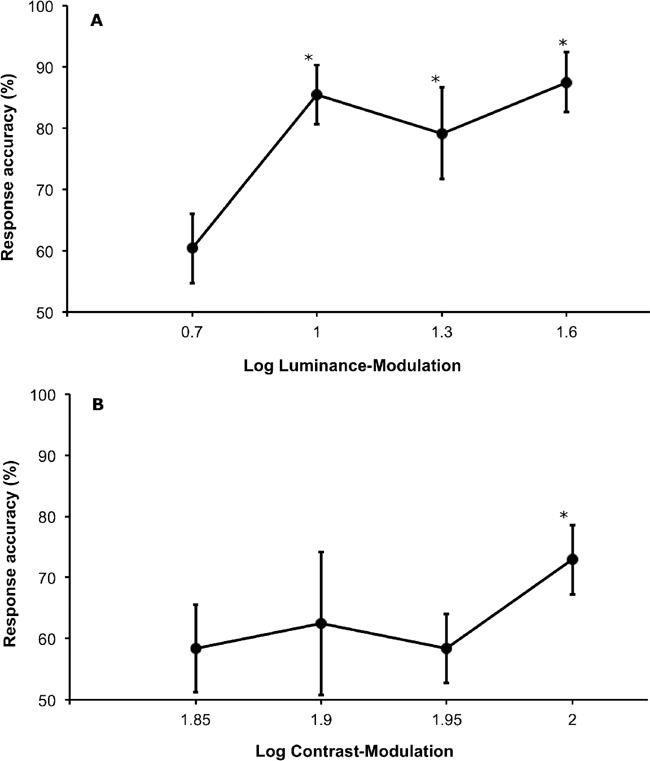
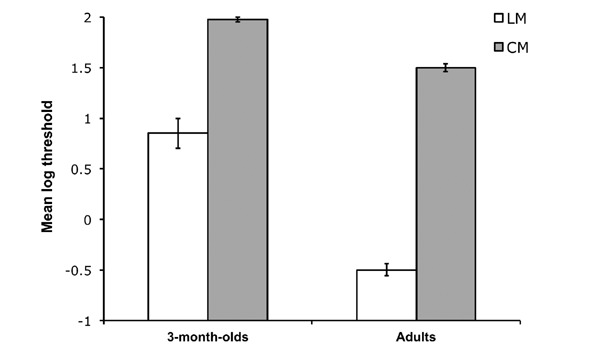
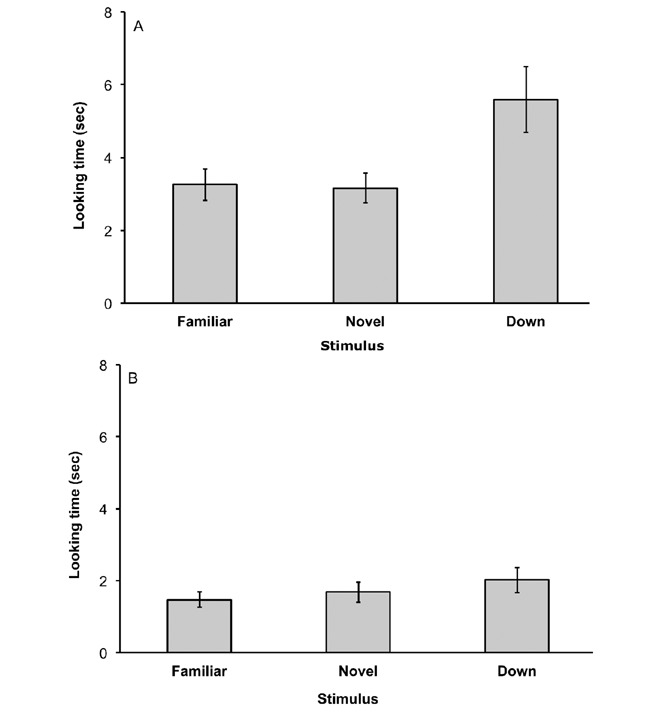
In two experiments, we investigated 3-month-old infants' sensitivity to first- and second-order drifting gratings. In Experiment 1 we used forced-choice preferential looking with drifting versus stationary gratings to estimate depth modulation thresholds for 3-month-old infants and a similar task for a comparison group of adults. Thresholds for infants were more adult-like for second-order than first-order gratings. In Experiment 2, 3-month-olds dishabituated to a change in first-order orientation, but not to a change in direction of first- or second-order motion. Hence, results from Experiment 1 were likely driven by the perception of flicker rather than motion. Thus, infants' sensitivity to uniform motion is slow to develop and appears to be driven initially by flicker-sensitive mechanisms. The underlying mechanisms have more mature tuning for second-order than for first-order information.
Keywords: Development; first-order; flicker; infants; motion; second-order.
Figures
References
-
- Allen H A, Ledgeway T, Hess R F. “Poor encoding of position by contrast-defined motion”. Vision Research. 2004;44:17–17. - PubMed
-
- Aslin R N, Shea S L. “Velocity thresholds in human infants: Implications for the perception of motion Developmental Psychology”. 2. 1990;6:589–598.
-
- Atkinson J, Braddick O. “Development of optokinetic nystagmus in infants: An indicator of cortical binocularity?”. In: Fisher D F, A Monty R, W Senders J, editors. Eye movements: Cognition and Visual Perception. Hillsdale, NJ: Lawrence Erlbaum; 1981. pp. 53–64.
LinkOut - more resources
Full Text Sources
