


Cognitive mechanisms for explaining dynamics of aesthetic appreciation
- PMID: 23145254
- PMCID: PMC3485809
- DOI: 10.1068/i0463aap
Cognitive mechanisms for explaining dynamics of aesthetic appreciation
Abstract
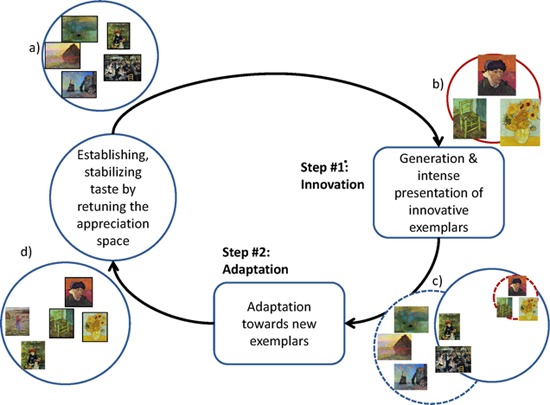
For many domains aesthetic appreciation has proven to be highly reliable. Evaluations of facial attractiveness, for instance, show high internal consistencies and impressively high inter-rater reliabilities, even across cultures. This indicates general mechanisms underlying such evaluations. It is, however, also obvious that our taste for specific objects is not always stable-in some realms such stability is hardly conceivable at all since aesthetic domains such as fashion, design, or art are inherently very dynamic. Gaining insights into the cognitive mechanisms that trigger and enable corresponding changes of aesthetic appreciation is of particular interest for psychologists as this will probably reveal essential mechanisms of aesthetic evaluations per se. The present paper develops a two-step model, dynamically adapting itself, which accounts for typical dynamics of aesthetic appreciation found in different research areas such as art history, philosophy, and psychology. The first step assumes singular creative sources creating and establishing innovative material towards which, in a second step, people adapt by integrating it into their visual habits. This inherently leads to dynamic changes of the beholders- aesthetic appreciation.
Keywords: adaptation; aesthetic processing; art and vision; dynamics; liking; model; preference.
Figures


References
-
- Augustin M D, Leder H, Hutzler F, Carbon C C. “Style follows content: On the microgenesis of art perception”. Acta Psychologica. 2008;128:127–138. - PubMed
-
- Bazin G. Impressionist paintings in the Louvre. London: Thames & Hudson; 1958.
-
- Blijlevens J, Carbon C C, Mugge R, Schoormans J P L. “Aesthetic appraisal of product designs: Independent effects of typicality and arousal”. British Journal of Psychology. in press. - PubMed
-
- Carbon C C. “What “exactly” is a prototype? Not sure, but average objects are not necessarily good candidates for…”. Journal of Vision. 2009;9:512–512. doi: 10.1167/9.8.512. - DOI
LinkOut - more resources
Full Text Sources
