. 2011;2(7):708-19.
doi: 10.1068/i0463aap. Epub 2011 Nov 1.

Cognitive mechanisms for explaining dynamics of aesthetic appreciation

Affiliations

Cognitive mechanisms for explaining dynamics of aesthetic appreciation

Claus-Christian Carbon. Iperception. 2011.

Abstract

For many domains aesthetic appreciation has proven to be highly reliable. Evaluations of facial attractiveness, for instance, show high internal consistencies and impressively high inter-rater reliabilities, even across cultures. This indicates general mechanisms underlying such evaluations. It is, however, also obvious that our taste for specific objects is not always stable-in some realms such stability is hardly conceivable at all since aesthetic domains such as fashion, design, or art are inherently very dynamic. Gaining insights into the cognitive mechanisms that trigger and enable corresponding changes of aesthetic appreciation is of particular interest for psychologists as this will probably reveal essential mechanisms of aesthetic evaluations per se. The present paper develops a two-step model, dynamically adapting itself, which accounts for typical dynamics of aesthetic appreciation found in different research areas such as art history, philosophy, and psychology. The first step assumes singular creative sources creating and establishing innovative material towards which, in a second step, people adapt by integrating it into their visual habits. This inherently leads to dynamic changes of the beholders- aesthetic appreciation.

Keywords: adaptation; aesthetic processing; art and vision; dynamics; liking; model; preference.


Figures
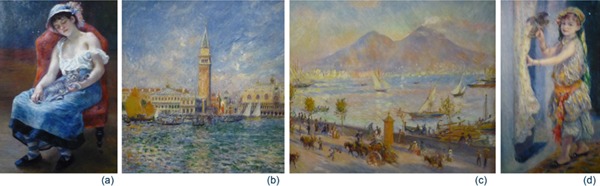
Figure 1.
Figure 1.
Paintings by Pierre-Auguste Renoir (1841–1919) from a narrow period of time of his artistry show a high consistency of the specific usage of the colour blue. From left to right: (a) Sleeping Girl (1880), (b) Venezia, the Doge's Palace (1881), (c) Bay of Naples, Evening (1881), (d) Child with a Bird (1882). Photographs made by CCC.
Figure 2.
Figure 2.
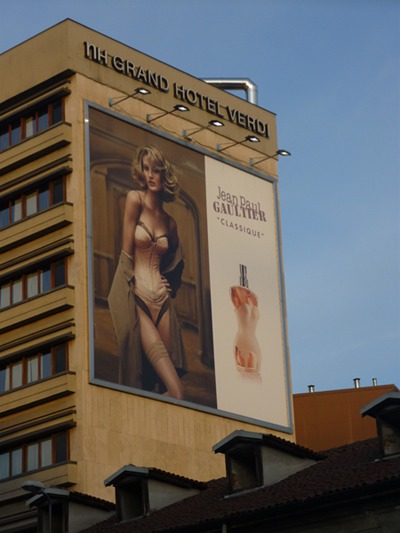
Jean-Paul Gaultier 2011 advertising campaign for the Gaultier perfume brand “Classique”, first introduced in 1993, which directly refers to the concept of “classic” or “eternal” (good) taste comparable to a perfect body shape which stays rather constant. Photograph made by CCC.
Figure 3.
Figure 3.
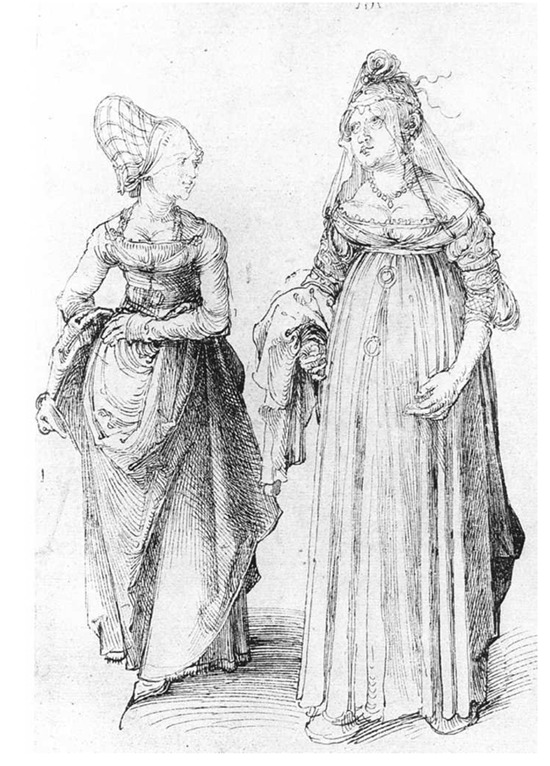
Illustration of desynchronization of fashion styles in former times: The picture shows a drawing by Albrecht Dürer from 1496–1497 depicting a typical style of a bourgeois from Nuremberg (left) and from Venice (right) emphasising long legs by the usage of high chopines plus a skirt cut with the waist edge just beneath the female bust. Source: Wikimedia Commons.
Figure 4.
Figure 4.
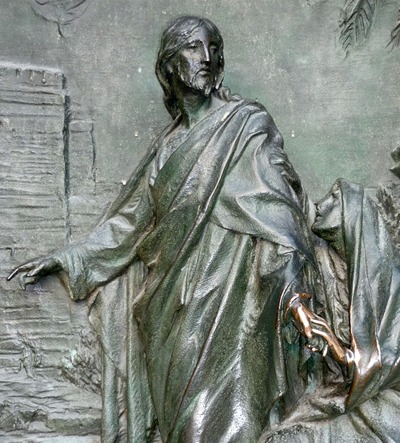
Detail of the bronze gates of the Duomo di Milano (Milan cathedral; lower part of the Major Door, planned by L Pogliaghi) demonstrating frequent touching of specific parts of the holy scenes, which results in burnishing these parts over the years. The highly selective burnishing indicates synchronized visitors— behaviour, here the touching of the central and significant mutual soft touch of Jesus— and Maria's hands. Photograph made by CCC.
Figure 5.
Figure 5.
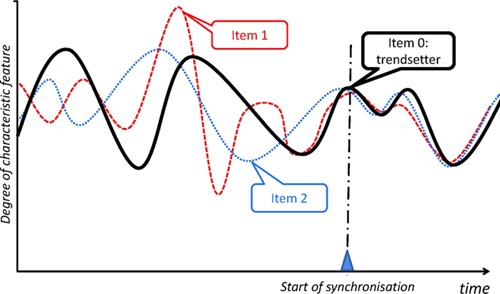
Model of trendsetters triggering starting points of synchronisation: From a certain point of time, the characteristic feature, which can vary among many different aspects such as material, form, colour, etc, indicated by “Item 0” which is generated by a highly creative and publicly renowned trendsetter is appreciated via adaptation. Competing items (works of art, consumer products, design) oriented towards this innovative feature, even copying or imitating it, increase the availability and consequently the appreciation of the new feature.
Figure 6.
Figure 6.
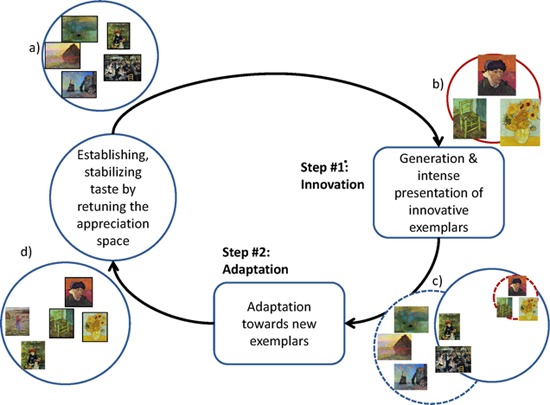
Two-step model of the dynamics of aesthetic appreciation, illustrated with appreciation changing from impressionist to post-impressionist paintings. Taste is (a) established and stabilized until beholders are (b) intensively confronted with innovative exemplars (step #1). In a subsequent adaptation phase (step #2) beholders (c) adapt towards the new stimuli integrating them into their visual habits. The appreciation space is (d) continuously retuned, establishing and stabilizing taste again. Paintings depicted here are from the Wikimedia Commons showing (a) typical impressionist works by Claude Monet and Pierre-Auguste Renoir and (b) distinctive and, in the period of impressionism, highly innovative post-impressionist/expressionist works by Vincent Van Gogh.
Figure 7.
Figure 7.
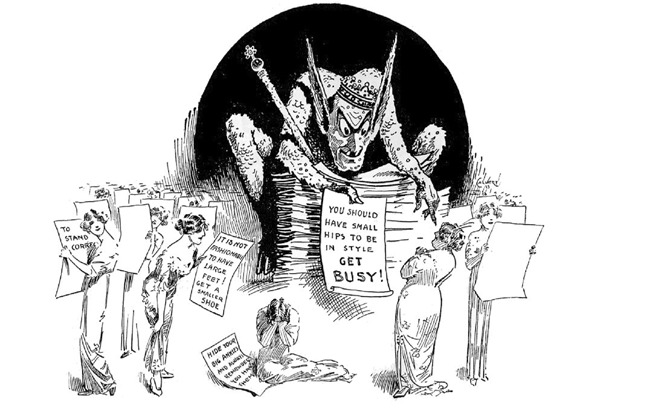
Image is from the Wikimedia Commons, originally from Life magazine from 1913 describing fashion as an evil force which explicitly dictates fashion rules that people have to follow.

References

    1. Augustin M D, Leder H, Hutzler F, Carbon C C. “Style follows content: On the microgenesis of art perception”. Acta Psychologica. 2008;128:127–138. - PubMed
    1. Bazin G. Impressionist paintings in the Louvre. London: Thames & Hudson; 1958.
    1. Blijlevens J, Carbon C C, Mugge R, Schoormans J P L. “Aesthetic appraisal of product designs: Independent effects of typicality and arousal”. British Journal of Psychology. in press. - PubMed
    1. Buhlmann U, Etcoff N L, Wilhelm S. “Facial attractiveness ratings and perfectionism in body dysmorphic disorder and obsessive-compulsive disorder”. Journal of Anxiety Disorders. 2008;22:540–547. doi: 10.1016/j.janxdis.2007.05.004. - DOI - PubMed
    1. Carbon C C. “What “exactly” is a prototype? Not sure, but average objects are not necessarily good candidates for…”. Journal of Vision. 2009;9:512–512. doi: 10.1167/9.8.512. - DOI

LinkOut - more resources