doi: 10.1121/1.4758770.
Channel interaction limits melodic pitch perception in simulated cochlear implants
Affiliations
- PMID: 23145706
- PMCID: PMC3494451
- DOI: 10.1121/1.4758770
Item in Clipboard
Channel interaction limits melodic pitch perception in simulated cochlear implants
J Acoust Soc Am.
2012 Nov.
Abstract
In cochlear implants (CIs), melodic pitch perception is limited by the spectral resolution, which in turn is limited by the number of spectral channels as well as interactions between adjacent channels. This study investigated the effect of channel interaction on melodic contour identification (MCI) in normal-hearing subjects listening to novel 16-channel sinewave vocoders that simulated channel interaction in CI signal processing. MCI performance worsened as the degree of channel interaction increased. Although greater numbers of spectral channels may be beneficial to melodic pitch perception, the present data suggest that it is also important to improve independence among spectral channels.
Figures
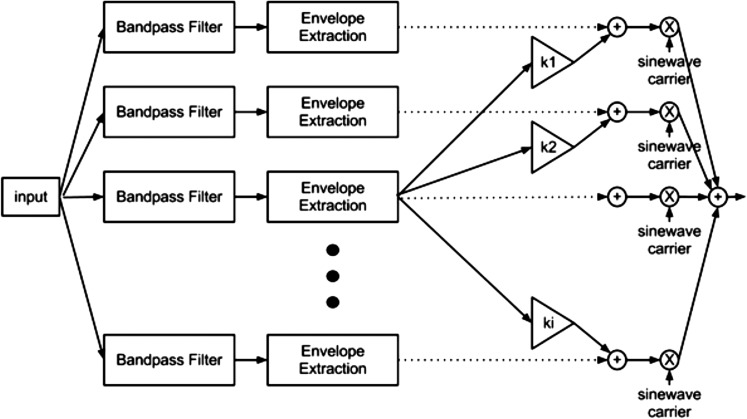
Block diagram of the signal processing for the acoustic CI simulation. Temporal envelope information extracted from an analysis band (only one band is shown) is added to other bands with a gain of ki, which corresponds to filter slope in dB/octave. The sinewave carriers were the center frequency of the frequency analysis band.
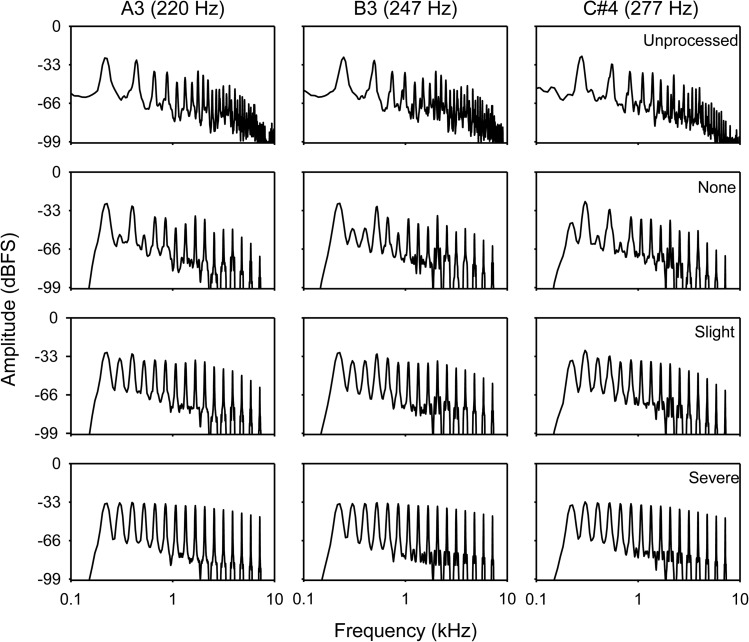
Frequency analysis of experimental stimuli. From the left to right, the columns indicate different notes. The top row shows the unprocessed signal. Rows 2, 3, and 4 show stimuli processed by the CI simulations with no, slight, and severe channel interaction, respectively.
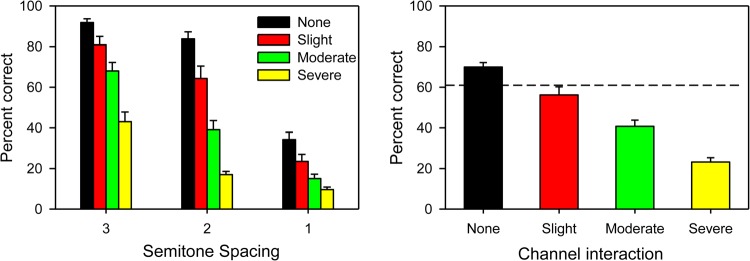
(Color online) Mean MCI performance with the CI simulation as a function of semitone spacing (left panel) or the degree of channel interaction (right panel; performance averaged across semitone spacing conditions). The error bars indicate the standard error. The dashed line in the right-hand panel shows mean CI performance from Zhu et al. (2011).
References
Publication types
MeSH terms
Grants and funding
LinkOut - more resources
Full Text Sources
Medical