Review
. 2012:46:651-75.
doi: 10.1146/annurev-genet-110711-155616.

Active transposition in genomes

Affiliations
Review

Active transposition in genomes

Cheng Ran Lisa Huang et al. Annu Rev Genet. 2012.

Abstract

Transposons are DNA sequences capable of moving in genomes. Early evidence showed their accumulation in many species and suggested their continued activity in at least isolated organisms. In the past decade, with the development of various genomic technologies, it has become abundantly clear that ongoing activity is the rule rather than the exception. Active transposons of various classes are observed throughout plants and animals, including humans. They continue to create new insertions, have an enormous variety of structural and functional impact on genes and genomes, and play important roles in genome evolution. Transposon activities have been identified and measured by employing various strategies. Here, we summarize evidence of current transposon activity in various plant and animal genomes.


Figures
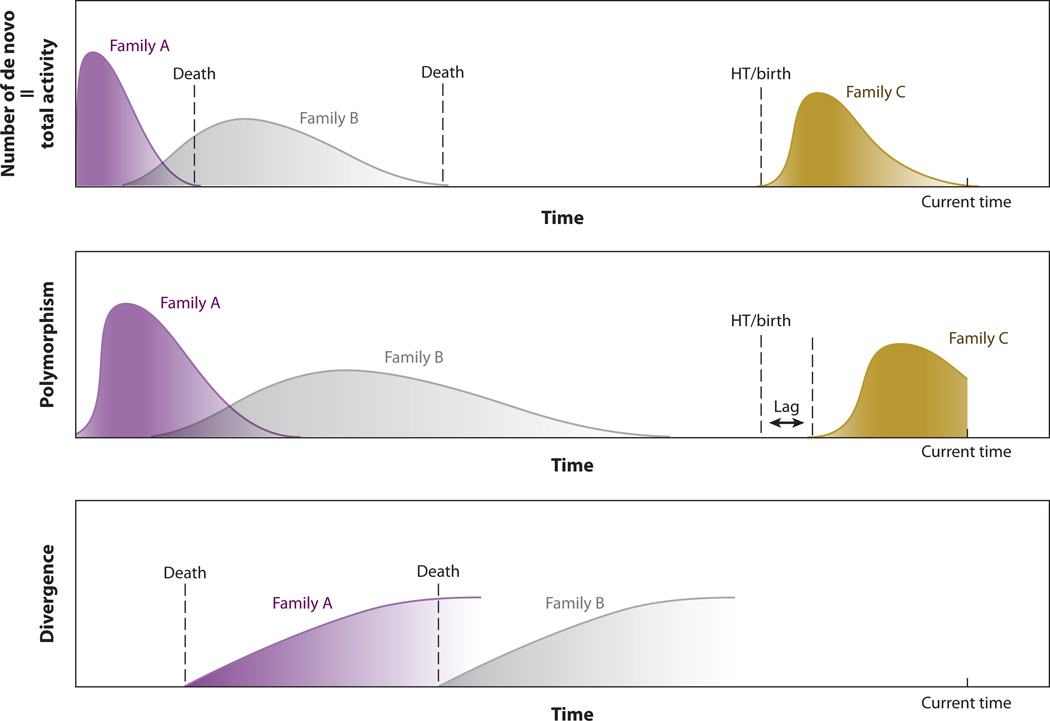
Figure 1
Figure 1
Transposon dynamics in genomes. Transposon activity in the genome varies throughout evolution of the host organism (see total activity track). Multiple families of the transposon can be active at the same time (overlapping peaks). Each family has a different activity tempo as shown by the different peak shapes. The birth of a transposon family can occur through horizontal transfer (HT), often seen with long terminal repeat (LTR) retrotransposons or DNA transposons, or with mutation of a preexisting family, e.g., by acquisition of a new promoter, which can occur in non-LTR retrotransposons. For simplicity, only HT is shown in this figure as an example. Transposon activity can be measured by various methods. Detecting the number of de novo insertions (which are found in offspring but not parents) in a population is the most direct way to measure the total activity. However, this method requires high-throughput screening of large sample sizes and is thus difficult to achieve. Polymorphic insertions between individuals reflect insertions that occur after diverging from a common ancestor. The number of polymorphic insertions in the population provides an indirect measurement of the activity. There is always a lag (middle panel), i.e., polymorphism, before new insertions can achieve an appreciable allele frequency and can be maintained/detected in the population. Polymorphism also remains in the population for some time after the death of the transposon family. Finally, transposon activity can also be inferred from sequence divergence among the elements within a family. At insertion, a transposon is assumed to be identical to a parent (template) copy, whereas older insertions will have passively accumulated more mutations through cycles of host replication. Therefore, if insertions with identical sequences are observed within a family, it is likely that the family remains active (bottom panel). Death of a transposon family occurs when the last remaining active copy of an element is lost through a mutational event(s) (top panel). Polymorphism of element copies will persist for some time following death of an element family, until either deleterious elements are eliminated by purifying selection and/or a population bottleneck and/or genetic drift eliminates variation. Transposon families are recognizable only for a certain period of time (the look-back time) after which sequence divergence becomes so extreme that the family is not recognizable by current sequence-analysis algorithms; this is indicated by the fading of the right boundary of the divergence curve (bottom panel).
Figure 2
Figure 2
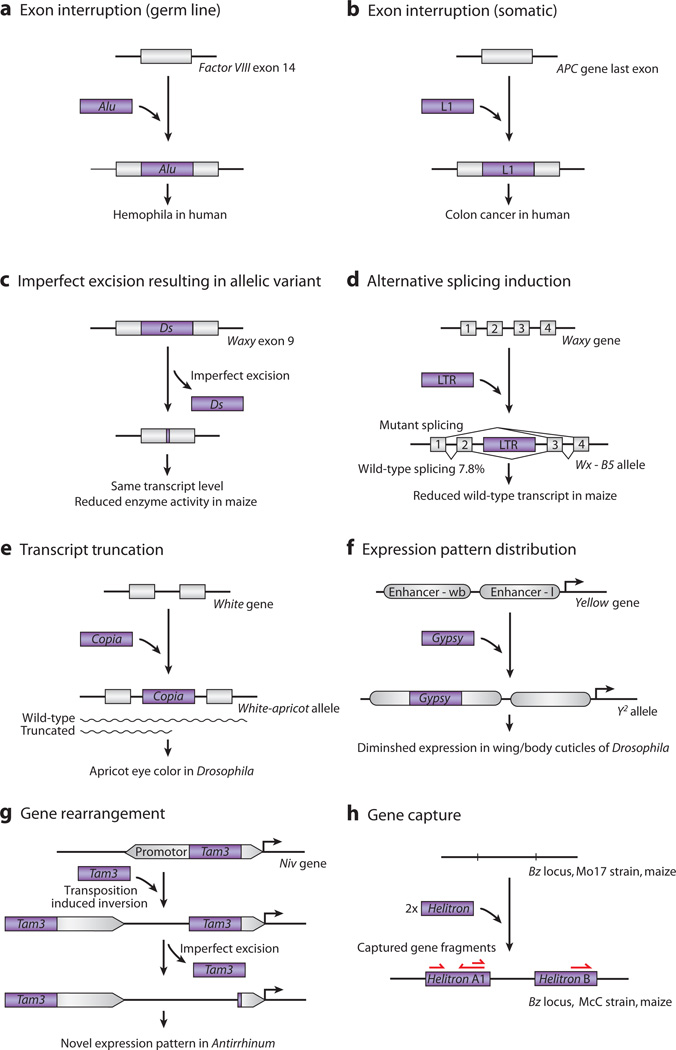
Functional impact of de novo insertions. (a) Exon interruption (germ line). A heritable human Alu SINE retrotransposon insertion interrupting exon 14 of human factor VIII gene causes hemophilia (117). (b) Exon interruption (somatic). A somatic insertion of a human L1 retrotransposon leads to loss of function of the APC gene, thereby promoting colon cancer development (85). (c) Long terminal repeat (LTR) recombination resulting in allelic variant. Recombination between the two LTRs of a Gret retrotransposon at the VvmybA1 locus rescued its gene expression. This recombined allele, VvmybA1b, reconstituted the expression of skin pigment in red grapes (68). (d) Alternative splicing induction. Insertion of an LTR retrotransposon in the waxy locus leads to exon skipping and kernel color changes in maize due to reduced transcript level (122). (e) Transcript truncation. A copia LTR retrotransposon insertion in Drosophila causes a hypomorphic white allele (white-apricot, w[a]). The intronic insertion causes truncated and nonfunction transcripts, with some read-through transcripts remaining functional; the result is the apricot phenotype (78). (f) Gene silencing. In the Melon genome, a hAT family DNA transposon inserted into the second intron of CmWIP1 gene leads to the spread of DNA methylation to the promoter region and subsequent gene silencing. Organisms with this insertion develop female flowers because of repressed CmWIP1 gene expression (82). (g) Gene rearrangement. A Tam3 DNA transposon–related inversion at the niv locus in Antirrhinum. The inversion results from DNA breaks on opposite ends of replicated copies of Tam3 rather than on opposite ends of a single copy. Their recombination with the upstream sequence leads to an inversion with altered niv promoter sequences and reduced expression. Excision of the proximal Tam3 causes another allele with increased and novel patterning of anthocyanin pigment (21). (h) Gene capture. Helitron DNA transposons inserted at the bronze (bz) locus in maize have also captured several neighboring genes, leading to their duplication and significant noncolinearity at this locus in different strains. Functional consequences have not been shown (124).
Figure 3
Figure 3
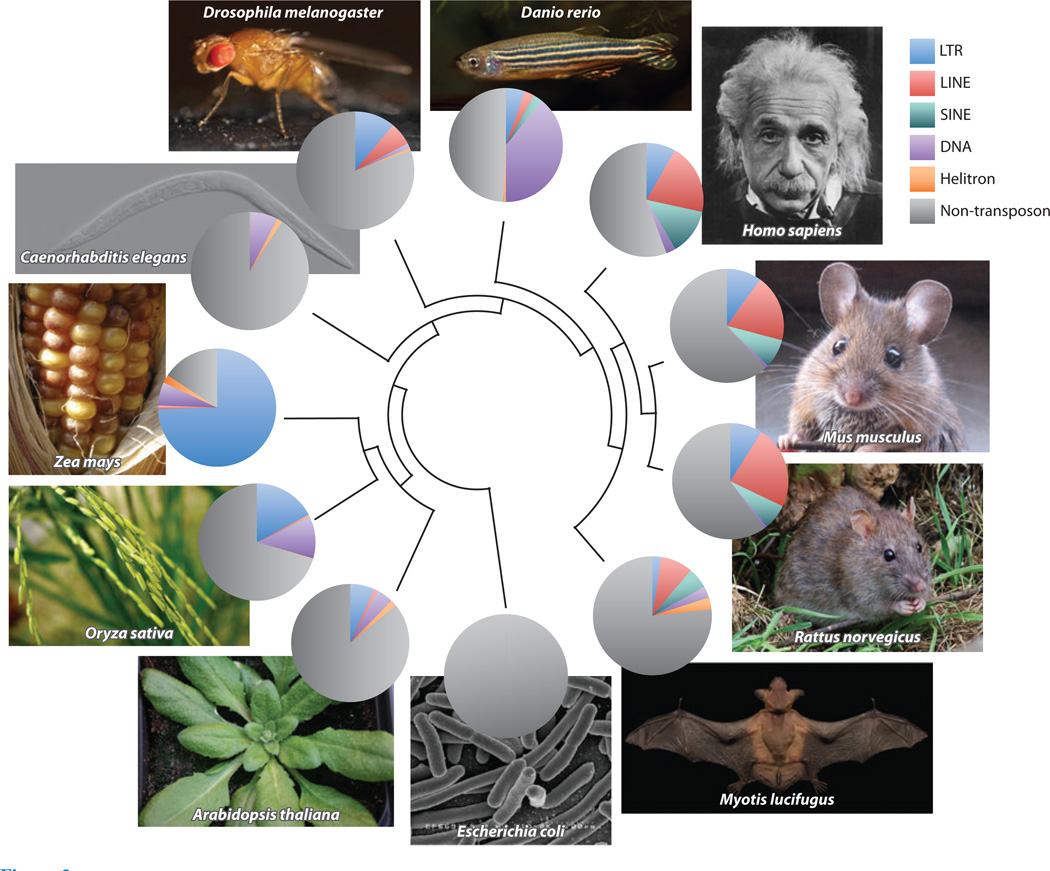
Transposon compositions in different species. In clockwise order, species shown are Homo sapiens, Mus musculus, Rattus norvegicus, Myotis lucifugus, Escherichia coli, Arabidopsis thaliana, Oryza sativa, Zea mays, Caenorhabditis elegans, Drosophila melanogaster, and Danio rerio. The phylogenetic tree in the center describes the evolutionary relationships among them. The pie charts illustrate the fraction of the genome accounted for by different transposon classes (113). Although the bat Myotis lucifugus is a mammal, its transposon composition is distinct, even among bats. Data on non-Myotis bats provided by D.A. Ray & H. Pagán, personal communication (105, 106).

References

    1. Adey NB, Schichman SA, Graham DK, Peterson SN, Edgell MH, Hutchison CA. Rodent L1 evolution has been driven by a single dominant lineage that has repeatedly acquired new transcriptional regulatory sequences. Mol. Biol. Evol. 1994;11:778–789. - PubMed
    1. Akagi K, Li J, Stephens RM, Volfovsky N, Symer DE. Extensive variation between inbred mouse strains due to endogenous L1 retrotransposition. Genome Res. 2008;18:869–880. - PMC - PubMed
    1. Aparicio S, Chapman J, Stupka E, Putnam N, Chia J, et al. Whole-genome shotgun assembly and analysis of the genome of fugu rubripes. Science. 2002;297:1301–1310. - PubMed
    1. Baillie JK, Barnett MW, Upton KR, Gerhardt DJ, Richmond TA, et al. Somatic retrotransposition alters the genetic landscape of the human brain. Nature. 2011;479:534–537. - PMC - PubMed
    1. Banks JA, Nishiyama T, Hasebe M, Bowman JL, Gribskov M, et al. The selaginella genome identifies genetic changes associated with the evolution of vascular plants. Science. 2011;332:960–963. - PMC - PubMed

Substances

LinkOut - more resources