. 2012 Nov 12:6:141.
doi: 10.1186/1752-0509-6-141.

Regulation of leukotriene and 5oxoETE synthesis and the effect of 5-lipoxygenase inhibitors: a mathematical modeling approach

Affiliations

Regulation of leukotriene and 5oxoETE synthesis and the effect of 5-lipoxygenase inhibitors: a mathematical modeling approach

Tatiana A Karelina et al. BMC Syst Biol. .

Abstract

Background: 5-lipoxygenase (5-LO) is a key enzyme in the synthesis of leukotrienes and 5-Oxo-6E,8Z,11Z,14Z-eicosatetraenoic acid (oxoETE). These inflammatory signaling molecules play a role in the pathology of asthma and so 5-LO inhibition is a promising target for asthma therapy. The 5-LO redox inhibitor zileuton (Zyflo IR/CR(®)) is currently marketed for the treatment of asthma in adults and children, but widespread use of zileuton is limited by its efficacy/safety profile, potentially related to its redox characteristics. Thus, a quantitative, mechanistic description of its functioning may be useful for development of improved anti-inflammatory targeting this mechanism.

Results: A mathematical model describing the operation of 5-LO, phospholipase A2, glutathione peroxidase and 5-hydroxyeicosanoid dehydrogenase was developed. The catalytic cycles of the enzymes were reconstructed and kinetic parameters estimated on the basis of available experimental data. The final model describes each stage of cys-leukotriene biosynthesis and the reactions involved in oxoETE production. Regulation of these processes by substrates (phospholipid concentration) and intracellular redox state (concentrations of reduced glutathione, glutathione (GSH), and lipid peroxide) were taken into account. The model enabled us to reveal differences between redox and non-redox 5-LO inhibitors under conditions of oxidative stress. Despite both redox and non-redox inhibitors suppressing leukotriene A4 (LTA4) synthesis, redox inhibitors are predicted to increase oxoETE production, thus compromising efficacy. This phenomena can be explained in terms of the pseudo-peroxidase activity of 5-LO and the ability of lipid peroxides to transform 5-LO into its active form even in the presence of redox inhibitors.

Conclusions: The mathematical model developed described quantitatively different mechanisms of 5-LO inhibition and simulations revealed differences between the potential therapeutic outcomes for these mechanisms.


Figures
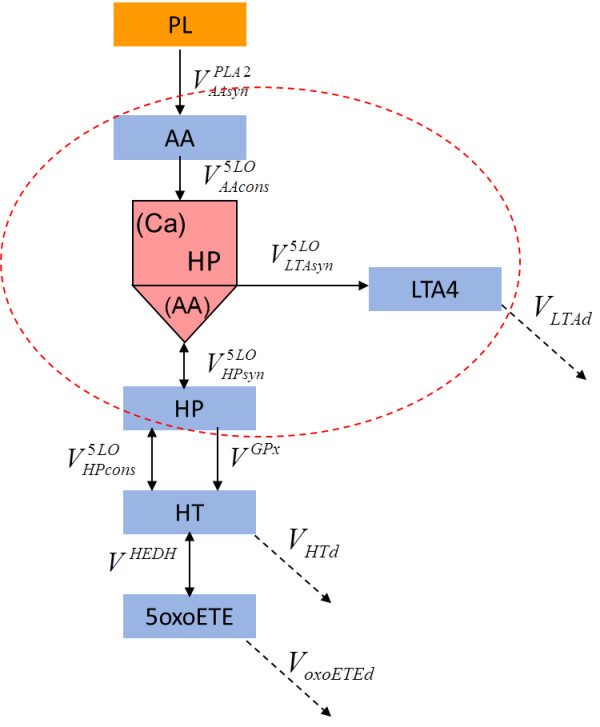
Figure 1
Figure 1
Schematic representation of Leukotriene and oxoETE synthesis model (“LOS model”). The reactions occurring with 5-LO are in the dashed red circle. Blue rectangular represents metabolites which are variables of “LOS model”. Pink colour indicates complex of 5-LO and HP. Dashed arrows stand for degradation processes.
Figure 2
Figure 2
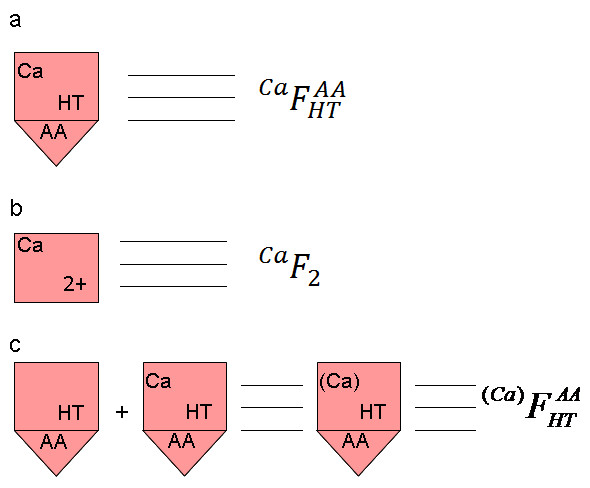
Examples of notations of 5-LO states. Notations in kinetic schemes are given at the left and in the text and equations are given at the right: a) ferric state of 5-LO with Ca2+ and HT bound to catalytic site of the enzyme; b) ferrous state with Ca2+ bound; c) sum of concentrations of ferric state with and without Ca2+ bound and with HT and AA bound.
Figure 3
Figure 3
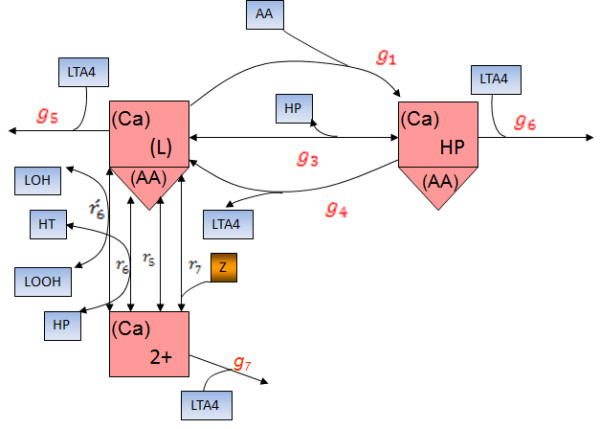
Reduced catalytic cycle of 5-LO. Blue rectangular represents metabolites which are variables of “LOS model”. Designation of enzyme states corresponds to Figure 2. Letters with indexes designate effective rate constants (see Additional file 1: Appendix 1).
Figure 4
Figure 4
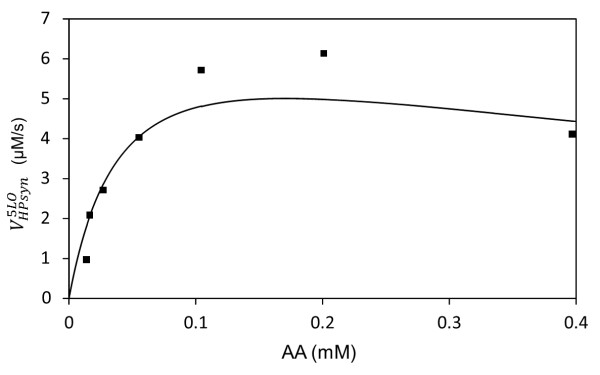
Dependence of rate of HP synthesis on AA concentration[24]. Experimental conditions: 0.2 mM ATP, 0.3 mM CaCl2. Dots correspond to experimental data; solid line is model generated curve.
Figure 5
Figure 5
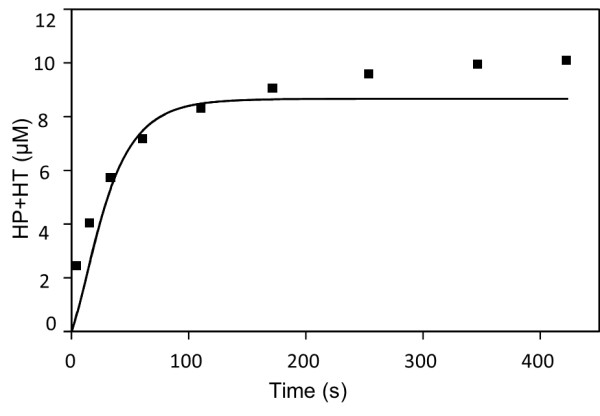
Time dependence of cumulative concentration of HP and HT. Experimental conditions: 20 μM of AA, 100 μM of Ca, 0.5 mg of 5-LO in the volume of 500 μL [25]. Dots correspond to experimental data; solid line is model generated curve.
Figure 6
Figure 6
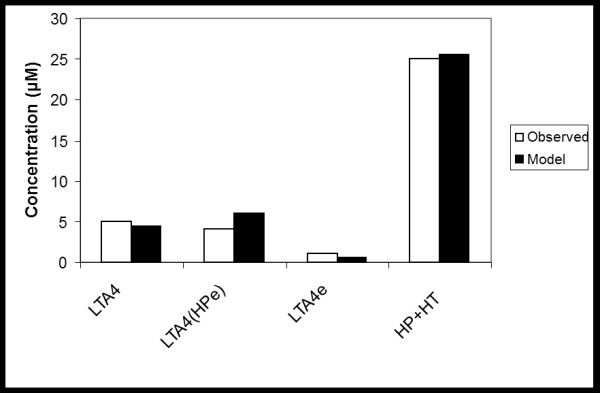
The effect of exogenous HP on the formation of deuterated LTA4 hydrolysis products. Human leukocyte homogenate supernatant was incubated with 100 μM octadeuterated arachidonic acid and 80 μM of the exogenous HP, from left to right: LTA4 in the absence of endogenous HP, deuterated LTA4 in presence of exogenous HP, LTA4 formed from exogenous HP, total amount of 5-LO products HP and HT in the absence of exogenous HP.
Figure 7
Figure 7
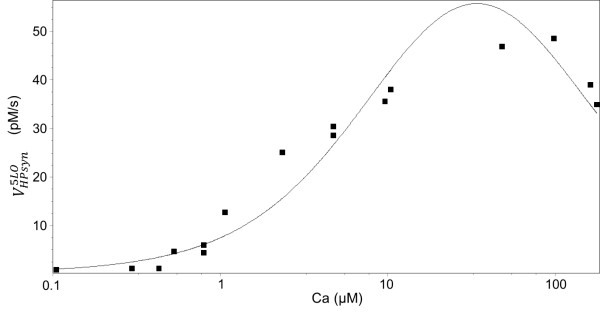
Dependence of the HP production on the Ca concentration. Experimental conditions: 20 μM of AA, 0.1 mM ATP. Dots correspond to experimental data from [38], line correspond to results of calculations.
Figure 8
Figure 8
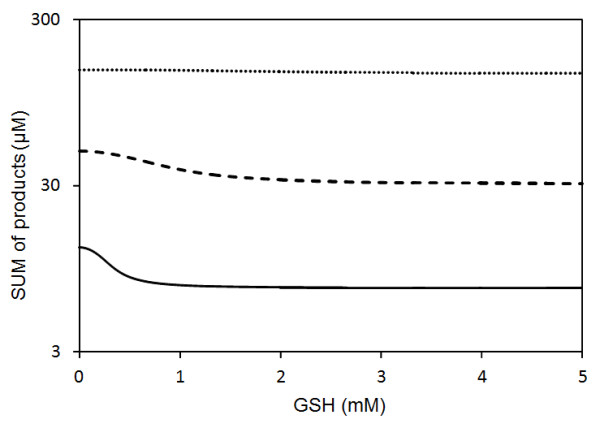
Simulation of influence of glutathione on production of 5-LO metabolites (sum of LTA4, HP and HT). Parameters of the LOS model used for simulation: pool of NADP 3 mM; NADPH 2 mM; Ca 1 mM; 5-LO 0.1 μM; HEDH5 0.1 μM; Values of parameter PL responsible for steady state AA level are 117 (solid), 120 (dash), 125 (dot).
Figure 9
Figure 9
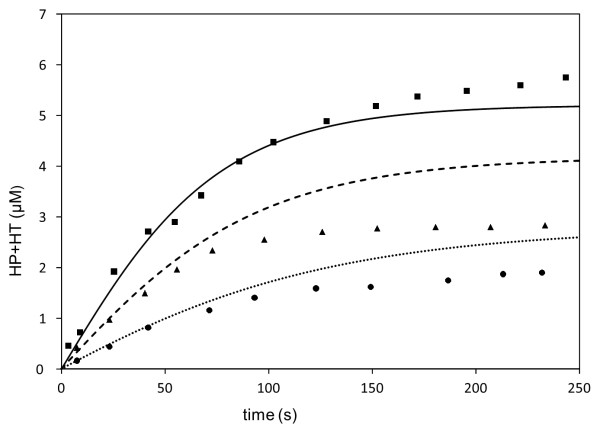
Dependence of sum of the concentrations of HP and HT on time in presence of zileuton. Experimental conditions: with no 5-LO inhibitor applied ((squares – data, solid line – model results), with 5 μM of Zileuton applied (triangles – data, dashed line – model results)) and with 20 μM of Zileuton applied (circles – data, dotted line – model results) [3]. Other concentrations: 20 μM of AA, 0.4 mM of Ca.
Figure 10
Figure 10
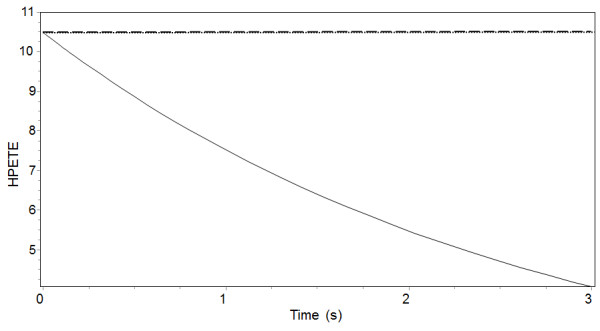
Quantitative simulation of experiment[18]with different inhibitors. Consumption of 10 μM HP by 5-LO system in presence of 10 μM PF (dotted line) or 10 μM Zileuton (solid line) or in the absence of inhibitors (dashed line, coinciding with dotted line). Concentrations: PL 40 μM, pool of glutathione 10 mM, GSH 5 mM. Other parameters are as in the legend to Figure 8.
Figure 11
Figure 11
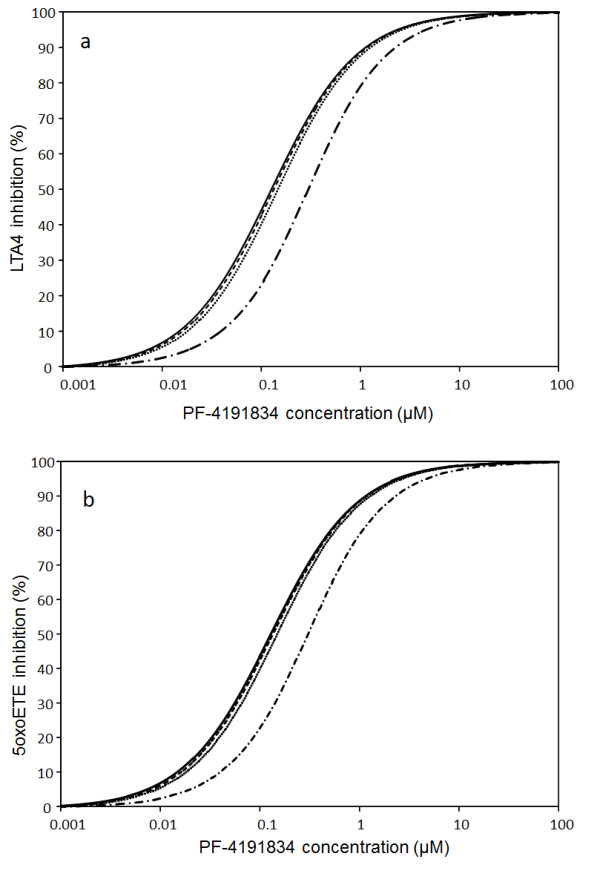
Simulation of influence of PF on LTA4 and oxoETE production. Concentrations of lipid peroxide (LOOH): 0 (solid), 5 μM (dash), 10 μM (dot), 100 μM (dash-dot). Other parameters are as in the legend to Figure 10.
Figure 12
Figure 12
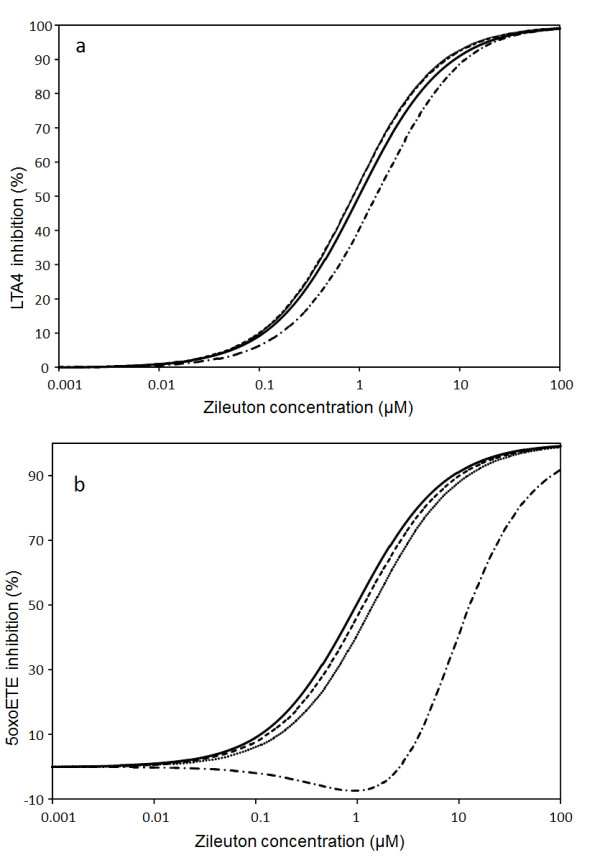
Simulation of influence of zileuton on LTA4 and oxoETE production. Concentrations of lipid peroxide (LOOH): 0 (solid), 5 μM (dash), 10 μM (dot), 100 μM (dash-dot). Other parameters are as in the legend to Figure 10.

References

    1. Hammarstrom S. Leukotrienes. Ann Rev Biochem. 1983;52:355–77. doi: 10.1146/annurev.bi.52.070183.002035. - DOI - PubMed
    1. Batt DG. 5-lipoxygenase inhibitors and their anti-inflammatory activities. Prog Med Chem. 1992;29:1–63. - PubMed
    1. Falgueyret J-P, Hutchinson JH, Riendau D. Criteria for the identification of non-redox inhibitors of 5-lipoxygenase. Biochem Pharmacol. 1993;45:978–981. doi: 10.1016/0006-2952(93)90185-Y. - DOI - PubMed
    1. Ford-Hutchinson AW, Gresser M, Young RN. 5-lipoxygenase. Ann Rev Biochem. 1994;63:383–417. doi: 10.1146/annurev.bi.63.070194.002123. - DOI - PubMed
    1. Werz O. 5-Lipoxygenase: cellular biology and molecular pharmacology. Curr Drug Targets Inflamm Allergy. 2002;1:23–44. doi: 10.2174/1568010023344959. - DOI - PubMed

MeSH terms

LinkOut - more resources