


Gene expression profiling to identify potentially relevant disease outcomes and support human health risk assessment for carbon black nanoparticle exposure
- PMID: 23146762
- PMCID: PMC7125805
- DOI: 10.1016/j.tox.2012.10.014
Gene expression profiling to identify potentially relevant disease outcomes and support human health risk assessment for carbon black nanoparticle exposure
Abstract
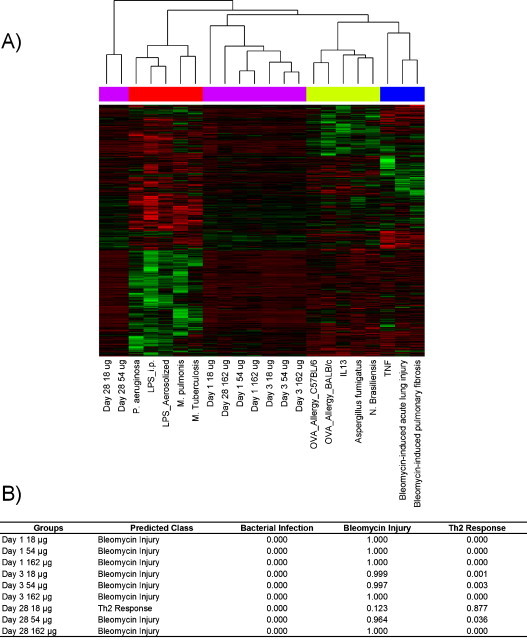
New approaches are urgently needed to evaluate potential hazards posed by exposure to nanomaterials. Gene expression profiling provides information on potential modes of action and human relevance, and tools have recently become available for pathway-based quantitative risk assessment. The objective of this study was to use toxicogenomics in the context of human health risk assessment. We explore the utility of toxicogenomics in risk assessment, using published gene expression data from C57BL/6 mice exposed to 18, 54 and 162 μg Printex 90 carbon black nanoparticles (CBNP). Analysis of CBNP-perturbed pathways, networks and transcription factors revealed concomitant changes in predicted phenotypes (e.g., pulmonary inflammation and genotoxicity), that correlated with dose and time. Benchmark doses (BMDs) for apical endpoints were comparable to minimum BMDs for relevant pathway-specific expression changes. Comparison to inflammatory lung disease models (i.e., allergic airway inflammation, bacterial infection and tissue injury and fibrosis) and human disease profiles revealed that induced gene expression changes in Printex 90 exposed mice were similar to those typical for pulmonary injury and fibrosis. Very similar fibrotic pathways were perturbed in CBNP-exposed mice and human fibrosis disease models. Our synthesis demonstrates how toxicogenomic profiles may be used in human health risk assessment of nanoparticles and constitutes an important step forward in the ultimate recognition of toxicogenomic endpoints in human health risk. As our knowledge of molecular pathways, dose-response characteristics and relevance to human disease continues to grow, we anticipate that toxicogenomics will become increasingly useful in assessing chemical toxicities and in human health risk assessment.
Crown Copyright © 2012. Published by Elsevier Ireland Ltd. All rights reserved.
Figures
References
-
- Auerbach S., Shah R., Mav D., Smith C., Walker N., Vallant M., Boorman G., Irwin R. Predicting the hepatocarcinogenic potential of alkenylbenzene flavoring agents using toxicogenomics and machine learning. Toxicol. Appl. Pharmacol. 2010;243:300–314. - PubMed
-
- Bellmann B., Creutzenberg H., Ernst H., Muhle H. Rat inhalation test with particles from biomass combustion and biomass co-firing exhaust. J. Phys.Conf. Ser. 2009:151.
-
- Bermudez E., Mangum J., Wong B., Bahman A., Hext P., Warheit D., Everitt J. Pulmonary responses of mice, rats, and hamsters to subchronic inhalation of ultrafine titanium dioxide particles. Toxicol. Sci. 2004;77:347–357. - PubMed
-
- Black M.B., Budinsky R.A., Dombkowski A., Cukovic D., LeCluyse E.L., Ferguson S.S., Thomas R.S., Rowlands J.C. Cross-species comparisons of transcriptomic alterations in human and rat primary hepatocytes exposed to 2,3,7,8-tetrachlorodibenzo-p-dioxin. Toxicol. Sci. 2012;127:199–215. - PubMed
Publication types
MeSH terms
Substances
LinkOut - more resources
Full Text Sources
Other Literature Sources
Molecular Biology Databases
Research Materials
