Review
. 2013 Jul-Aug;4(4):207-11.
doi: 10.4161/bioe.22856. Epub 2012 Nov 12.

Production of biopharmaceutical proteins by yeast: advances through metabolic engineering

Affiliations
Review

Production of biopharmaceutical proteins by yeast: advances through metabolic engineering

Jens Nielsen. Bioengineered. 2013 Jul-Aug.

Abstract

Production of recombinant proteins for use as pharmaceuticals, so-called biopharmaceuticals, is a multi-billion dollar industry. Many different cell factories are used for the production of biopharmaceuticals, but the yeast Saccharomyces cerevisiae is an important cell factory as it is used for production of several large volume products. Insulin and insulin analogs are by far the dominating biopharmaceuticals produced by yeast, and this will increase as the global insulin market is expected to grow from USD12B in 2011 to more than USD32B by 2018. Other important biopharmaceuticals produced by yeast are human serum albumin, hepatitis vaccines and virus like particles used for vaccination against human papillomavirus. Here is given a brief overview of biopharmaceutical production by yeast and it is discussed how the secretory pathway can be engineered to ensure more efficient protein production. The involvement of directed metabolic engineering through the integration of tools from genetic engineering, systems biology and mathematical modeling, is also discussed.

Keywords: Saccharomyces cerevisiae; industrial biotechnology; insulin; secretory pathway; systems biology.


Figures
None
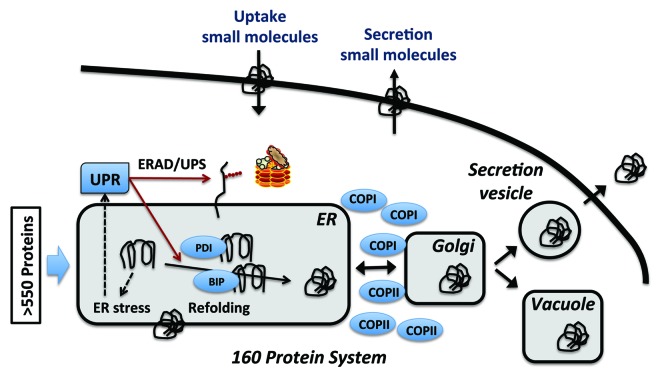
Figure 1. Schematic overview of the secretory pathway in yeast. Proteins targeted for secretion enter the endoplasmic reticulum (ER). If they fold correctly they can enter the secretory pathway, whereas misfolded protein cause ER stress leading to the activation of the unfolded protein response (UPR) that results in activation of a very large number of cellular processes, including activation of chaperones and foldases (like BIP and PDI) that assist with refolding. UPR is also upregulating ER-associated degradation (ERAD) where the unfolded proteins are exported from the ER, ubiquitinated and hereby targeted for degradation by the proteasome (ubiquitin-proteasome system, UPS). Correctly folded proteins can be exported to the Golgi for further processing (including additional glycosylation). The COPI- and COPII-complexes facilitate the ER-Golgi transfer, and from the Golgi the protein may be secreted via the endosome or be targeted to the vacuole for storage and/or degradation. Different colors represent different types of vesicular compartments of the secretory pathway.
None
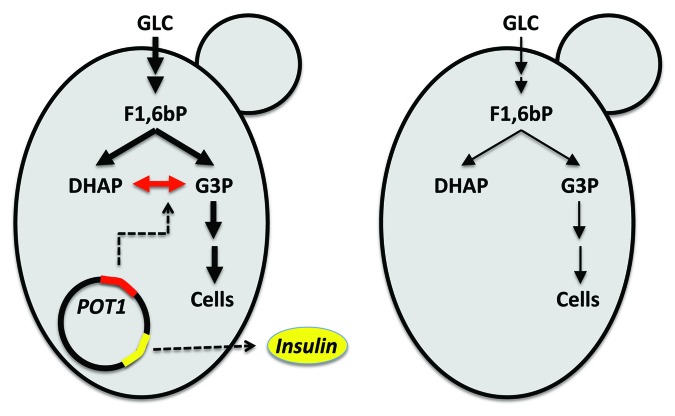
Figure 2. Illustration of the stable expression system with a glycolytic gene as the selection marker. One of the glycolytic enzymes is used as a marker for plasmid presence: the endogenous gene encoding triosephosphate isomerase (TPI1) is deleted and the corresponding gene (POT1) from Schizosaccharomyces pombe is expressed from a plasmid. The same plasmid carries the gene for the heterologous gene to be expressed (here demonstrated with a gene encoding human insulin). If the plasmid is lost the cells lack a key glycolytic enzyme and the glycolytic flux is therefore reduced dramatically resulting in impaired growth. Cells that are replicating the plasmid in high copy numbers and expressing the genes from the plasmid therefore have an inherent growth advantage.
None
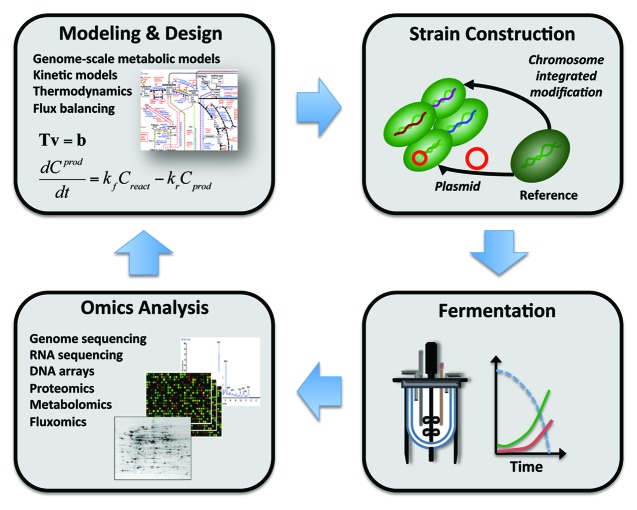
Figure 3. Schematic overview of the metabolic engineering cycle where systems biology tools are implemented for design of improved cell factories. Through advanced modeling novel targets for genetic engineering can be identified, e.g., to ensure improved protein secretion. These targets are evaluated by characterizing the strains in bioreactors where rates of biomass growth, sugar consumption, and product formation are quantified. Fermentation analysis may be combined with high-throughput analyses, or omics analyses, where the transcriptome, proteome, metabolome and fluxome are measured. Omics analyses may provide new insights into the cellular metabolism and physiology, and this may be used to improve the models, that can hence be used for further design. The metabolic engineering cycle is very similar to the workflow of many systems biology studies where perturbation of the cellular system is performed using genetic engineering, e.g., by overexpression or deletion of specific genes, followed by detailed analysis that can be used to define a mathematical model for the biological system.

References

    1. Cohen SN, Chang ACY, Boyer HW, Helling RB. Construction of biologically functional bacterial plasmids in vitro. Proc Natl Acad Sci U S A. 1973;70:3240–4. doi: 10.1073/pnas.70.11.3240. - DOI - PMC - PubMed
    1. Walsh G. Biopharmaceutical benchmarks. Nat Biotechnol. 2000;18:831–3. doi: 10.1038/78720. - DOI - PubMed
    1. Walsh G. Biopharmaceuticals: Biochemistry and Biotechnology. 1998. J. Wiley & Sons, Ltd., Chichester, UK.
    1. Chang CN, Rey M, Bochner B, Heyneker H, Gray G. High-level secretion of human growth hormone by Escherichia coli. Gene. 1987;55:189–96. doi: 10.1016/0378-1119(87)90279-4. - DOI - PubMed
    1. Langer ES. Biomanufacturing outsourcing outlook. BioPharm International. 2012;25:15–6.

Publication types

MeSH terms

Substances