


Differences in risk factors for voluntary early retirement and disability pension: a 15-year follow-up in a cohort of nurses' aides
- PMID: 23148337
- PMCID: PMC3533112
- DOI: 10.1136/bmjopen-2012-000991
Differences in risk factors for voluntary early retirement and disability pension: a 15-year follow-up in a cohort of nurses' aides
Abstract
Objective: To estimate the extent of early retirement and to examine risk factors for voluntary early retirement and disability pension in a cohort of nurses' aides.
Design: Register study including baseline questionnaire and register data covering all transfer incomes from 1991 to 2008 in a cohort of nurses' aides established in 1993 with a follow-up period of 15 years.
Setting: Nurses' aides working in nursery homes, homecare or hospitals.
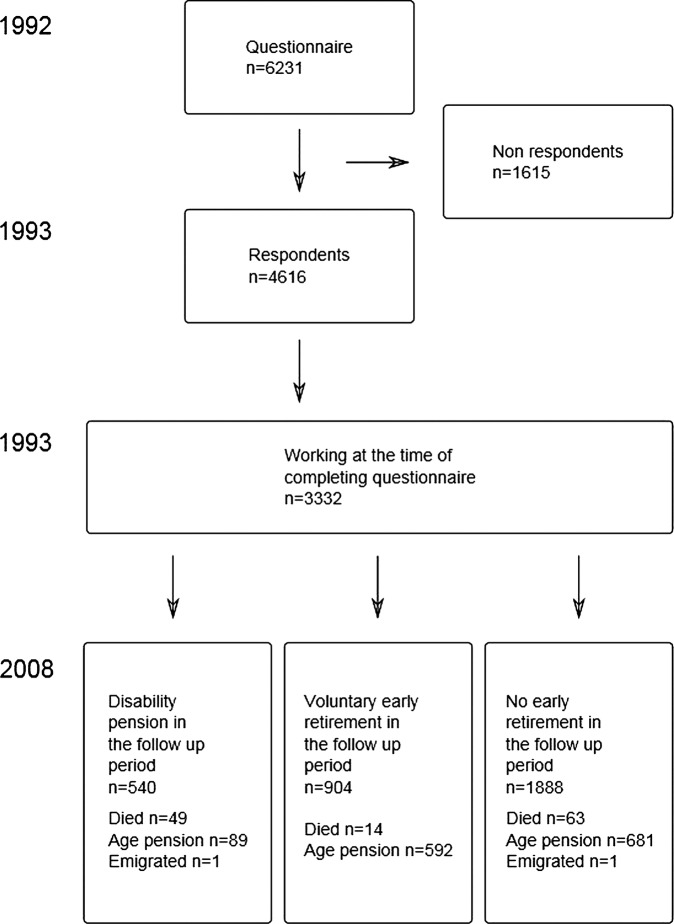
Participants: 3332 gainfully employed nurses' aides at the time of inclusion in the study.
Outcome: Disability pension or early voluntary retirement.
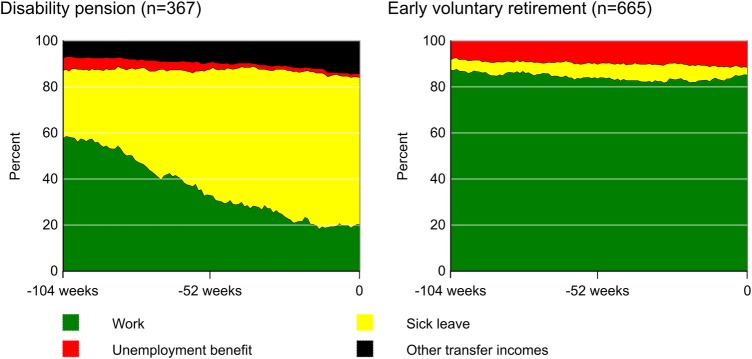
Results: 16.2% of the population was granted disability pension and 27.1% entered early voluntary retirement in the follow-up period representing 11 186 lost working years with a direct cost in transfer payment amounting about €410 million. Health-related risk factors for disability pension was long-lasting low-back pain (HR 2.27(95% CI 1.55 to 3.34), sick leave because of upper-extremity disorders (HR 2.18 (95% CI 1.08 to 2.11), and inflammatory rheumatic disease (HR 2.42 (95% CI 1.67 to 3.52)). Of non-health-related factors, low education, workers compensation case, evening work and high-rated perceived exertion at work all were minor risk factors for disability pension. The primary risk factor for early voluntary retirement was low education (HR 3.19 (95% CI 2.65 to 3.85)).
Conclusions: 43.3% of nurses' aides gainfully employed in 1993 retired before due time during the follow-up period. Work-related factors at baseline only seemed to have a minor prognostic role. Risk factors for disability pension were mainly health-related factors, whereas economical factors seemed to influence the decision to choose early voluntary retirement. The number of persons and the amount of lost working years underscores the need of a more active counselling towards maintaining employment especially among those with persistent musculoskeletal disorders.
Figures

References
-
- Fallentin N, Faber A, Sharipova M. Fysiske belastninger i plejearbejdet. Resultater fra en spørgeskemaundersøgelse i den kommunale ældrepleje. Copenhagen: Det nationale forskningscenter for arbejdsmiljø; 2007:1–26, NFA-Rapport SOSU-Rapport 14
-
- Jensen LD, Andersen JH, Ryom P. Kroniske lænderygsmerter hos sygehjælpere—en undersøgelse af forekomst og risikofaktorer. Copenhagen: Arbejdsmiljøfondet, 1995:3–90
-
- Lagerstrom M, Hansson T, Hagberg M. Work-related low-back problems in nursing. Scand J Work Environ Health 1998;24:449–64 - PubMed
-
- Ngan K, Drebit S, Siow S, et al. Risks and causes of musculoskeletal injuries among health care workers. Occup Med (Lond) 2010;60:389–94 - PubMed
LinkOut - more resources
Full Text Sources
