. 2012 Nov 13:12:259.
doi: 10.1186/1471-2180-12-259.

A method for high throughput determination of viable bacteria cell counts in 96-well plates

Affiliations

A method for high throughput determination of viable bacteria cell counts in 96-well plates

Ronen Hazan et al. BMC Microbiol. .

Abstract

Background: There are several methods for quantitating bacterial cells, each with advantages and disadvantages. The most common method is bacterial plating, which has the advantage of allowing live cell assessment through colony forming unit (CFU) counts but is not well suited for high throughput screening (HTS). On the other hand, spectrophotometry is adaptable to HTS applications but does not differentiate between dead and living bacteria and has low sensitivity.

Results: Here, we report a bacterial cell counting method termed Start Growth Time (SGT) that allows rapid and serial quantification of the absolute or relative number of live cells in a bacterial culture in a high throughput manner. We combined the methodology of quantitative polymerase chain reaction (qPCR) calculations with a previously described qualitative method of bacterial growth determination to develop an improved quantitative method. We show that SGT detects only live bacteria and is sensitive enough to differentiate between 40 and 400 cells/mL. SGT is based on the re-growth time required by a growing cell culture to reach a threshold, and the notion that this time is proportional to the number of cells in the initial inoculum. We show several applications of SGT, including assessment of antibiotic effects on cell viability and determination of an antibiotic tolerant subpopulation fraction within a cell population. SGT results do not differ significantly from results obtained by CFU counts.

Conclusion: SGT is a relatively quick, highly sensitive, reproducible and non-laborious method that can be used in HTS settings to longitudinally assess live cells in bacterial cell cultures.


Figures
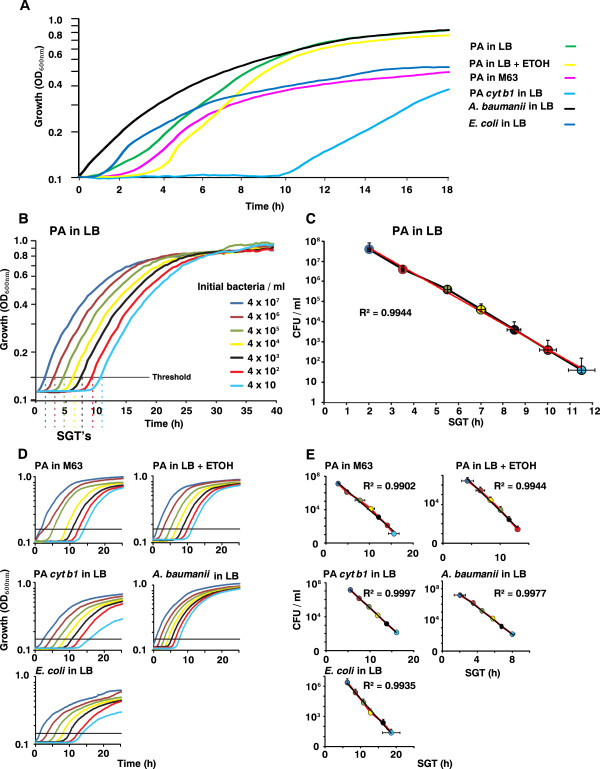
Figure 1
Figure 1
SGT values are proportional to the initial inoculum. The linearity of SGT method was assessed in various strains and conditions. (A) Growth curves of the wild-type P. aeruginosa strain PA14 (PA) grown in LB (Green), LB + 3% Ethanol (Yellow) and in the defined medium M63 (Pink); PA14 isogenic mutant derivative cyt b1 (light blue); and wild-type strains A. baumanii (black) and E. coli DH5α (dark blue). (B) The time when the growth curves crossed the threshold (OD600nm = 0.15 - 0.2) is defined as the SGT. P. aeruginosa PA14 cells were grown to OD600nm = 2.0, when the concentration of cells was 4.07 x 10⁹ ± 7.02 x 10⁸ cells/mL according to CFU counts. The cells were diluted serially 1:10 in a 96-well plate reader to ODs below the detection threshold of the spectrophotometer, after which their growth kinetics was recorded and also determined at 18 h by CFU counts. Each growth curve is the average of at least 3 repeats. (C) Plots of SGT values versus bacterial concentrations detected by CFU count reveal linear correlation in all cases (R2 >0.99). Colors of the circles correspond to inoculum concentrations. The linear regression curve is shown in red. (D - E) Growth curves and plots of SGT values versus bacterial concentrations detected by CFU count for the additional conditions and strains.
Figure 2
Figure 2
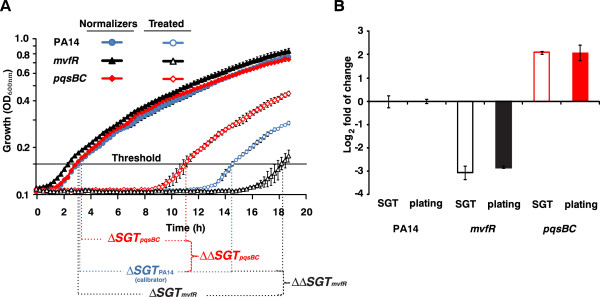
Example of SGT method use: assessment of the relative bactericidal activity of meropenem on various P. aeruginosa isogenic mutants. (A) Wild-type PA14 (blue) and its isogenic mutant derivatives mvfR (black) and pqsBC (red) were grown to mid-logarithmic phase before being subjected to a 24 h treatment with meropenem (10 mg/L) at 37°C (no meropenem added to normalizers). Following 1:500 dilution, the growth kinetics of normalizers and treated samples were recorded. Employing an OD600nm = 0.15, ∆SGT values were calculated as the difference between treated and normalizer SGTs. ∆∆SGT values were calculated as the difference of between ∆SGTs of the mutants to that of wild-type PA14, which served as the calibrator. (B) For the SGT method, log2 fold of change was calculated as -∆∆SGT (empty bars). For CFU counting, normalizers and treated cells were serially diluted and plated. For comparison purposes, CFU count results are also presented as log2 fold of change (filled bars). The differences between the values obtained by the two methods did not differ significantly (p > 0.1).
Figure 3
Figure 3
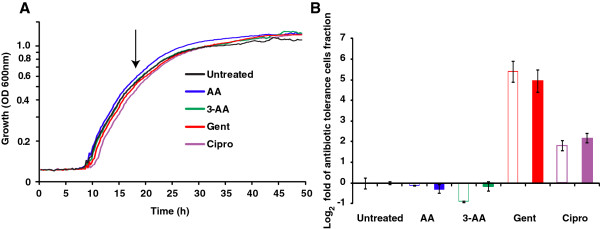
Example of SGT method use: assessment of the relative efficacy of compounds on the size of the persister cell fraction using the SGT method. (A) PA14 cells were grown to the mid-logarithmic stage (arrow) in the absence or presence of AA (0.75 mM), 3-AA (0.75 mM), gentamicin (Gent, 1.5 mg/L) and ciprofloxacin (Cipro, 0.04 mg/L). Meropenem was applied as in Figure 2. (B) A comparison of survival fraction sizes obtained by SGT (empty bars) and CFU counting (filled bars) methods, presented as log2 fold change. SGT values were determined using a threshold OD600nm = 0.15. ∆SGT values were calculated as the difference between the SGT values of meropenem treated and untreated cultures and ∆∆SGT values as the difference between compound-treated cultures and the untreated calibrator. The SGT and CFU count data were not significantly different (p > 0.05).

References

    1. Miller JH. In: Experiments in Molecular Genetics. Miller JH, editor. New York: Cold Spring Harbor; 1972. Determination of viable cell counts: bacterial growth curves; pp. 31–36.
    1. Bapat P, Nandy SK, Wangikar P, Venkatesh KV. Quantification of metabolically active biomass using Methylene Blue dye Reduction Test (MBRT): measurement of CFU in about 200 s. J Microbiol Methods. 2006;65:107–116. doi: 10.1016/j.mimet.2005.06.010. - DOI - PubMed
    1. Jepras RI, Paul FE, Pearson SC, Wilkinson MJ. Rapid assessment of antibiotic effects on Escherichia coli by bis-(1,3-dibutylbarbituric acid) trimethine oxonol and flow cytometry. Antimicrob Agents Chemother. 1997;41:2001–2005. - PMC - PubMed
    1. Allison KR, Brynildsen MP, Collins JJ. Metabolite-enabled eradication of bacterial persisters by aminoglycosides. Nature. 2011;473:216–220. doi: 10.1038/nature10069. - DOI - PMC - PubMed
    1. Lewis K. Persister cells, dormancy and infectious disease. Nat Rev Microbiol. 2007;5:48–56. doi: 10.1038/nrmicro1557. - DOI - PubMed

Publication types

MeSH terms

LinkOut - more resources