


Systemic inflammation associated with mechanical ventilation among extremely preterm infants
- PMID: 23148992
- PMCID: PMC3518391
- DOI: 10.1016/j.cyto.2012.10.014
Systemic inflammation associated with mechanical ventilation among extremely preterm infants
Abstract
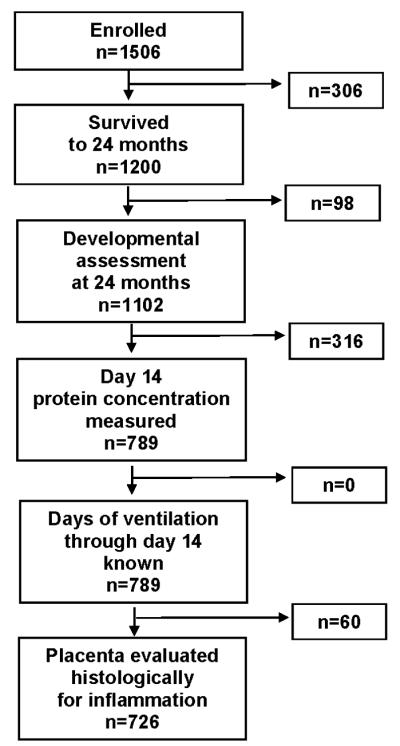
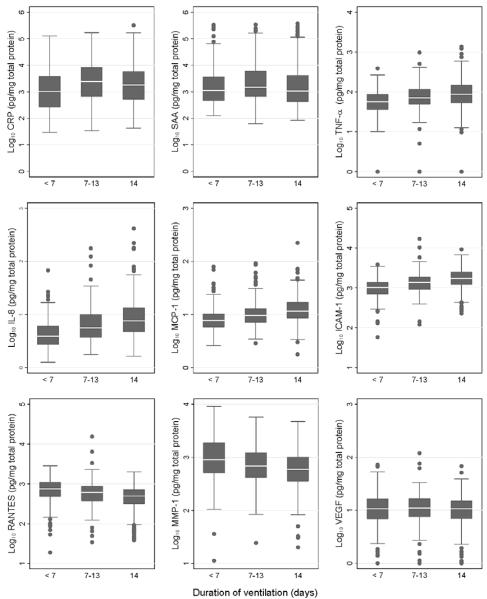
Little evidence is available to document that mechanical ventilation is an antecedent of systemic inflammation in preterm humans. We obtained blood on postnatal day 14 from 726 infants born before the 28th week of gestation and measured the concentrations of 25 inflammation-related proteins. We created multivariable models to assess the relationship between duration of ventilation and protein concentrations in the top quartile. Compared to newborns ventilated for fewer than 7 days (N=247), those ventilated for 14 days (N=330) were more likely to have elevated blood concentrations of pro-inflammatory cytokines (IL-1β, TNF-α), chemokines (IL-8, MCP-1), an adhesion molecule (ICAM-1), and a matrix metalloprotease (MMP-9), and less likely to have elevated blood concentrations of two chemokines (RANTES, MIP-1β), a matrix metalloproteinase (MMP-1), and a growth factor (VEGF). Newborns ventilated for 7-13 days (N=149) had systemic inflammation that approximated the pattern of newborns ventilated for 14 days. These relationships were not confounded by chorioamnionitis or antenatal corticosteroid exposure, and were not altered appreciably among infants with and without bacteremia. These findings suggest that 2 weeks of ventilation are more likely than shorter durations of ventilation to be accompanied by high blood concentrations of pro-inflammatory proteins indicative of systemic inflammation, and by low concentrations of proteins that might protect from inflammation-mediated organ injury.
Copyright © 2012 Elsevier Ltd. All rights reserved.
Figures
References
-
- Bose C, Laughon M, Allred EN, Van Marter LJ, O’Shea TM, Ehrenkranz RA, Fichorova RN, Leviton A, Investigators ftES Blood protein concentrations in the first two postnatal weeks that predict bronchopulmonary dysplasia among infants born before the 28th week of gestation. Pediatr Research. l2011;69:347–353. - PMC - PubMed
-
- Leviton A, Kuban K, O’Shea TM, Paneth N, Fichorova R, Allred EN, Dammann O. The Relationship between Early Concentrations of 25 Blood Proteins and Cerebral White Matter Injury in Preterm Newborns: The ELGAN Study. J Pediatr. l2011;158:897–903. - PubMed
-
- Leviton A, Kuban K, Allred EN, Fichorova R, O’Shea TM, Paneth N. Elevated concentrations of circulating indicators of inflammation in infants born before the 28th post-menstrual week predict a small head circumference two years later. Early Hum Dev. l2011;87:325–330. - PubMed
-
- O’Shea TM, Allred EN, Kuban K, Dammann O, Paneth N, Fichorova R, Hirtz D, Leviton A, Investigators FtES Elevated concentrations of inflammation-related proteins in postnatal blood predict severe developmental delay at two years in extremely premature infants. J Pediatr. l2012;160:395–401.e4. - PMC - PubMed
Publication types
MeSH terms
Substances
Grants and funding
LinkOut - more resources
Full Text Sources
Other Literature Sources
Medical
Miscellaneous
