


Effect of more frequent hemodialysis on cognitive function in the frequent hemodialysis network trials
- PMID: 23149295
- PMCID: PMC3546160
- DOI: 10.1053/j.ajkd.2012.09.009
Effect of more frequent hemodialysis on cognitive function in the frequent hemodialysis network trials
Abstract
Background: Cognitive impairment is common in patients with end-stage renal disease receiving hemodialysis 3 times per week.
Study design: Randomized clinical trial.
Setting & participants: 218 individuals participating in the Frequent Hemodialysis Network (FHN) Daily Trial and 81 participating in the FHN Nocturnal Trial.
Intervention: The Daily Trial tested in-center hemodialysis 6 times per week versus 3 times per week. The Nocturnal Trial tested home nocturnal hemodialysis 6 times per week versus home or in-center hemodialysis 3 times per week.
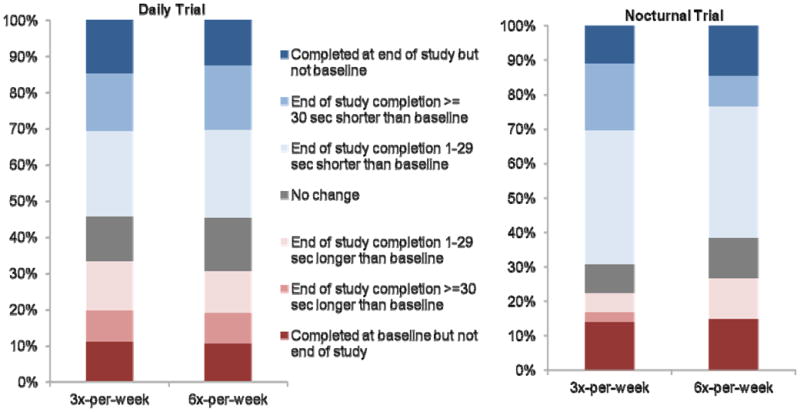
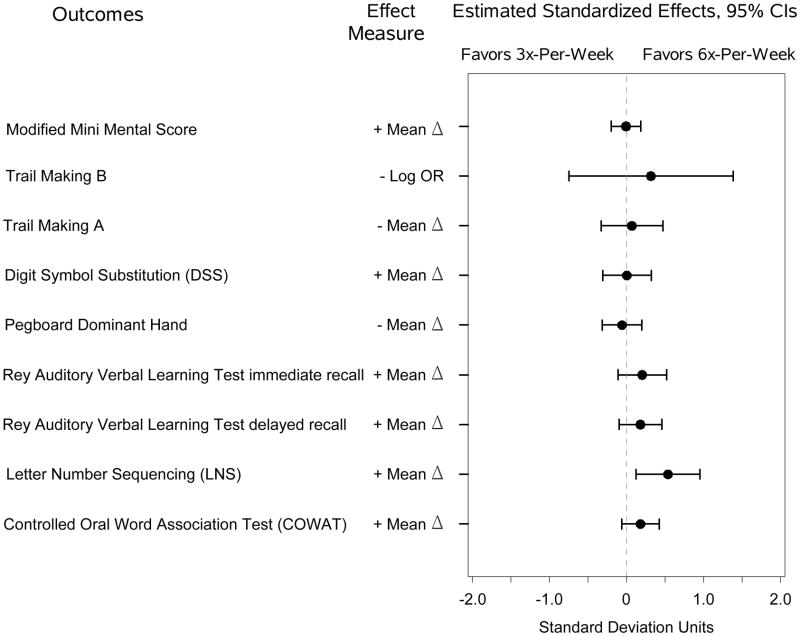
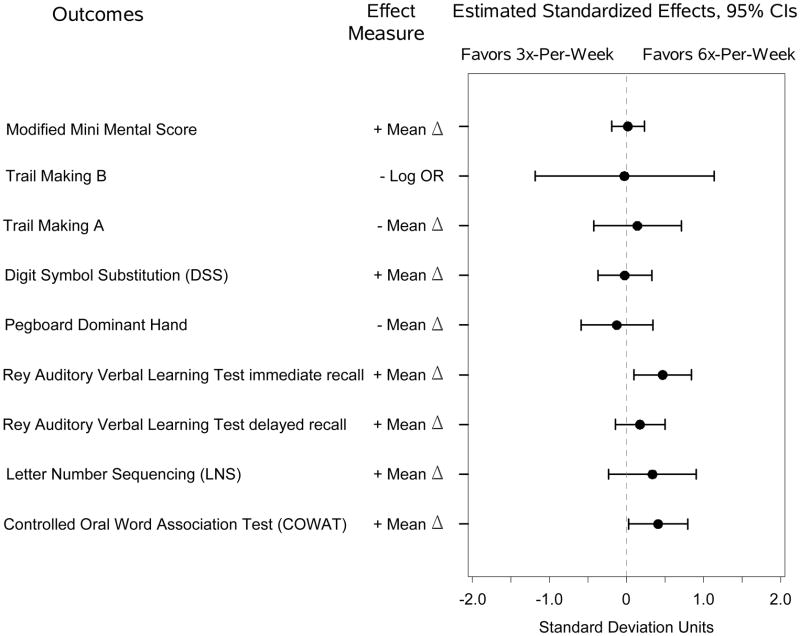
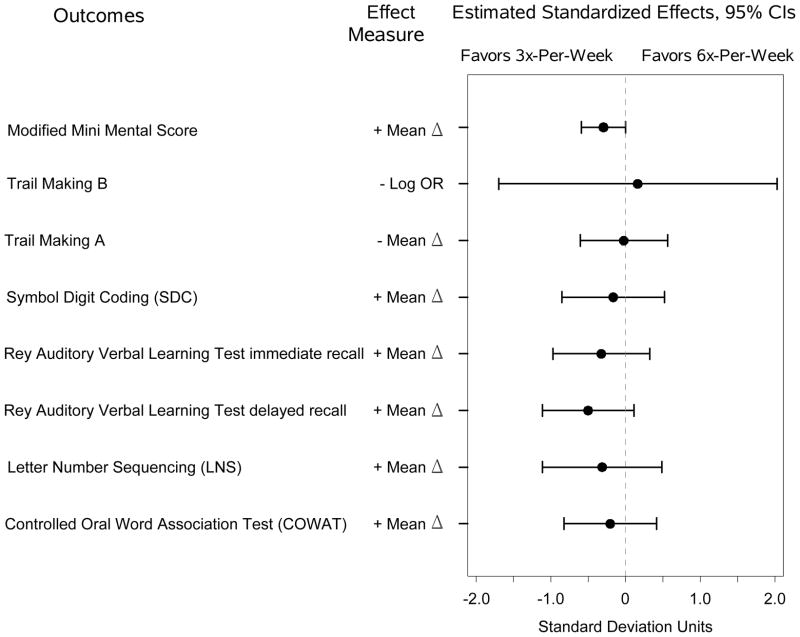
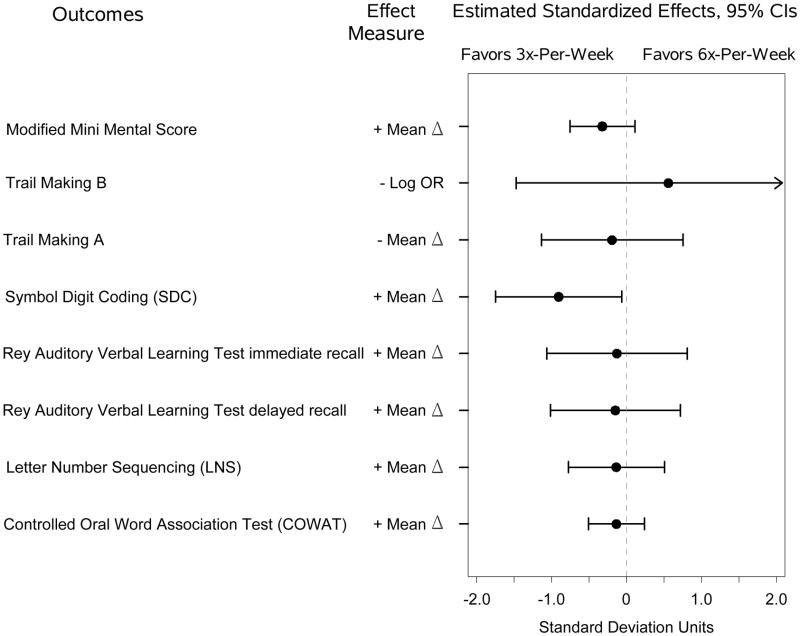
Outcomes: Cognitive function was measured at baseline, month 4, and month 12. The primary outcome was performance on the Trail-Making Test, Form B, a measure of executive function, and a secondary outcome was performance on the Modified Mini-Mental State Examination, a measure of global cognition. The domains of attention, psychomotor speed, memory, and verbal fluency were assessed in 59 participants in the Daily Trial and 19 participants in the Nocturnal Trial.
Results: We found no benefit of frequent hemodialysis in either trial for the primary cognitive outcome (Daily Trial: OR for improvement, 0.99; 95% CI, 0.59-1.66; Nocturnal Trial: OR, 1.19; 95% CI, 0.48-2.96). Similarly, there was no benefit of frequent hemodialysis in either trial on global cognition, the secondary cognitive outcome. Exploratory analyses in the Daily Trial suggested possible benefits of frequent hemodialysis for memory and verbal fluency, but not for attention and psychomotor speed. Exploratory analyses in the Nocturnal Trial suggested no benefit of frequent hemodialysis on attention, psychomotor speed, memory, or verbal fluency.
Limitations: Unblinded intervention, small sample.
Conclusions: Frequent hemodialysis did not improve executive function or global cognition.
Trial registration: ClinicalTrials.gov NCT00264758 NCT00271999.
Published by Elsevier Inc.
Figures
Comment in
-
Cognitive impairment in dialysis patients: focus on the blood vessels?Am J Kidney Dis. 2013 Feb;61(2):187-90. doi: 10.1053/j.ajkd.2012.12.002. Am J Kidney Dis. 2013. PMID: 23318010 Free PMC article. No abstract available.
References
-
- Teschan PE. Electroencephalographic and other neurophysiological abnormalities in uremia. Kidney Int Suppl. 1975;(2):210–216. - PubMed
-
- Teschan PE, Bourne JR, Reed RB, Ward JW. Electrophysiological and neurobehavioral responses to therapy: the National Cooperative Dialysis Study. Kidney Int Suppl. 1983;(13):S58–65. - PubMed
-
- Sehgal AR, Grey SF, DeOreo PB, Whitehouse PJ. Prevalence, recognition, and implications of mental impairment among hemodialysis patients. Am J Kidney Dis. 1997;30(1):41–49. - PubMed
-
- Murray AM, Tupper DE, Knopman DS, et al. Cognitive impairment in hemodialysis patients is common. Neurology. 2006 Jul 25;67(2):216–223. - PubMed
-
- Williams MA, Sklar AH, Burright RG, Donovick PJ. Temporal effects of dialysis on cognitive functioning in patients with ESRD. Am J Kidney Dis. 2004 Apr;43(4):705–711. - PubMed
Publication types
MeSH terms
Associated data
Grants and funding
LinkOut - more resources
Full Text Sources
Other Literature Sources
Medical
