Review
. 2013:61:289-317.
doi: 10.1007/978-94-007-4525-4_13.

The role of DNA methylation and histone modifications in transcriptional regulation in humans

Affiliations
Review

The role of DNA methylation and histone modifications in transcriptional regulation in humans

Jaime L Miller et al. Subcell Biochem. 2013.

Abstract

Although the field of genetics has grown by leaps and bounds within the last decade due to the completion and availability of the human genome sequence, transcriptional regulation still cannot be explained solely by an individual's DNA sequence. Complex coordination and communication between a plethora of well-conserved chromatin modifying factors are essential for all organisms. Regulation of gene expression depends on histone post translational modifications (HPTMs), DNA methylation, histone variants, remodeling enzymes, and effector proteins that influence the structure and function of chromatin, which affects a broad spectrum of cellular processes such as DNA repair, DNA replication, growth, and proliferation. If mutated or deleted, many of these factors can result in human disease at the level of transcriptional regulation. The common goal of recent studies is to understand disease states at the stage of altered gene expression. Utilizing information gained from new high-throughput techniques and analyses will aid biomedical research in the development of treatments that work at one of the most basic levels of gene expression, chromatin. This chapter will discuss the effects of and mechanism by which histone modifications and DNA methylation affect transcriptional regulation.


Figures
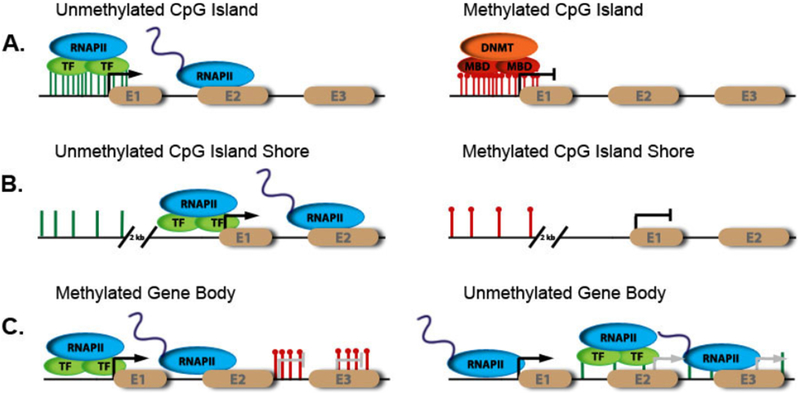
Figure 1.1
Figure 1.1
Various sites and effects of DNA methylation throughout the genome DNA methylation is found at inter- and intragenic regions throughout the genome. DNA methylation dependent transcriptional activity is contingent on CpG dinucleotide genic location and density. Normal methylation events and subsequent effects are shown on the left. (a) CpG islands at promoters are normally unmethylated resulting in gene expression. However, aberrant hypermethylation at the same promoter results in corepressor complex recruitment and subsequent gene repression. (b) Intragenic regions characterized by scattered CpG dinucleotides located 2kb upstream of the promoter called CpG island shores are regulated in the same manner as (a). (c) DNA methylation within the gene body prevents initiation of transcription from spurious sites in the gene. If unmethylated, these sites become transcriptional start sites resulting in an incorrect product. (Portela and Estellar 2010)
Figure 1.2
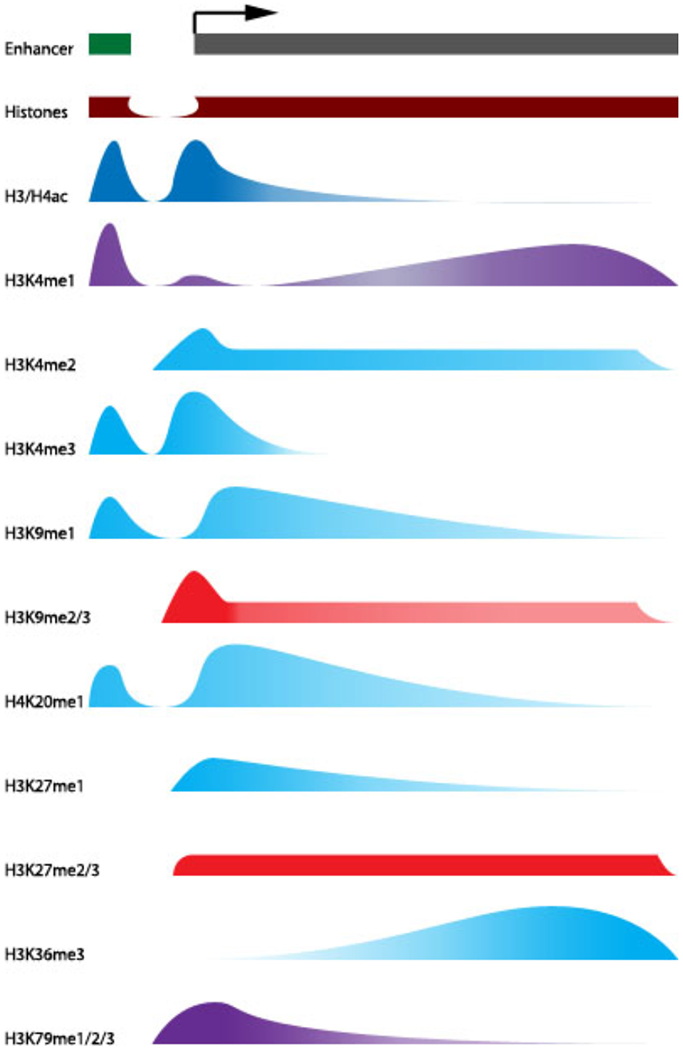
Figure 1.2
Localization of histone modifications across genes as it relates to transcriptional regulation Patterns of histone modification enrichment are shown across an arbitrary enhancer and gene. The enhancer is shown as the smaller region succeeded by a gap denoting a nucleosome-free region and transcriptional start site as shown by the arrow. Data used to compile the profiles are from GWAS on histone modifications. The correlative effects of the modifications on gene expression are indicated by the labels: (+) expression, (−) repression, and (+/−) studies show enrichment in both expression and repressed genes. (Wang et al. 2008; Barski et al. 2007; Li et al. 2007)
Figure 1.3
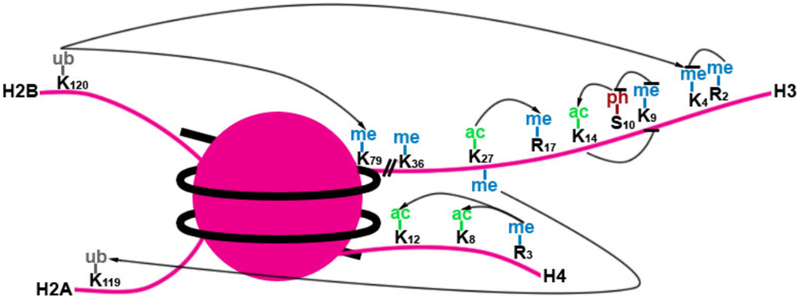
Figure 1.3
Histone modification crosstalk Various post-translational histone modifications affect the binding of certain domains and catalysis of other HPTMs. Arrows indicate a positive effect and bars indicate inhibitory effects on other HPTMs. (Bannister and Kouzarides 2011)

References

    1. Agger K, Cloos PA, Christensen J, Pasini D, Rose S, Rappsilber J, et al. (2007). UTX and JMJD3 are histone H3K27 demethylases involved in HOX gene regulation and development. Nature, 449(7163), 731–734. - PubMed
    1. Allis CD, Bowen JK, Abraham GN, Glover CV, & Gorovsky MA (1980). Proteolytic processing of histone H3 in chromatin: A physiologically regulated event in tetrahymena micronuclei. Cell, 20(1), 55–64. - PubMed
    1. Antequera F, & Bird A (1993). Number of CpG islands and genes in human and mouse. Proceedings of the National Academy of Sciences of the United States of America, 90(24), 11995–11999. - PMC - PubMed
    1. Baker SP, Phillips J, Anderson S, Qiu Q, Shabanowitz J, Smith MM, et al. (2010). Histone H3 thr 45 phosphorylation is a replication-associated post-translational modification in S. cerevisiae. Nature Cell Biology, 12(3), 294–298. - PMC - PubMed
    1. Bannister AJ, & Kouzarides T (2011). Regulation of chromatin by histone modifications. Cell Research, 21(3), 381–395. - PMC - PubMed

LinkOut - more resources