. 2012 Dec 11;109(50):20200-3.
doi: 10.1073/pnas.1215482109. Epub 2012 Nov 13.

McClintock's challenge in the 21st century

Affiliations

McClintock's challenge in the 21st century

Nina V Fedoroff. Proc Natl Acad Sci U S A. .

Abstract

In 1950, Barbara McClintock published a Classic PNAS article, "The origin and behavior of mutable loci in maize," which summarized the evidence leading to her discovery of transposition. The article described a number of genome alterations revealed through her studies of the Dissociation locus, the first mobile genetic element she identified. McClintock described the suite of nuclear events, including transposon activation and various chromosome aberrations and rearrangements, that unfolded in the wake of genetic crosses that brought together two broken chromosomes 9. McClintock left future generations with the challenge of understanding how genomes respond to genetic and environmental stresses by mounting adaptive responses that frequently include genome restructuring.


Conflict of interest statement

The author declares no conflict of interest.

Figures
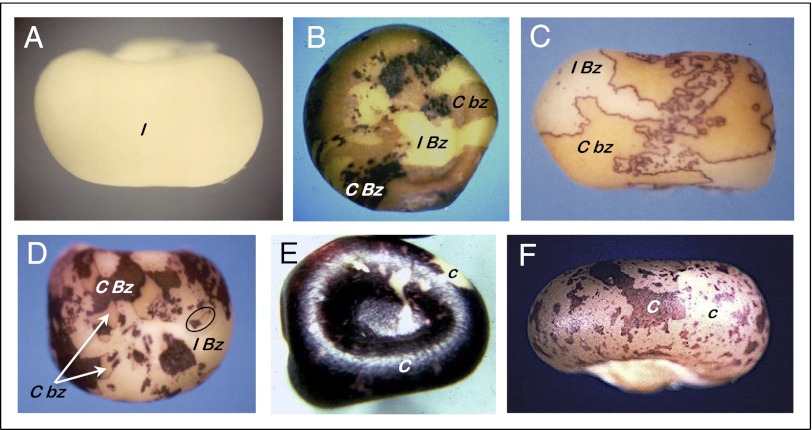
Fig. 1.
Fig. 1.
Phenotypes of kernels that led to McClintock’s discovery of chromosome breakage at Ds. I: dominant inhibitory allele of the C gene; C: full anthocyanin pigmentation when together with the wild-type Bz allele of the Bronze gene; bz: recessive allele of the Bronze gene, bronze pigmentation with C. The chromosome constitution of the kernels shown in A–D is I Bz/C bz (neglecting endosperm triploidy). (A) Colorless I Bz/C bz phenotype. (B) Random breakage of chromosome 9 results in loss of the I allele to reveal fully pigmented C Bz sectors, followed by loss of the Bz allele to reveal the bronze-colored C bz phenotype. (C) Chromosome breakage at a Ds transposon located proximal to both the C and Bz loci results in simultaneous loss of both the I and Bz alleles, giving only the colorless and bronze phenotypes. The colored rims result from complementation between the wild-type C allele in C bz tissue and the wild-type Bz allele in tissue containing the inhibitory I allele of the C gene. (D) Altered phenotype produced by chromosome breakage at Ds after transposition to a new site just proximal to the C gene at the distal end of chromosome 9. The initial chromosome break at Ds eliminates the I allele, revealing pigmented C Bz sectors. The circle highlights a twin sector arising from a dicentric chromatid formed at the cleavage site and subsequent random breakage of the dicentric during cell division, giving rise to adjacent patches of C Bz and C bz tissue. (E) Phenotype resulting from chromosome breakage at the Ds just proximal to the C gene in a kernel having the genetic constitution C Ds/c, where C is the dominant allele (pigmented aleurone) and c is the recessive allele (colorless aleurone). The Cc variegation results from chromosome breakage at Ds and subsequent loss of the C allele. (F) Phenotype of an unstable mutation arising by transposition of Ds into the C gene, causing a mutation to the colorless c allele. The cC variegation is caused by somatic transposition of Ds out of the gene, restoring the colored phenotype of the C allele.
Fig. 2.
Fig. 2.
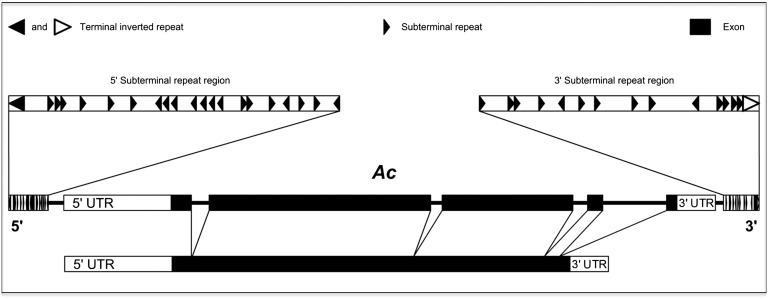
Structure of the Activator (Ac) transposon. The 4.6-kb transposon has a single transcription unit with 5 exons, encoding its transposase. The termini are 11-bp inverted repeats, adjacent to which are subterminal repetitive regions containing many copies of sequences homologous or identical to the hexamer AAACGG in both orientations. Figure prepared by T. Peterson and reproduced here with his permission. Note that Fig. 2 was prepared for Peterson T and Zhang J (2013) The mechanism of Ac/Ds transposition. Plant Transposons and Genome Dynamics in Evolution, ed Fedoroff NV (Wiley-Blackwell, Hoboken, NJ), in press.

References

    1. McClintock B. The origin and behavior of mutable loci in maize. Proc Natl Acad Sci USA. 1950;36(6):344–355. - PMC - PubMed
    1. Dooner HK, Nelson OE. Genetic control of UDPglucose:flavonol 3-O-glucosyltransferase in the endosperm of maize. Biochem Genet. 1977;15(5-6):509–519. - PubMed
    1. Dooner HK, Nelson OE. Interaction among C, R, and Vp in the control of the Bz glucosyltransferase during endosperm development in maize. Genetics. 1979;91(2):309–315. - PMC - PubMed
    1. Chen SM, Coe EH., Jr Control of anthocyanin synthesis by the C locus in maize. Biochem Genet. 1977;15(3–4):333–346. - PubMed
    1. de Koning APJ, Gu W, Castoe TA, Batzer MA, Pollock DD. Repetitive elements may comprise over two-thirds of the human genome. PLoS Genet. 2011;7(12):e1002384. - PMC - PubMed

Substances

Personal name as subject

LinkOut - more resources