


Adenosine A2A receptor modulates vascular response in soluble epoxide hydrolase-null mice through CYP-epoxygenases and PPARγ
- PMID: 23152114
- PMCID: PMC3543649
- DOI: 10.1152/ajpregu.00213.2012
Adenosine A2A receptor modulates vascular response in soluble epoxide hydrolase-null mice through CYP-epoxygenases and PPARγ
Abstract
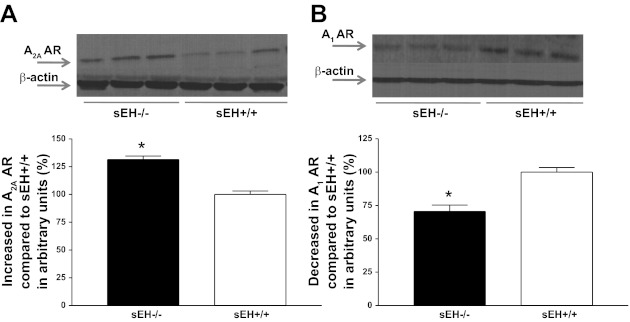
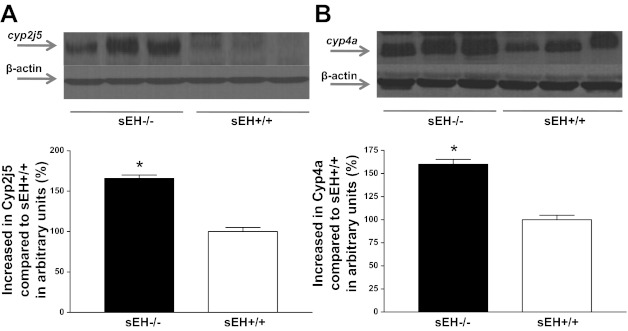
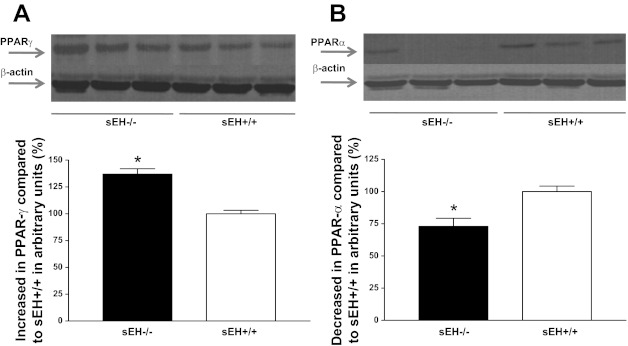
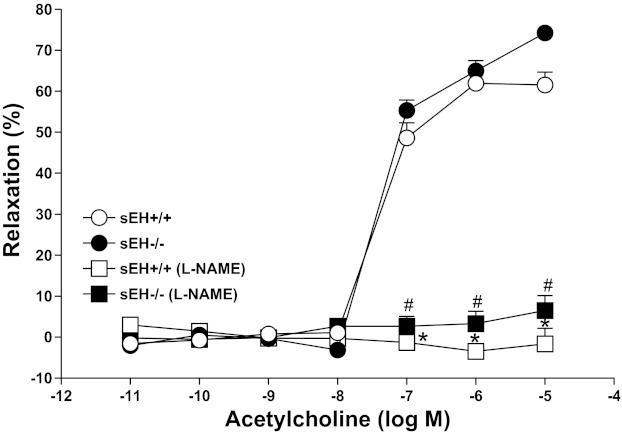
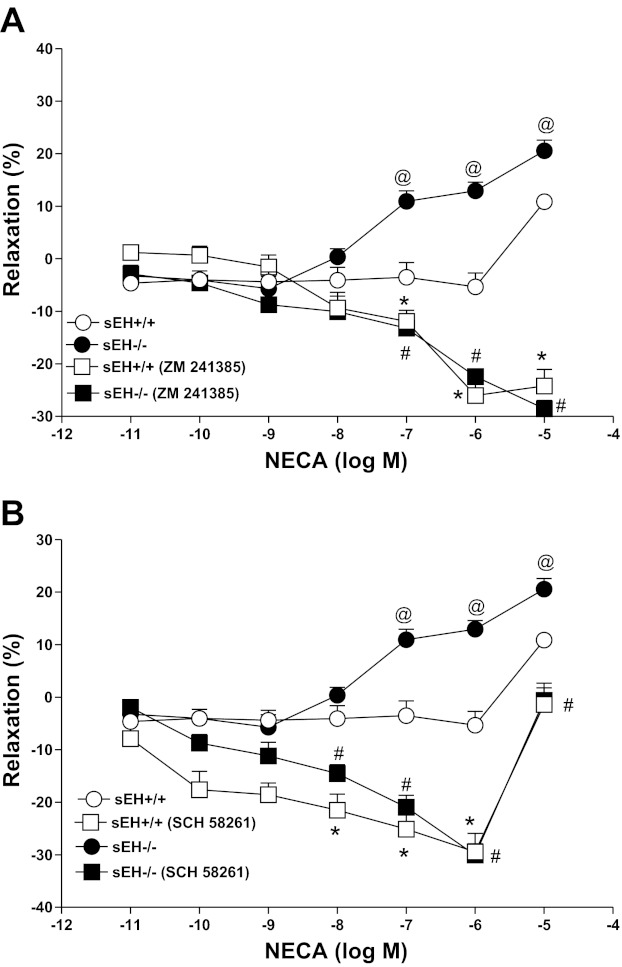
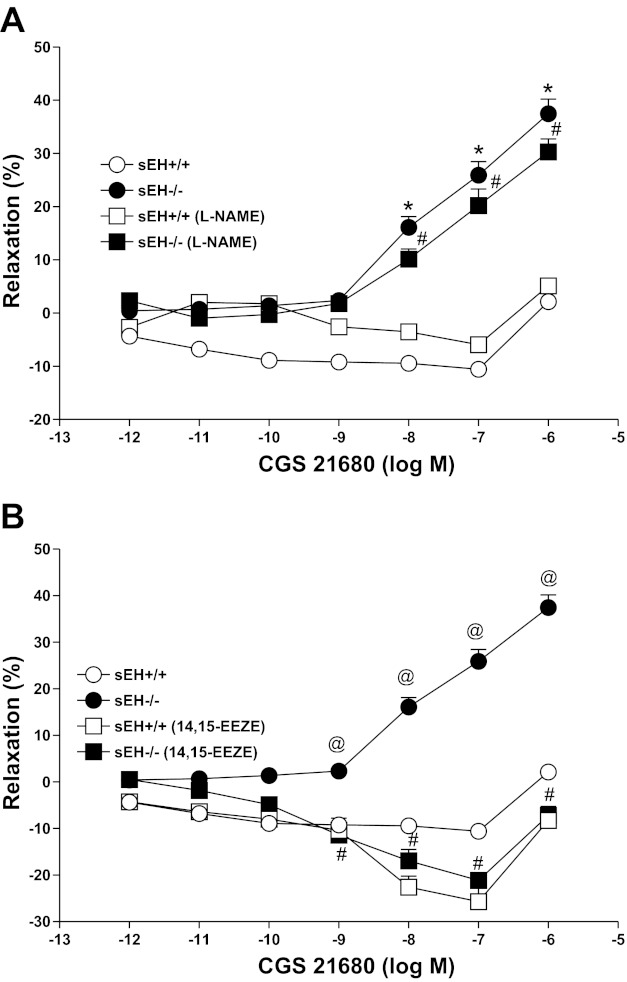
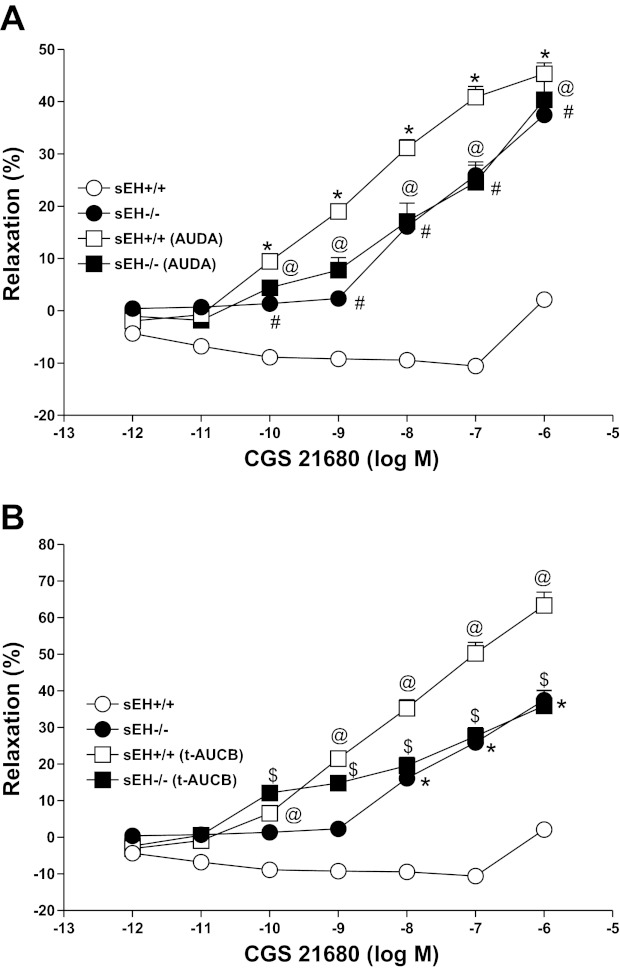
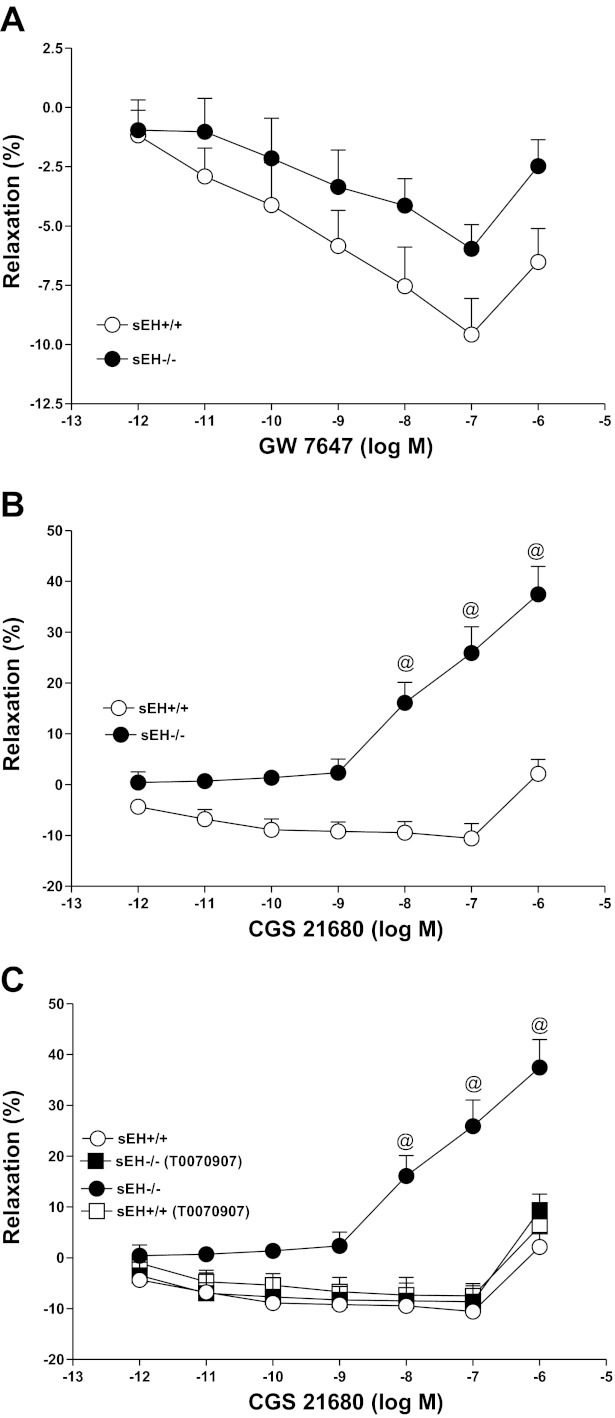
The interaction between adenosine and soluble epoxide hydrolase (sEH) in vascular response is not known. Therefore, we hypothesized that lack of sEH in mice enhances adenosine-induced relaxation through A(2A) adenosine receptors (AR) via CYP-epoxygenases and peroxisome proliferator-activated receptor γ (PPARγ). sEH(-/-) showed an increase in A(2A) AR, CYP2J, and PPARγ by 31%, 65%, and 36%, respectively, and a decrease in A(1)AR and PPARα (30% and 27%, respectively) vs. sEH(+/+). 5'-N-ethylcarboxamidoadenosine (NECA, an adenosine receptor agonist), CGS 21680 (A(2A) AR-agonist), and GW 7647 (PPARα-agonist)-induced responses were tested with nitro-l-arginine methyl ester (l-NAME) (NO-inhibitor; 10(-4) M), ZM-241385, SCH-58261 (A(2A) AR-antagonists; 10(-6) M), 14,15-epoxyeicosa-5(Z)-enoic acid (14,15-EEZE, an epoxyeicosatrienoic acid-antagonist; 10(-5) M), 12-(3-adamantan-1-yl-ureido) dodecanoic acid (AUDA; 10 μM) or trans-4-[4-(3-adamantan-1-yl-ureido)-cyclohexyloxy]-benzoic acid (t-AUCB, sEH-inhibitors; 10(-5) M), and T0070907 (PPARγ-antagonist; 10(-7) M). In sEH(-/-) mice, ACh response was not different from sEH(+/+) (P > 0.05), and l-NAME blocked ACh-responses in both sEH(-/-) and sEH(+/+) mice (P < 0.05). NECA (10(-6) M)-induced relaxation was higher in sEH(-/-) (+12.94 ± 3.2%) vs. sEH(+/+) mice (-5.35 ± 5.2%); however, it was blocked by ZM-241385 (-22.42 ± 1.9%) and SCH-58261(-30.04 ± 4.2%). CGS-21680 (10(-6) M)-induced relaxation was higher in sEH(-/-) (+37.4 ± 5.4%) vs. sEH(+/+) (+2.14 ± 2.8%). l-NAME (sEH(-/-), +30.28 ± 4.8%, P > 0.05) did not block CGS-21680-induced response, whereas 14,15-EEZE (-7.1 ± 3.7%, P < 0.05) did. Also, AUDA and t-AUCB did not change CGS-21680-induced response in sEH(-/-) (P > 0.05), but reversed in sEH(+/+) (from +2.14 ± 2.8% to +45.33 ± 4.1%, and +63.37 ± 7.2, respectively). PPARα-agonist did not relax as CGS 21680 (-2.48 ± 1.1 vs. +37.4 ± 5.4%) in sEH(-/-), and PPARγ-antagonist blocked (from +37.4 ± 5.4% to +9.40 ± 3.1) CGS 21680-induced relaxation in sEH(-/-). Our data suggest that adenosine-induced relaxation in sEH(-/-) may depend on the upregulation of A(2A) AR, CYP2J, and PPARγ, and the downregulation of A(1) AR and PPARα.
Figures
References
-
- Abebe W, Makujina SR, Mustafa SJ. Adenosine receptor-mediated relaxation of porcine coronary artery in presence and absence of endothelium. Am J Physiol Heart Circ Physiol 266: H2018–H2025, 1994 - PubMed
-
- Campbell WB, Gebremedhin D, Pratt PF, Harder DR. Identification of epoxyeicosatrienoic acids as endothelium-derived hyperpolarizing factors. Circ Res 78: 415–423, 1996 - PubMed
-
- Campbell WB, Harder DR. Endothelium-derived hyperpolarizing factors and vascular cytochrome P450 metabolites of arachidonic acid in the regulation of tone. Circ Res 84: 484–488, 1999 - PubMed
-
- Delerive P, De Bosscher K, Besnard S, Vanden Berghe W, Peters JM, Gonzalez FJ, Fruchart JC, Tedgui A, Haegeman G, Staels B. Peroxisome proliferators-activated receptor alpha negatively regulates the vascular inflammatory gene response by negative cross-talk with transcription factors NF-κB and AP-1. J Biol Chem 274: 32048–32054, 1999 - PubMed
Publication types
MeSH terms
Substances
Grants and funding
LinkOut - more resources
Full Text Sources
Other Literature Sources
Molecular Biology Databases
Research Materials
Miscellaneous
