


Blood pressure lowering efficacy of potassium-sparing diuretics (that block the epithelial sodium channel) for primary hypertension
- PMID: 23152254
- PMCID: PMC11380160
- DOI: 10.1002/14651858.CD008167.pub3
Blood pressure lowering efficacy of potassium-sparing diuretics (that block the epithelial sodium channel) for primary hypertension
Abstract
Background: Potassium-sparing diuretics, which block the epithelial sodium channel (ENaC), are widely prescribed for hypertension as a second-line drug in patients taking other diuretics (e.g. thiazide diuretics) and much less commonly prescribed as monotherapy. Therefore, it is essential to determine the effects of ENaC blockers on blood pressure (BP), heart rate and withdrawals due to adverse effects (WDAEs) when given as a first-line or second-line therapy.
Objectives: To quantify the dose-related reduction in systolic blood pressure (SBP) and diastolic blood pressure (DBP) of ENaC blocker therapy as a first-line or second-line drug in patients with primary hypertension.
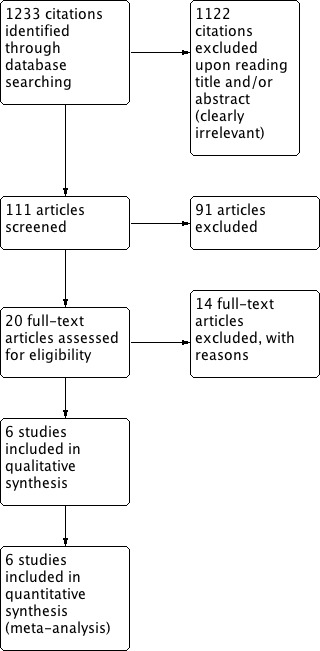
Search methods: We searched CENTRAL (The Cochrane Library 2012), MEDLINE (1950 to August 2012), EMBASE (1980 to August 2012) and reference lists of articles.
Selection criteria: Double-blind, randomized, controlled trials in patients with primary hypertension that evaluate, for a duration of 3 to 12 weeks, the BP lowering efficacy of: 1) fixed-dose monotherapy with an ENaC blocker compared with placebo; or 2) an ENaC blocker in combination with another class of anti-hypertensive drugs compared with the respective monotherapy (without an ENaC blocker).
Data collection and analysis: Two authors independently assessed the risk of bias and extracted data. Study authors were contacted for additional information. WDAE information was also collected from the trials.
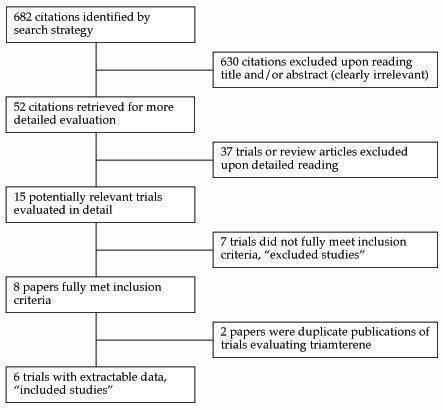
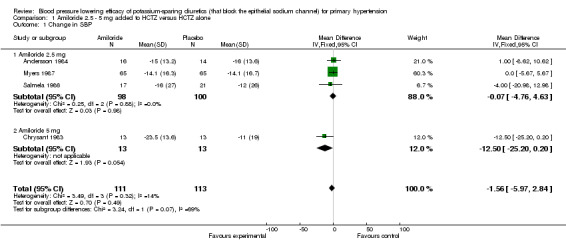
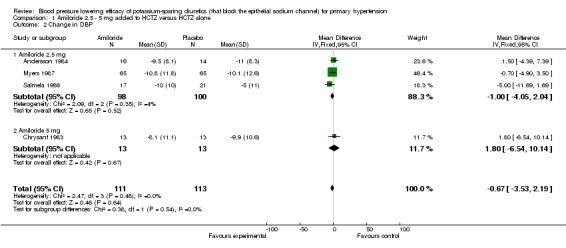
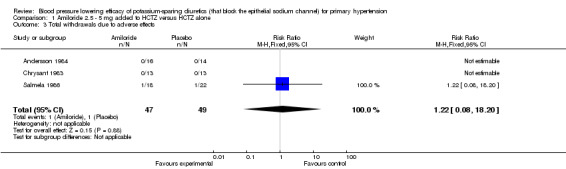
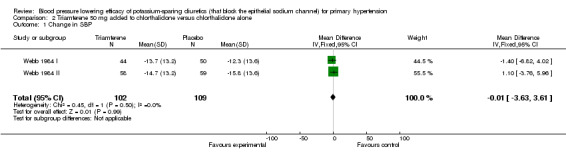
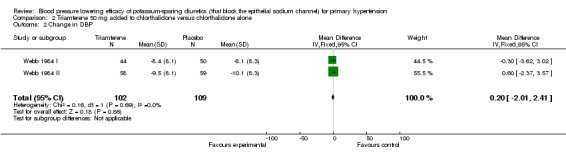
Main results: No trials evaluating the BP lowering efficacy of ENaC blockers as monotherapy in patients with primary hypertension were identified. Only 6 trials evaluated the BP lowering efficacy of low doses of amiloride and triamterene as a second drug in 496 participants with a baseline BP of 151/102 mm Hg. The additional BP reduction caused by the ENaC blocker as a second drug was estimated by comparing the difference in BP reduction between the combination and monotherapy groups. The addition of low doses of amiloride and triamterene in these trials did not reduce BP. An estimate of the dose-related BP lowering efficacy for ENaC blockers was not possible because of a lack of trial data at higher doses.
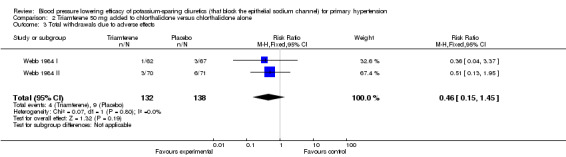
Authors' conclusions: ENaC blockers do not have a statistically or clinically significant BP lowering effect at low doses but trials at higher doses are not available. The review did not provide a good estimate of the incidence of harms associated with ENaC blockers.
Conflict of interest statement
None known.
Figures
Update of
-
Blood pressure lowering efficacy of potassium-sparing diuretics (that block the epithelial sodium channel) for primary hypertension.Cochrane Database Syst Rev. 2010 Jan 20;(1):CD008167. doi: 10.1002/14651858.CD008167.pub2. Cochrane Database Syst Rev. 2010. Update in: Cochrane Database Syst Rev. 2012 Nov 14;11:CD008167. doi: 10.1002/14651858.CD008167.pub3. PMID: 20091662 Updated.
References
References to studies included in this review
Andersson 1984 {published data only}
-
- Andersson P O, Andersen H H, Hagman A, Henning R. Potassium sparing by amiloride during thiazide therapy in hypertension. Clinical Pharmacology and Therapeutics 1984;36(2):197‐200. - PubMed
Chrysant 1983 {published data only}
-
- Chrysant S G, Brown J L, Hagstrom D. Antihypertensive and metabolic effects of hydrochlorothiazide, amiloride‐hydrochlorothiazide, and timolol. Journal of Clinical Pharmacology 1983;23(4):147‐54. - PubMed
Myers 1987 {published data only}
-
- Myers M G. Hydrochlorothiazide with or without amiloride for hypertension in the elderly. A dose‐titration study. Archives of Internal Medicine 1987;147(6):1026‐30. - PubMed
Salmela 1986 {published data only}
-
- Salmela P I, Juustila H, Kinnunen O, Koistinen P. Comparison of low doses of hydrochlorothiazide plus amiloride and hydrochlorothiazide alone in hypertension in elderly patients. Annals of Clinical Research 1986;18(2):88‐92. - PubMed
Webb 1984 I {published data only}
-
- Hort J F, Wilkins H M. Changes in blood pressure, serum potassium and electrolytes with a combination of triamterene and a low dose of chlorthalidone. Current Medical Research & Opinion 1991;12(7):430‐40. - PubMed
-
- Webb E L, Godfrey J C, Gertel A. The efficacy of a potassium‐sparing combination of chlorthalidone and triamterene in the control of mild and moderate hypertension. I. Journal of International Medical Research 1984;12(3):133‐9. - PubMed
Webb 1984 II {published data only}
-
- Spiers D R, Wade R C. Double‐blind parallel study of a combination of chlorthalidone 50 mg and triamterene 50 mg in patients with mild and moderate hypertension. Current medical research and opinion 1996;13(7):409‐15. - PubMed
-
- Webb E L, Godfrey J C, Gertel A. The efficacy of a potassium‐sparing combination of chlorthalidone and triamterene in the control of mild and moderate hypertension. II. Journal of International Medical Research 1984;12(3):140‐6. - PubMed
References to studies excluded from this review
Andersen 1985 {published data only}
-
- Andersen B, Snorrason S P, Ragnarsson J, Hardarson T. Hydrochlorothiazide and potassium chloride in comparison with hydrochlorothiazide and amiloride in the treatment of mild hypertension. Acta Medica Scandinavica 1985;218(5):449‐54. - PubMed
Baroni 1985 {published data only}
-
- Baroni G, Lessi D R R P, Branco P P. Anti‐hypertensive and biochemical effects. Hydrochlorthiazide, long acting furosemide and combination amiloride/hydrochlorthiazide in the treatment of hypertension. [Portuguese]. Revista Brasileira de Medicina 1985;42(10):352‐7.
Baumann 1976 {published data only}
-
- Baumann VJC, Braun HD. Potassium‐sparing effect on hypertension and congestive heart failure with Moduretik [Kaliumsparende Saluretikabehandlung des Hochdruckes und der feuzden Herzdekompensation mit Moduretik]. Zeitschrift fur Allgermeinmedizin 1976;18:971‐5. - PubMed
Haimerl 1985 {published data only}
-
- Haimerl VF, Lehmann K, Kopcke W. Treatment of Essential Hypertension with a K‐Sparing Diuretic Combination. Results of a German Multicenter Study with Moduretic. Fortschr Med 1985;103:812‐16. - PubMed
Hintzen 1973 {published data only}
-
- Hintzen AHJ. Some Aspects of the use of Moduretic in the Treatment of Patients with Mild Hypertension . Acta Cardiologica 1973 ; 28 :331‐339. - PubMed
Koskelainen 1985 {published data only}
-
- Koskelainen J, Turpeinen T, Lehto H. Metabolic effects of hydrochlorothiazide and hydrochlorothiazide‐amiloride and trichlormethiazide‐triamterene combinations. Current Therapeutic Research ‐ Clinical and Experimental 1985;37(3):554‐65.
Larochelle 1985 {published data only}
Lumme 1986 {published data only}
-
- Lumme J A, Jounela A J. Cardiac arrhythmias in hypertensive outpatients on various diuretics. Correlation between incidence and serum potassium and magnesium levels. Annals of Clinical Research 1986;18(4):186‐90. - PubMed
Perola 1985 {published data only}
-
- Perola P, Lehto H, Lammintausta R, Viikari J. Metabolic effects of furosemide and the combination of furosemide and triamterene. Current Therapeutic Research ‐ Clinical and Experimental 1985;37(3):545‐53.
Salako 1973 {published data only}
-
- Salako LA, Falase AO. A Comparison of Moduretic and Hydrochlorothiazide in the Treatment of Hypertension in African Patients . East African Medical Journal 1973 ; 50 ( 1 ):38‐48. - PubMed
Siegel 1992 {published data only}
-
- Siegel D, Hulley S B, Black D M, Cheitlin M D, Sebastian A, Seeley D G, et al. Diuretics, serum and intracellular electrolyte levels, and ventricular arrhythmias in hypertensive men. JAMA 1992;267(8):1083‐9. - PubMed
-
- Siegel D, Saliba P, Haffner S. Glucose and insulin levels during diuretic therapy in hypertensive men. Hypertension 1994;23(6 Pt 1):688‐94. - PubMed
Simpson 1961 {published data only}
-
- Simpson FO, Waal HJ. Clinical Trial of Triamterene in Hypertensive Patients . New Zealand Medical Journal 1961 ; 63 :199‐203. - PubMed
Spiekerman 1966 {published data only}
-
- Spiekerman RE, Berge KG, Thurber DL, Gedge SW, McGuckin WF. Potassium‐Sparing Effects of Triamterene in the Treatment of Hypertension . Circulation 1966 ; 34 :524‐531. - PubMed
Vetter 1973 {published data only}
-
- Vetter G. Clinical trial of a new potassium‐sparing diuretic for hypertension [Klinische Prufun eines neuen kaliumsparenden Diuretikums zur Hochdruckbehandlung]. Pharmakotherapie in Kurze 1973;115(49):2249‐50. - PubMed
Additional references
Bucher 1997
-
- Bucher HC, Guyatt GH, Griffith LE, Walter D. The results of direct and indirect treatment comparisons in meta‐analysis of randomised controlled trials. Journal of Clinical Epidemiology 1997;50(6):683‐91. - PubMed
Chen 2009
Heran 2008a
Heran 2008b
Higgins 2009
-
- Higgins JPT, Green S (editors). Cochrane Handbook for Systematic Reviews of Interventions Version 5.0.2 [updated September 2009]. Cochrane Handbook for Systematic Reviews of Interventions Version 5.0.2. The Cochrane Collaboration, 2009. Available from www.cochrane‐handbook.org..
Musini 2008
Publication types
MeSH terms
Substances
LinkOut - more resources
Full Text Sources
Other Literature Sources
Medical
