


Changes in antibody seroprevalence of seven high-risk HPV types between nationwide surveillance studies from 1995-96 and 2006-07 in The Netherlands
- PMID: 23152809
- PMCID: PMC3495962
- DOI: 10.1371/journal.pone.0048807
Changes in antibody seroprevalence of seven high-risk HPV types between nationwide surveillance studies from 1995-96 and 2006-07 in The Netherlands
Abstract
Objective: This study evaluates trends in antibody seroprevalences of seven high-risk human papillomavirus (hr-HPV) serotypes (HPV16, 18, 31, 33, 45, 52, and 58) between the 1995-96 and 2006-07 sero-surveys among the Dutch general population in the pre-vaccination era.
Methods: Serum samples of men and women (0-79 years of age) from two cross-sectional population-based serosurveillance studies performed in 1995-96 (n = 3303) and 2006-07 (n = 6384) were tested for HPV-specific antibodies in a VLP-based multiplex immunoassay.
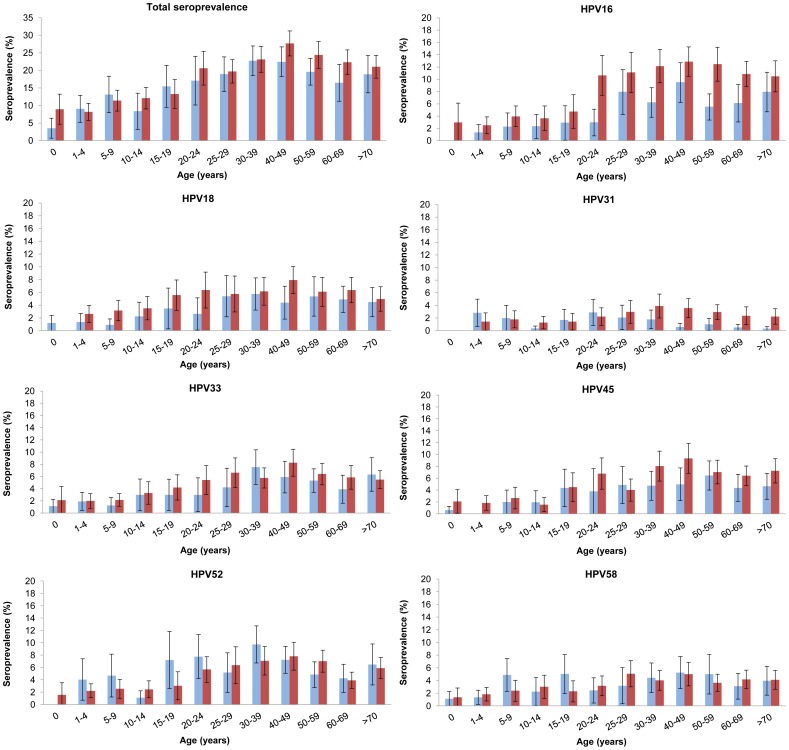
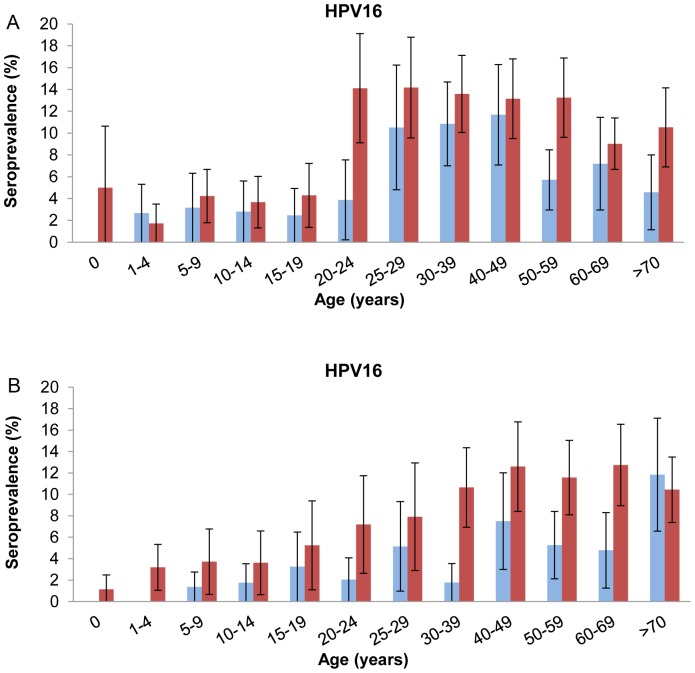
Results: HPV16-specific antibody seroprevalence increased during adolescence and shifted to younger ages in the 2006-07 survey compared to the 1995-96 survey. This step-up in HPV16 seroprevalence was most pronounced in women, while a more gradual increase was observed in men. Also in cohorts older than 49 years, HPV16 seroprevalence was higher in 2006-07 as compared to 1995-96 survey. A higher overall seroprevalence in individuals older than 15 years of age was found for HPV16, 18, 31 and 45 in 2006-07 as compared to 1995-96. For HPV33, 52 and 58 seroprevalences were comparable over this 11-year time period. Seropositivity for one or more HPV types was significantly higher in 2006-07 (23.1%) than in 1995-96 (20.0%) (p = 0.013). Multi-seropositivity increased from 7.1% in 1995-96 up to 10.2% in 2006-07 (p<0.0001). Differences in HPV seropositivity for at least one of the seven HPV types between both surveys could be explained in addition to demographic characteristics (age, sex, urbanization degree and ethnicity), also by changes in sexual behaviour (marital status, age of sexual debut and ever reported an STI).
Conclusion: The observed increase in particular HPV16 seroprevalence could be due to changes in sexual behaviour over the years, and especially in age of sexual debut. Seroprevalence studies provide insight into the distribution of HPV types and infection dynamics in the general population over time, which is important to assess the impact of HPV-vaccination.
Conflict of interest statement
Figures
References
-
- Woodman CB, Collins SI, Young LS (2007) The natural history of cervical HPV infection: unresolved issues. Nat Rev Cancer 7: 11–22. - PubMed
-
- Walboomers JM, Jacobs MV, Manos MM, Bosch FX, Kummer JA, et al. (1999) Human papillomavirus is a necessary cause of invasive cervical cancer worldwide. J Pathol 189: 12–19. - PubMed
-
- Li N, Franceschi S, Howell-Jones R, Snijders PJ, Clifford GM (2011) Human papillomavirus type distribution in 30,848 invasive cervical cancers worldwide: Variation by geographical region, histological type and year of publication. Int J Cancer 128: 927–935. - PubMed
-
- Markowitz LE, Sternberg M, Dunne EF, McQuillan G, Unger ER (2009) Seroprevalence of human papillomavirus types 6, 11, 16, and 18 in the United States: National Health and Nutrition Examination Survey 2003–2004. J Infect Dis 200: 1059–1067. - PubMed
-
- Newall AT, Brotherton JM, Quinn HE, McIntyre PB, Backhouse J, et al. (2008) Population seroprevalence of human papillomavirus types 6, 11, 16, and 18 in men, women, and children in Australia. Clin Infect Dis 46: 1647–1655. - PubMed
Publication types
MeSH terms
Substances
LinkOut - more resources
Full Text Sources
