. 2012;7(11):e49061.
doi: 10.1371/journal.pone.0049061. Epub 2012 Nov 12.

IgG responses to Pneumococcal and Haemophilus influenzae protein antigens are not impaired in children with a history of recurrent acute otitis media

Affiliations

IgG responses to Pneumococcal and Haemophilus influenzae protein antigens are not impaired in children with a history of recurrent acute otitis media

Selma P Wiertsema et al. PLoS One. 2012.

Abstract

Background: Vaccines including conserved antigens from Streptococcus pneumoniae and nontypeable Haemophilus influenzae (NTHi) have the potential to reduce the burden of acute otitis media. Little is known about the antibody response to such antigens in young children with recurrent acute otitis media, however, it has been suggested antibody production may be impaired in these children.

Methods: We measured serum IgG levels against 4 pneumococcal (PspA1, PspA 2, CbpA and Ply) and 3 NTHi (P4, P6 and PD) proteins in a cross-sectional study of 172 children under 3 years of age with a history of recurrent acute otitis media (median 7 episodes, requiring ventilation tube insertion) and 63 healthy age-matched controls, using a newly developed multiplex bead assay.

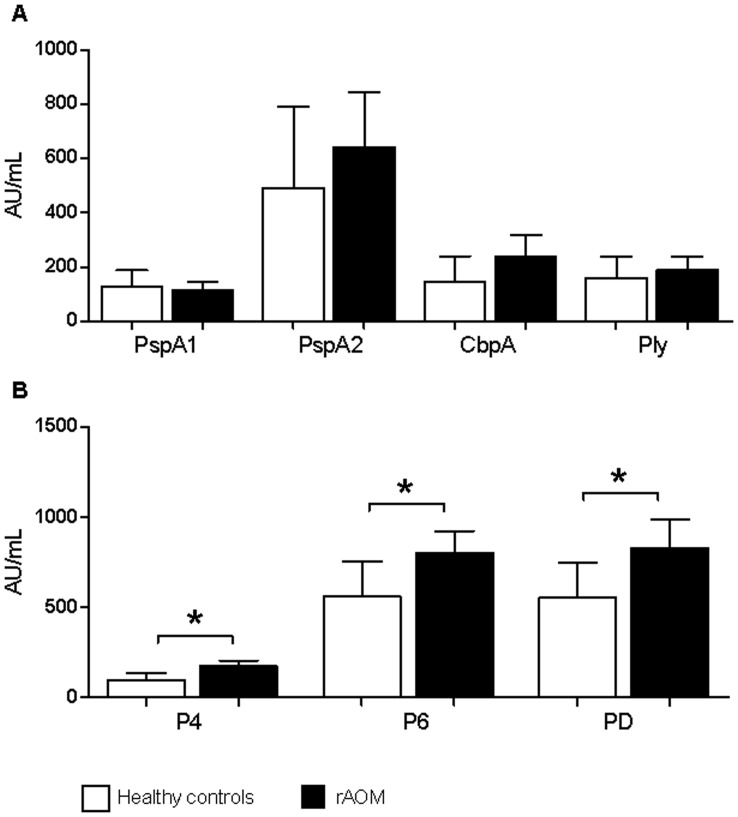
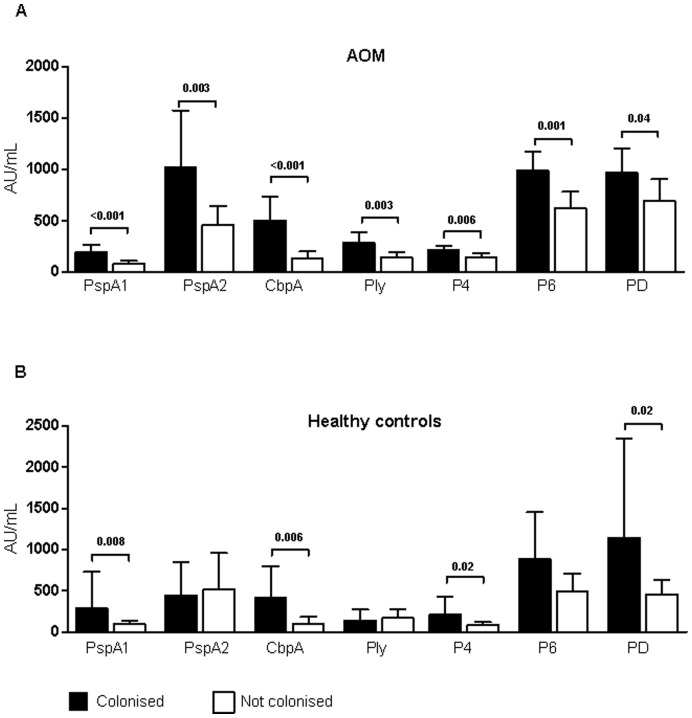
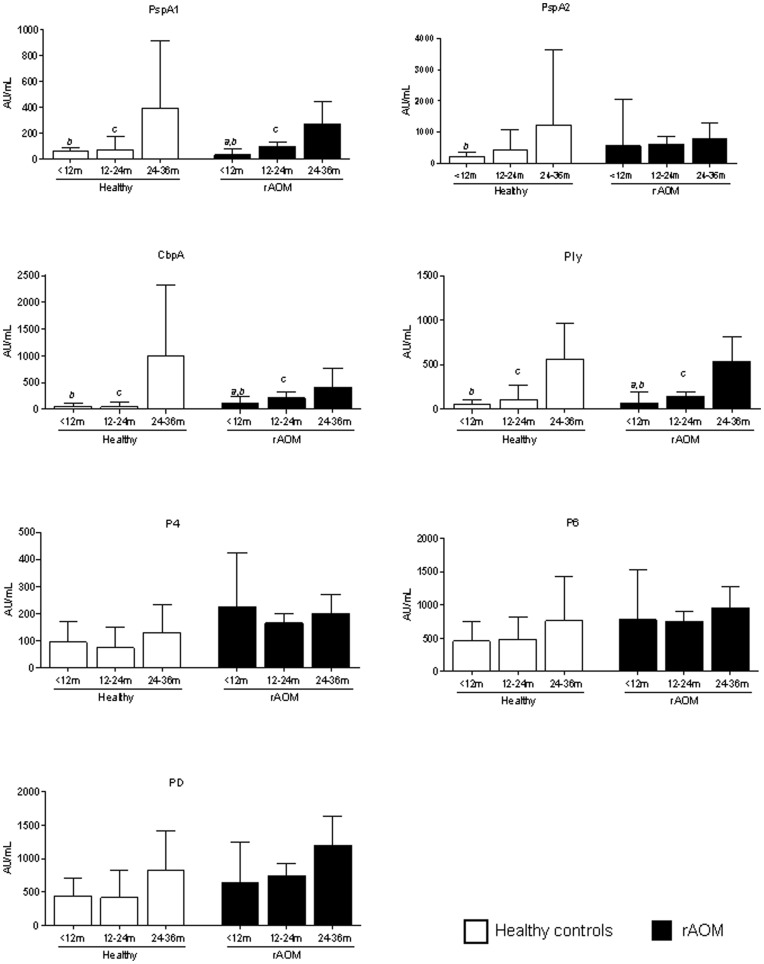
Results: Children with a history of recurrent acute otitis media had significantly higher geometric mean serum IgG levels against NTHi proteins P4, P6 and PD compared with healthy controls, whereas there was no difference in antibody levels against pneumococcal protein antigens. In both children with and without a history of acute otitis media, antibody levels increased with age and were significantly higher in children colonised with S. pneumoniae or NTHi compared with children that were not colonised.

Conclusions: Proteins from S. pneumoniae and NTHi induce serum IgG in children with a history of acute otitis media. The mechanisms in which proteins induce immunity and potential protection requires further investigation but the dogma of impaired antibody responses in children with recurrent acute otitis media should be reconsidered.


Conflict of interest statement

Competing Interests: SW and LK have received institutional funding for studies investigating bacterial pathogens in children with rAOM and travel funding from GlaxoSmithKline. TM has received institutional funding from Wyeth Vaccines and GlaxoSmithKline. LK and TM are co-inventors on patents PCT/GB2007/002242, PCT/GB2005/001792 and PCT/GB2005/001774. HC and SV have served as consultants and have received travel funding from GlaxoSmithKline Biologicals. PR has received institutional funding for epidemiological research from GlaxoSmithKline and CSL and served on advisory boards for CSL and Wyeth Vaccines. All other authors have indicated they have no conflicts of interest.

Figures

Figure 1
Figure 1. Serum IgG levels.
Adjusted (age, gender, day-care attendance) geometric mean concentration of serum IgG antibody levels in Arbituary Units/mL (95% CI) against pneumococcal (top panel A) and NTHi (bottom panel B) proteins in healthy children (white bars) and children with a history of rAOM (black bars). * p≤0.01 when comparing IgG levels between children with and without a history of rAOM using linear regression correcting for age, gender and day-care attendance PspA1/2, pneumococcal surface protein A families 1 and 2; CbpA, choline binding protein A; Ply, pneumolysin; P4, outer membrane protein 4; P6, outer membrane protein 6; PD, protein D.
Figure 2
Figure 2. Serum IgG levels according to AOM history and nasopharyngeal colonisation.
Adjusted (age, gender, day-care attendance) geometric mean concentration of serum IgG in Arbitrary Units/mL (95% CI) against pneumococcal and NTHi proteins in children positive (black bar) or negative (white bar) for nasopharyngeal colonisation with S. pneumoniae for IgG against PspA1, PspA2, CbpA, and Ply or nasopharyngeal colonisation with NTHi for IgG against P4, P6, and PD in children with a history of rAOM (top panel A) or healthy controls (bottom panel B). P-value determined using linear regression correcting for age, gender and day-care attendance… PspA1/2, pneumococcal surface protein A families 1 and 2; CbpA, choline binding protein A; Ply, pneumolysin; P4, outer membrane protein 4; P6, outer membrane protein 6; PD, protein D.
Figure 3
Figure 3. Serum IgG levels according to AOM history and age.
Adjusted (gender, day-care attendance) geometric mean concentration according to age of serum IgG in Arbitrary Units/mL (95% CI) against pneumococcal and NTHi protein antigens in healthy children (white bars) and children with a history of rAOM (black bars).General linear model followed by Tukey honestly significant difference test was used to compare differences between age groups within the group of children with rAOM and within the healthy control group, where p<0.05 was considered significant; a  =  p<0.05 when comparing <12 months with 12–14 months, b  =  p<0.05 when comparing <12 months with 24–36 months, c  =  p<0.05 when comparing 12–24 months with 24–36 months. PspA1/2, pneumococcal surface protein A families 1 and 2; CbpA, choline binding protein A; Ply, pneumolysin; P4, outer membrane protein 4; P6, outer membrane protein 6; PD, protein D.
Figure 4
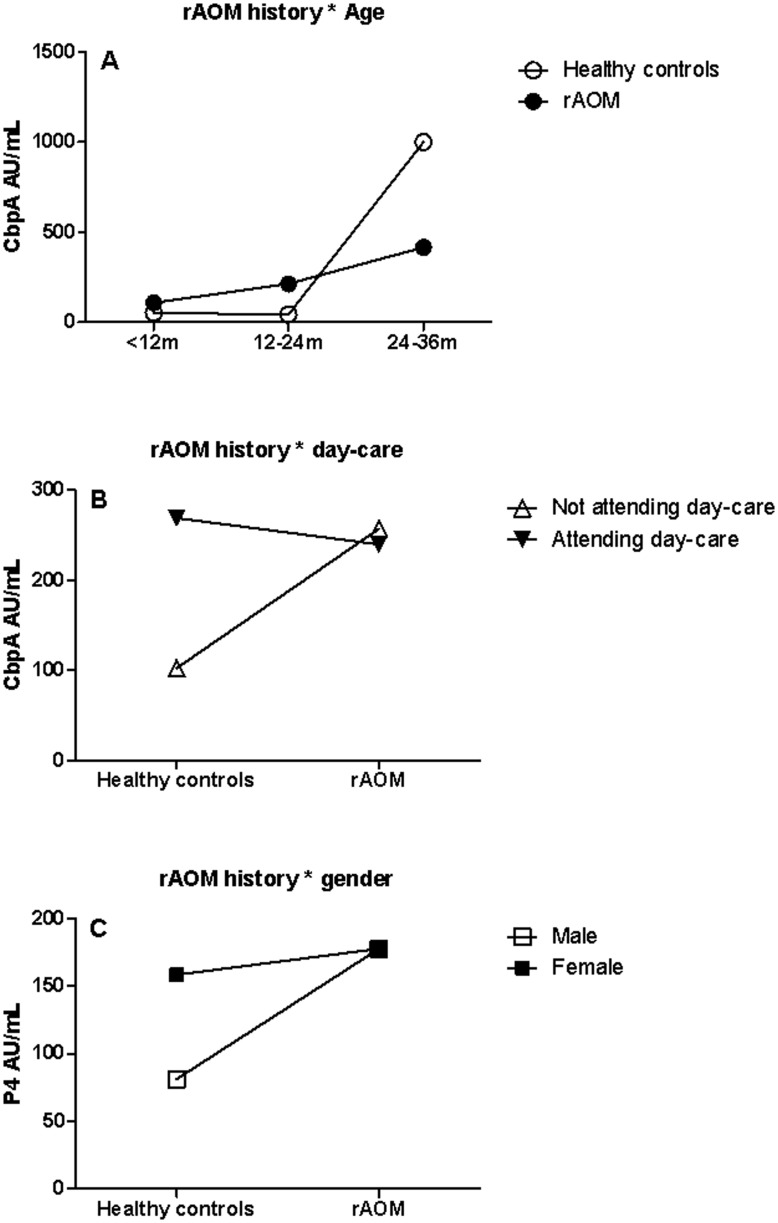
Figure 4. Interactive effects.
Interactive effects calculated using general linear model of rAOM * age (panel A; p = 0.003) and rAOM * day-care attendance (panel B; p = 0.04) on geometric mean CbpA levels (AU/mL) and the effect of rAOM * gender on GMC of anti-P4 IgG levels (panel C; p = 0.05). CbpA, choline binding protein A; P4, outer membrane protein 4.

References

    1. Vergison A, Dagan R, Arguedas A, Bonhoeffer J, Cohen R, et al. (2010) Otitis media and its consequences: beyond the earache. Lancet Infect Dis 10: 195–203. - PubMed
    1. Vergison A (2008) Microbiology of otitis media: a moving target. Vaccine 26 Suppl 7: G5–10. - PMC - PubMed
    1. Pletz MW, Maus U, Krug N, Welte T, Lode H (2008) Pneumococcal vaccines: mechanism of action, impact on epidemiology and adaption of the species. Int J Antimicrob Agents 32: 199–206. - PubMed
    1. Block SL, Hedrick J, Harrison CJ, Tyler R, Smith A, et al. (2004) Community-wide vaccination with the heptavalent pneumococcal conjugate significantly alters the microbiology of acute otitis media. PediatrInfectDisJ 23: 829. - PubMed
    1. Casey JR, Adlowitz DG, Pichichero ME (2010) New patterns in the otopathogens causing acute otitis media six to eight years after introduction of pneumococcal conjugate vaccine. Pediatr Infect Dis J 29: 304–309. - PMC - PubMed

Publication types

MeSH terms