Unhealthy interactions: the role of stereotype threat in health disparities
- PMID: 23153125
- PMCID: PMC3518353
- DOI: 10.2105/AJPH.2012.300828
Unhealthy interactions: the role of stereotype threat in health disparities
Abstract
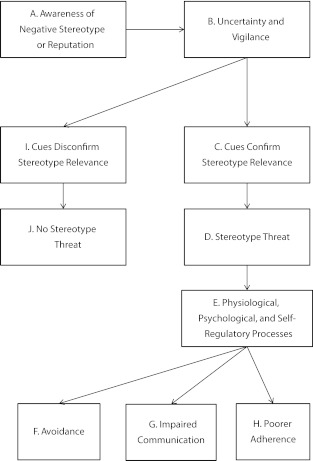
Stereotype threat is the unpleasant psychological experience of confronting negative stereotypes about race, ethnicity, gender, sexual orientation, or social status. Hundreds of published studies show how the experience of stereotype threat can impair intellectual functioning and interfere with test and school performance. Numerous published interventions derived from this research have improved the performance and motivation of individuals targeted by low-ability stereotypes. Stereotype threat theory and research provide a useful lens for understanding and reducing the negative health consequences of interracial interactions for African Americans and members of similarly stigmatized minority groups. Here we summarize the educational outcomes of stereotype threat and examine the implications of stereotype threat for health and health-related behaviors.
Figures
References
-
- Hippocrates , Precepts VI : Reiser SJ, Dyck AJ, Curran WJ, Ethics in Medicine: Historical Perspectives and Contemporary Concerns. Cambridge, MA: MIT Press; 1977:5
-
- Bartlett EE, Grayson M, Barker R, Levine DM, Golden A, Libber S. The effects of physician communications skills on patient satisfaction; recall, and adherence. J Chronic Dis. 1984;37(9–10):755–764 - PubMed
-
- Weinman J. Doctor–patient interaction: psychosocial aspects. : Smelser NJ, Baltes PB, International Encyclopedia of the Social and Behavioral Sciences. Oxford, UK: Elsevier; 2004:3816–3821
Publication types
MeSH terms
Grants and funding
LinkOut - more resources
Full Text Sources
Other Literature Sources
Medical