


Review
doi: 10.1016/j.ccm.2012.08.003.
Indoor fuel exposure and the lung in both developing and developed countries: an update
Affiliations
- PMID: 23153607
- PMCID: PMC3500516
- DOI: 10.1016/j.ccm.2012.08.003
Item in Clipboard
Review
Indoor fuel exposure and the lung in both developing and developed countries: an update
Clin Chest Med.
2012 Dec.
Abstract
Almost 3 billion people worldwide burn solid fuels indoors. Despite the large population at risk worldwide, the effect of exposure to indoor solid fuel smoke has not been adequately studied. Indoor air pollution from solid fuel use is strongly associated with chronic obstructive pulmonary disease, acute respiratory tract infections, and lung cancer, and weakly associated with asthma, tuberculosis, and interstitial lung disease. Tobacco use further potentiates the development of respiratory disease among subjects exposed to solid fuel smoke. There is a need to perform additional interventional studies in this field.
Copyright © 2012 Elsevier Inc. All rights reserved.
Figures
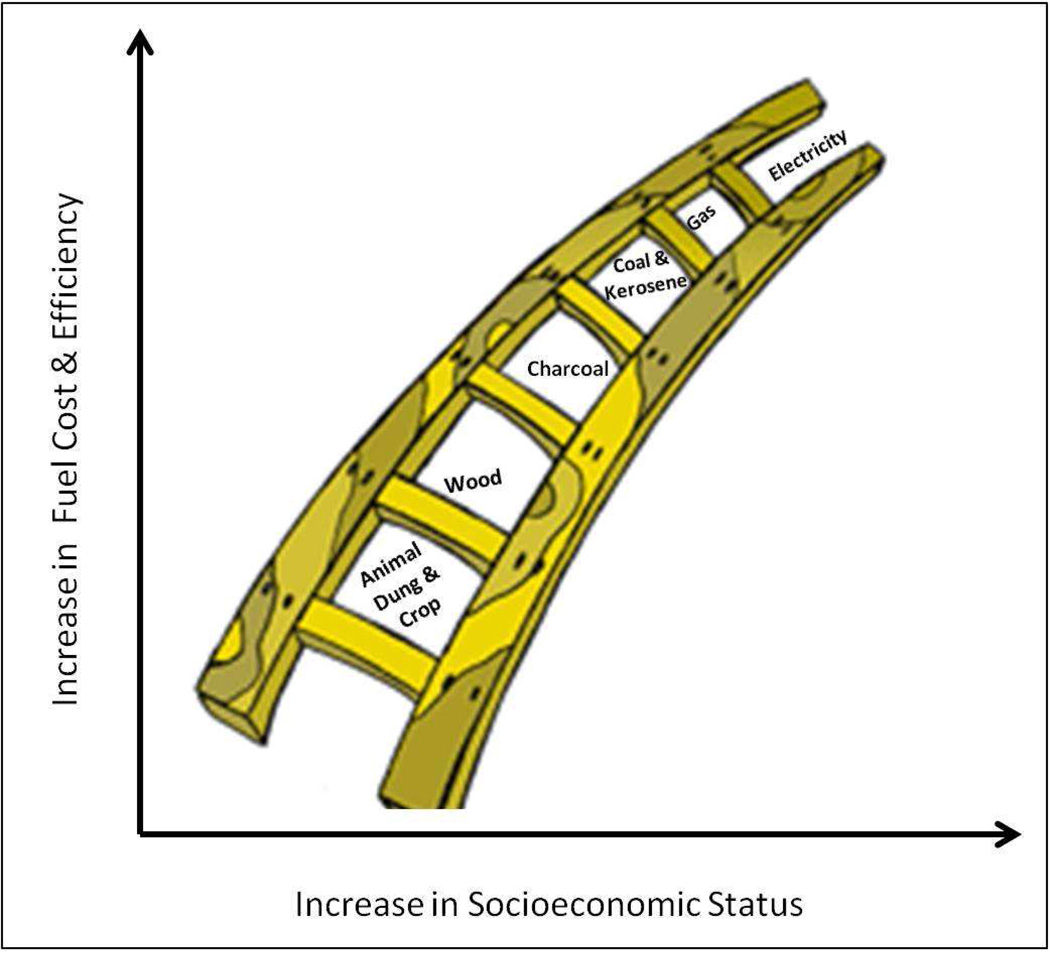
The Energy Ladder. Fuels lower in the energy ladder are less efficient and produce more pollution, but are less expensive. Conversely, fuels higher in the energy ladder are more efficient and produce less pollution, but are more expensive.
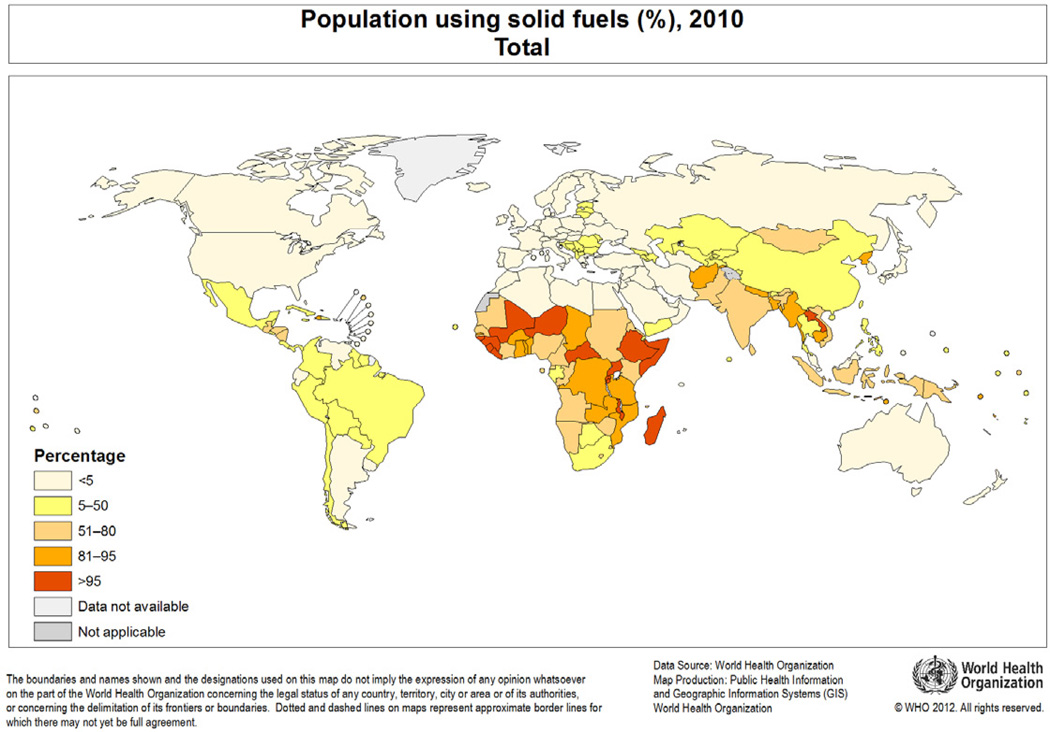
Global Use of indoor solid fuels in 2010, as reported in percent, by the World Health Organization (WHO). Reproduced with permission from the WHO .

Key differences in solid fuel exposure between developing and developed countries. The picture in the right in the panel was reprinted with permission from Elsevier (The Lancet, 2009; 374:733–743 ).
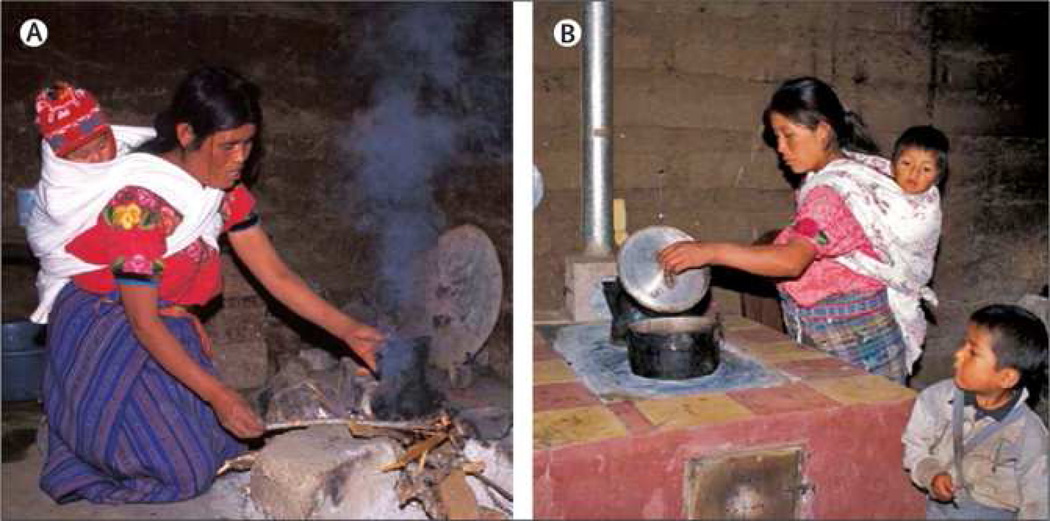
Traditional open fire used for cooking (panel A) and the locally developed and constructed chimney woodstove, the plancha (panel B) in Guatemala. The chimney woodstove has a thick metal heating surface for cooking tortillas and holes with removable concentric rings for pots, a firebrick combustion chamber with baffling, a concrete and brick body, tile surfaces around the cooking area, dirt and pumice stone insulation, a metal fuel door, and a metal chimney with damper. Infants and toddlers are highly exposed to combustion smoke as they are carried on their mother’s back while she cooks, a common cultural practice in Guatemala and other regions. Picture reprinted with permission from Elsevier (The Lancet, 2011; 378:1717–1726) .
References
-
- Kurmi OP, Lam KB, Ayres JG. Indoor air pollution and the lung in low and medium income countries. The European respiratory journal : official journal of the European Society for Clinical Respiratory Physiology. 2012 - PubMed
-
- World Health Organization. Geneva, Switzerland: World Health Organization; 2010. World Health Statistics, 2010.
-
- Legros G, Havet I, Briuce N, et al. The Energy Access Situation in Developing Countries: A Review Focusing on the Least Developed Countries and Sub-Saharan Africa. New York, NY: United Nations Development Program; 2009.
-
- Miah MD, Rashid HA, Shin MY. Wood fuel use in the traditional cooking stoves in the rural floodplain areas of Bangladesh: A socio-environmental perspective. Biomass and Bioenergy. 2009;33:70–78.
Publication types
MeSH terms
Substances
Grants and funding
LinkOut - more resources
Full Text Sources
Medical
