. 2013 Jan;24(2):74-84.
doi: 10.1091/mbc.E12-09-0678. Epub 2012 Nov 14.

Small heat shock proteins target mutant cystic fibrosis transmembrane conductance regulator for degradation via a small ubiquitin-like modifier-dependent pathway

Affiliations

Small heat shock proteins target mutant cystic fibrosis transmembrane conductance regulator for degradation via a small ubiquitin-like modifier-dependent pathway

Annette Ahner et al. Mol Biol Cell. 2013 Jan.

Abstract

Small heat shock proteins (sHsps) bind destabilized proteins during cell stress and disease, but their physiological functions are less clear. We evaluated the impact of Hsp27, an sHsp expressed in airway epithelial cells, on the common protein misfolding mutant that is responsible for most cystic fibrosis. F508del cystic fibrosis transmembrane conductance regulator (CFTR), a well-studied protein that is subject to cytosolic quality control, selectively associated with Hsp27, whose overexpression preferentially targeted mutant CFTR to proteasomal degradation. Hsp27 interacted physically with Ubc9, the small ubiquitin-like modifier (SUMO) E2 conjugating enzyme, implying that F508del SUMOylation leads to its sHsp-mediated degradation. Enhancing or disabling the SUMO pathway increased or blocked Hsp27's ability to degrade mutant CFTR. Hsp27 promoted selective SUMOylation of F508del NBD1 in vitro and of full-length F508del CFTR in vivo, which preferred endogenous SUMO-2/3 paralogues that form poly-chains. The SUMO-targeted ubiquitin ligase (STUbL) RNF4 recognizes poly-SUMO chains to facilitate nuclear protein degradation. RNF4 overexpression elicited F508del degradation, whereas Hsp27 knockdown blocked RNF4's impact on mutant CFTR. Similarly, the ability of Hsp27 to degrade F508del CFTR was lost during overexpression of dominant-negative RNF4. These findings link sHsp-mediated F508del CFTR degradation to its SUMOylation and to STUbL-mediated targeting to the ubiquitin-proteasome system and thereby implicate this pathway in the disposal of an integral membrane protein.


Figures
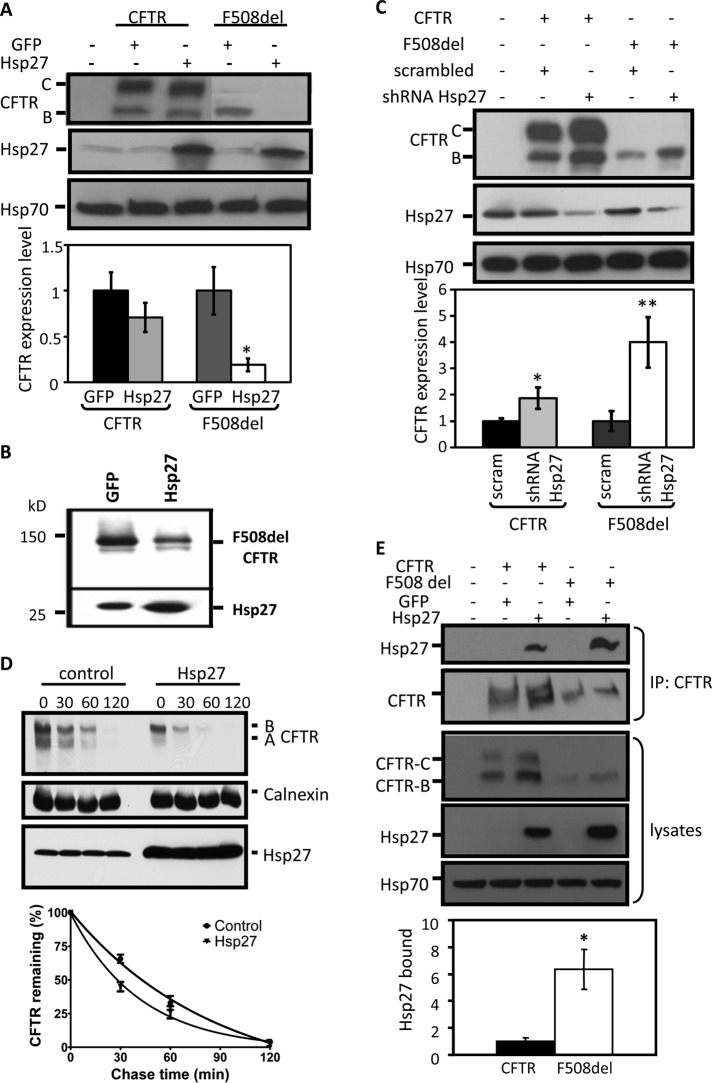
FIGURE 1:
FIGURE 1:
Hsp27 selectively interacts with F508del CFTR and facilitates its degradation. (A) Hsp27 overexpression reduces F508del levels. HEK293 cells were transfected with 1.5 μg CFTR or F508del CFTR and 1.5 μg GFP or Hsp27 per 60-mm dish. Steady-state CFTR protein levels (bands B and C) were quantified from four independent experiments and averaged. CFTR expression levels in cells coexpressing Hsp27 were normalized to values observed in cells coexpressing GFP. Differences in expressed Hsp27 in the panels are primarily due to differences in film exposure times and not due to differences in the amount of cDNA transfected. Error estimates: SEM (*, p = 0.013). (B) Hsp27 overexpression reduces F508del levels in airway cells. CFBE-F508del cells were electroporated with GFP or Hsp27 cDNAs as described in Materials and Methods, and cell lysates were blotted for CFTR; data are representative of three independent experiments showing a mean reduction of 60% relative to control (p = 0.043). (C) Hsp27 knockdown increases F508del levels. HEK293 cells were transfected as described in (A). CFTR protein levels (bands B and C) were quantified from six independent experiments and averaged. CFTR and F508del CFTR expression levels in cells coexpressing the pGeneClip hMGFP shRNA Hsp27 vector were normalized to those obtained from cells coexpressing a scrambled sequence (scram), as shown in the data summary. SEM: *, p = 0.036; **, p = 0.007. (D) Hsp27 accelerates F508del CFTR degradation. HEK293 cells were transfected with F508del CFTR and GFP or Hsp27 cDNAs as in (A). Cycloheximide chase experiments were performed as described in Materials and Methods. F508del CFTR remaining as a function of time was determined from blot densities in five independent experiments and averaged. Values were normalized to that obtained at the beginning of the chase period (t = 0). Closed circles: F508del CFTR plus GFP control; closed triangles: F508del CFTR plus Hsp27. SEM indicated. (E) Hsp27 interacts preferentially with mutant CFTR. HEK293 cells were transfected with 4 μg wild-type or F508del CFTR and 4 μg GFP or Hsp27 per 100-mm dish, and the interaction between CFTR or F508del CFTR and Hsp27 was assessed by CFTR IP, which was followed by Hsp27 IB. Hsp27 blot densities were normalized to CFTR in the IP. Relative binding represents the average of four independent experiments. SEM: *, p = 0.019.
FIGURE 2:
FIGURE 2:
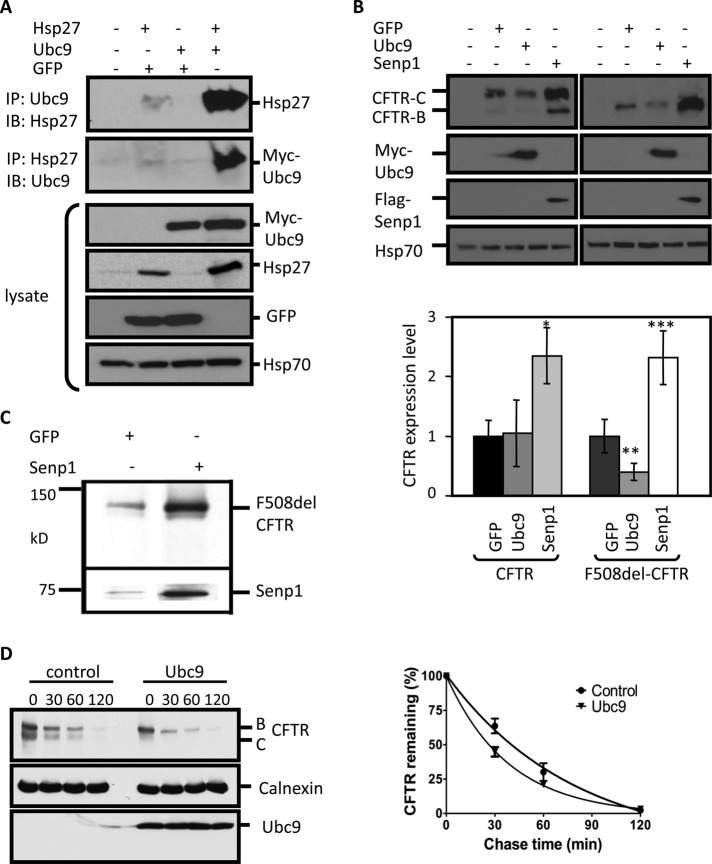
Hsp27 action links to the SUMO pathway. (A) Hsp27 interacts with the SUMO E2, Ubc9. HEK 293 cells were transfected with the indicated plasmids, 4 μg each per 100-mm dish. The interaction between Hsp27 and myc-Ubc9 was assessed by IP with anti-Hsp27 or anti-myc, followed by IP of myc or Hsp27, respectively, as indicated. (B) SUMOylation pathway components mimic the effect of Hsp27 on CFTR expression. HEK293 cells were cotransfected with CFTR or F508del CFTR plus GFP, myc-Ubc9, or Flag-Senp1, as in Figure 1A. CFTR protein levels were quantified from independent experiments for wild-type (n = 6) and F508del (n = 8). CFTR expression levels (bands B and C) were normalized to values obtained from cells coexpressing GFP. Error estimates are SEM: *, p = 0.024; **, p = 0.028; ***, p = 0.013; vs. GFP controls. (C) Senp1 expression increases F508del expression in airway cells. CFBE-F508del cells were electroporated with GFP or Senp1, which was followed by IB for CFTR. The data are representative of three independent experiments. The fold increase in F508del CFTR expression over control averaged 2.6 ± 0.4 (p = 0.01). (D) Ubc9 accelerates F508del CFTR degradation. HEK293 cells were cotransfected with F508del CFTR and GFP or myc-Ubc9, and mutant CFTR degradation kinetics were determined by cycloheximide chase, as in Figure 1D. Gel densities were normalized to those obtained at the beginning of the chase period in each of five experiments and averaged. Closed circles: F508del CFTR plus GFP; closed triangles: F508del CFTR plus Ubc9. Error estimates are SEM.
FIGURE 3:
FIGURE 3:
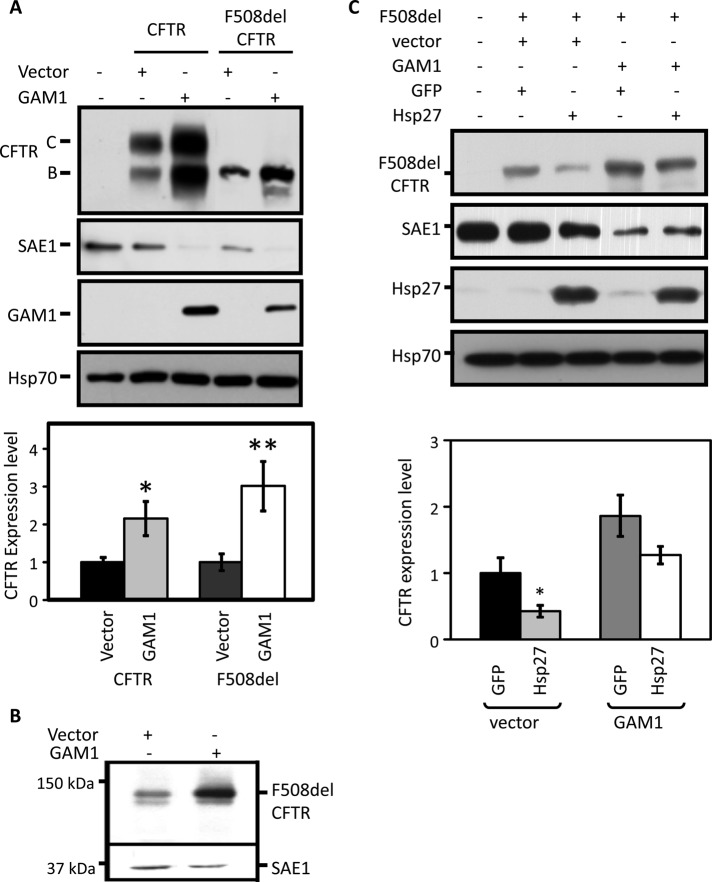
Functional linkage between the Hsp27 and SUMO pathways. (A) Disabling the SUMO pathway increases CFTR expression. HEK293 cells were cotransfected with wild-type or F508del CFTR and empty vector (control) or GAM1 cDNAs. GAM1 efficacy was assessed from SAE1 IB. Bottom panel, quantification of CFTR gel densities, normalized to vector controls and averaged: CFTR, n = 6; F508del, n = 5; SEM: *, p = 0.017, **, p = 0.010. (B) Knockdown of the SUMO E1, SAE1, increases F508del CFTR expression in airway cells. CFBE-F508del cells were transduced with empty vector or GAM1 cDNA followed by CFTR IB. The data are representative of three experiments in which SAE1 knockdown increased F508del CFTR expression 2.1 ± 0.3-fold (p = 0.03). (C) SUMO E1 knockdown obviates the impact of Hsp27 on F508del expression. HEK293 cells were transfected with F508del CFTR and GFP or Hsp27 and GAM1 or empty vector DNAs, as indicated. CFTR protein levels were quantified from three independent experiments and normalized to those observed in the GFP–empty vector control. SEM: *, p = 0.04.
FIGURE 4:
FIGURE 4:
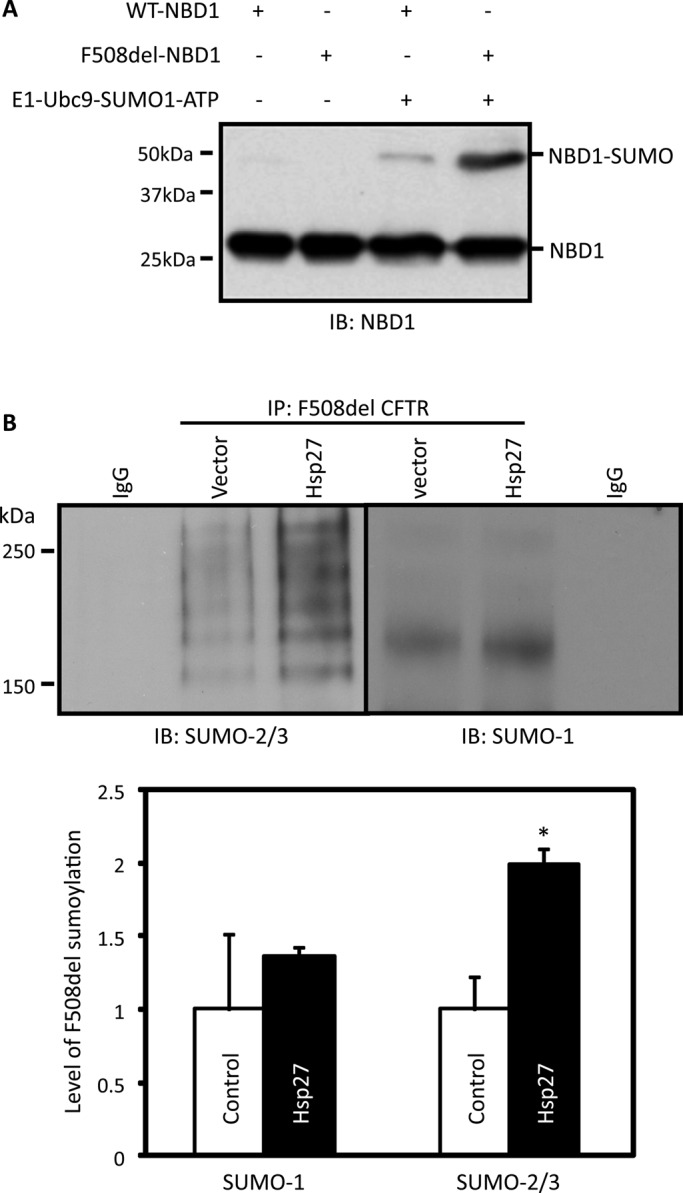
Functional linkage between the Hsp27 and SUMO pathways. (A) F508del NBD1 is preferentially modified by SUMO in vitro. Purified NBD1 proteins containing a single suppressor mutation (1S, F494N) were incubated with or without purified components for 1 h at 27°C as illustrated and described in Materials and Methods. The mixture was then resolved by SDS–PAGE and blotted with anti-NBD1. The thermal stabilities of the wild-type and mutant NBD1-1S proteins show that the 1S mutation marginally improves the F508del NBD1 conformational defect, while improving the solubility of the domain sufficiently to permit in vitro studies (Rabeh et al., 2012). The data are representative of four independent experiments. (B) Hsp27 promotes SUMOylation of F508del CFTR, which prefers SUMO-2/3. HEK293 cells were transfected with F508del CFTR and empty vector or Hsp27 DNAs, as described in Figure 1E. Modification of F508del CFTR by endogenous SUMO paralogues was assessed by CFTR IP followed by SUMO-1 or SUMO-2/3 IB. An irrelevant immunoglobulin G served as a control. SUMO density values were normalized to CFTR in the IPs, and mean values from three experiments are provided in the bottom panel.
FIGURE 5:
FIGURE 5:
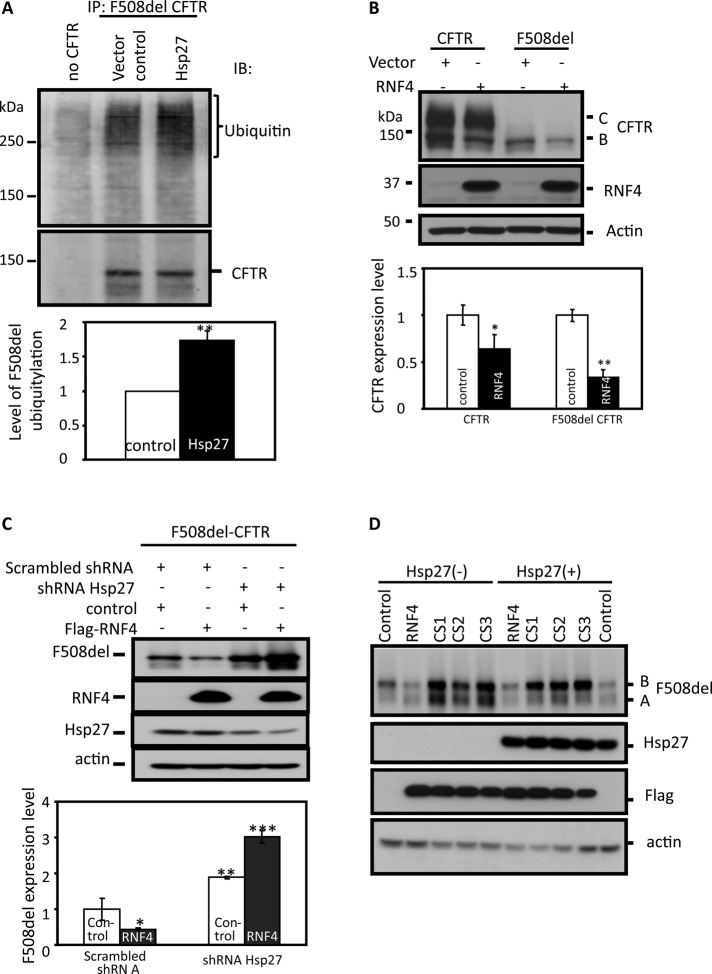
A SUMO-targeted ubiquitin ligase links F508del to the proteasome. (A) Hsp27 promotes F508del ubiquitylation. HEK293 cells were transfected with F508del CFTR and Hsp27 or empty vector, and CFTR modification was assessed by CFTR IP followed by ubiquitin IB. The bottom panel provides mean values for total ubiquitin density from five experiments, which indicate a 75% increase in CFTR ubiquitylation with Hsp27 coexpression. SEM: *, p = 0.004. (B) Expression of RNF4 preferentially decreases F508del expression. HEK293 cells were transfected with wild-type or F508del CFTR and either empty vector or Flag-RNF4 cDNAs. The bottom panel provides steady-state CFTR protein levels quantified from four independent experiments averaged and normalized to their respective controls. SEM: *, p = 0.04; **, p = 0.001. (C) Hsp27 knockdown blocks the ability of RNF4 to reduce F508del CFTR expression. HEK293 cells were transfected with either Hsp27 or scrambled shRNAs, and after 48 h, these cells were transfected with F508del CFTR and either RNF4 or empty vector (control) cDNAs. After 24 h, steady-state F508del protein levels were determined by IB. Mean data from three experiments are summarized in the bottom panel. (D) Dominant-negative RNF4 blocks the ability of Hsp27 to reduce F508del CFTR levels. HEK293 cells were transfected with F508del CFTR and Hsp27 or vector control and RNF4, DN-RNF4s (CS1-CS3), or control DNAs. The DN-RNF4s harbor cysteine-to-serine mutations within the RING domain that mediate thioester ubiquitin transfer, as noted in Materials and Methods. After 24 h, F508del protein levels were determined by IB; the data are representative of two independent experiments in which three DN constructs produced similar results.

References

    1. Ahner A, Nakatsukasa K, Zhang H, Frizzell RA, Brodsky JL. Small heat-shock proteins select ΔF508-CFTR for endoplasmic reticulum-associated degradation. Mol Biol Cell. 2007;18:806–814. - PMC - PubMed
    1. Alberti S, Bohse K, Arndt V, Schmitz A, Hohfeld J. The cochaperone HspBP1 inhibits the CHIP ubiquitin ligase and stimulates the maturation of the cystic fibrosis transmembrane conductance regulator. Mol Biol Cell. 2004;15:4003–4010. - PMC - PubMed
    1. Arrigo AP, Firdaus WJ, Mellier G, Moulin M, Paul C, Diaz-latoud C, Kretz-remy C. Cytotoxic effects induced by oxidative stress in cultured mammalian cells and protection provided by Hsp27 expression. Methods. 2005;35:126–138. - PubMed
    1. Bebok Z, Collawn JF, Wakefield J, Parker W, Li Y, Varga K, Sorscher EJ, Clancy JP. Failure of cAMP agonists to activate rescued ΔF508 CFTR in CFBE410− airway epithelial monolayers. J Physiol. 2005;569:601–615. - PMC - PubMed
    1. Biswas A, Das KP. Role of ATP on the interaction of α-crystallin with its substrates and its implications for the molecular chaperone function. J Biol Chem. 2004;279:42648–42657. - PubMed

Publication types

MeSH terms