Review
. 2013 Oct 10;19(11):1220-35.
doi: 10.1089/ars.2012.5066. Epub 2013 Jan 4.

Specificity in S-nitrosylation: a short-range mechanism for NO signaling?

Affiliations
Review

Specificity in S-nitrosylation: a short-range mechanism for NO signaling?

Antonio Martínez-Ruiz et al. Antioxid Redox Signal. .

Abstract

Significance: Nitric oxide (NO) classical and less classical signaling mechanisms (through interaction with soluble guanylate cyclase and cytochrome c oxidase, respectively) operate through direct binding of NO to protein metal centers, and rely on diffusibility of the NO molecule. S-Nitrosylation, a covalent post-translational modification of protein cysteines, has emerged as a paradigm of nonclassical NO signaling.

Recent advances: Several nonenzymatic mechanisms for S-nitrosylation formation and destruction have been described. Enzymatic mechanisms for transnitrosylation and denitrosylation have been also studied as regulators of the modification of specific subsets of proteins. The advancement of modification-specific proteomic methodologies has allowed progress in the study of diverse S-nitrosoproteomes, raising clues and questions about the parameters for determining the protein specificity of the modification.

Critical issues: We propose that S-nitrosylation is mainly a short-range mechanism of NO signaling, exerted in a relatively limited range of action around the NO sources, and tightly related to the very controlled regulation of subcellular localization of nitric oxide synthases. We review the nonenzymatic and enzymatic mechanisms that support this concept, as well as physiological examples of mammalian systems that illustrate well the precise compartmentalization of S-nitrosylation.

Future directions: Individual and proteomic studies of protein S-nitrosylation-based signaling should take into account the subcellular localization in order to gain further insight into the functional role of this modification in (patho)physiological settings.


Figures

FIG. 1.
FIG. 1.
Short-range and long-range NO signaling. Classical NO signaling, such as sGC activation, can be exerted at a relatively long distance from NO sources (NOS enzymes), even if NO concentration diminishes while targets are farther from the NOS. We postulate that S-nitrosylation of target proteins (TP) is essentially a short-range mechanism, limited to a tiny sphere around NOS. Among other factors described in the text, RNS formation requires higher NO concentrations, which are easier to achieve in the NOS surroundings (this is more clear in interacting proteins, IP), and denitrosylases such as Trx or GSNOR with GSH can narrow the range of action by reducing target protein S-nitrosylation.
FIG. 2.
FIG. 2.
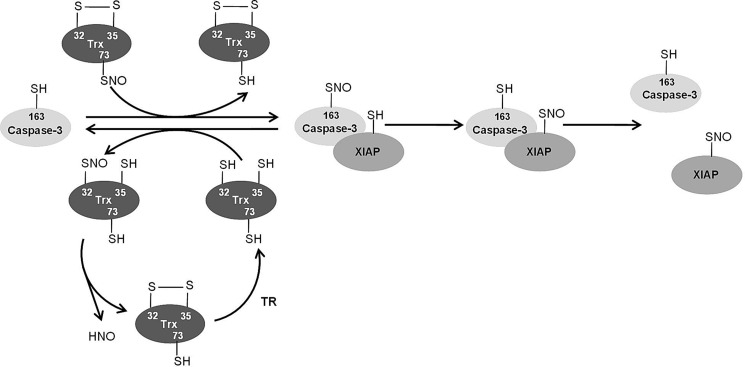
Summary of transnitrosylation reactions between Trx, caspase-3, and XIAP that leads to caspase-3 activity regulation, including Cys residues that undergo S-nitrosylation. The active site of Trx denitrosylases caspase-3 in normal conditions, producing HNO and its own disulfide, which is reduced back by Trx reductase (TR). When its active site Cys is oxidized, Trx S-nitrosylated in Cys73 is able to transnitrosylate caspase-3 in Cys163. S-nitrosylated caspase-3 may also transnitrosylate its inhibitor XIAP, leading to a release of caspase-3.
FIG. 3.
FIG. 3.
Agonist-stimulated internalization of β2-AR is regulated by S-nitrosylation. After agonist (epinephrine) stimulation, β2-AR stimulates separation of α from β and γ subunits of the G protein. The two latter subunits bind reduced GRK2, which phosphorylates β2-AR. S-Nitrosylation of GRK2 prevents its binding to β and γ subunits. Once phosphorylated, β2-AR recruits β-arrestin which becomes S-nitrosylated and subsequently binds to AP2 and clathrin, thus allowing internalization. If β-arrestin is not S-nitrosylated, internalization of β2-AR becomes attenuated.
FIG. 4.
FIG. 4.
Compartmentalized S-nitrosylation of N-Ras but not K-Ras in antigen-stimulated T cells. The figure represents the signaling pathways involved in the selective eNOS-dependent S-nitrosylation and activation of N-Ras on the Golgi complex. Although K- and N-Ras are both farnesylated, K-Ras is targeted to the plasma membrane (PM) by means of a basic carboxyl-terminal region of amino acids, whereas N-Ras is mainly localized on the Golgi by palmitoylation, co-localizing with eNOS. Upon TCR binding to antigen (Ag) on an antigen presenting cell (APC), the TCR complex is phosphorylated on the CD3ξ chains, which induces the activation of PLC-γ and Akt by recruitment of the tyrosine kinase ZAP-70. PLC-γ increases the cytosolic levels of inositol 1,4,5-triphosphate, releasing Ca2+ from internal stores, which in turn can bind calmodulin-associated eNOS. On the other hand, Akt can phosphorylate eNOS on Ser1177. As a result of the combined actions of Ca2+ and phosphorylation, eNOS is activated producing NO on the Golgi, fostering N-Ras activation by S-nitrosylation on Cys118, an amino acid residue shared by K-Ras but which is not S-nitrosylated in T cells due to K-Ras localization at a different cell compartment.
FIG. 5.
FIG. 5.
Postsynaptic localization of nNOS and S-nitrosylation signaling in a glutamatergic synapse. Production of NO by nNOS following glutamate release is coupled to activation of Ca2+-permeable NMDA receptors (NMDAr), which are anchored at the postsynaptic density by scaffolding proteins, including PSD-95. PSD-95 binds to NMDAr and nNOS via PDZ domains, allowing for a close proximity of permeable NMDAr and nNOS. NO produced in close proximity to NMDA receptors triggers the S-nitrosylation of NR2A subunits (SNO-NR2A), which then allow less Ca2+ in. Activation of NMDAr also triggers the recruitment of more AMPA receptors (AMPAr) towards the membrane surface. S-Nitrosylation of stargazin (SNO-stargazin) and NSF (SNO-NSF) contributes to increase the surface expression of AMPAr during events of synaptic plasticity following the activation of NMDAr. On the other hand, S-nitrosylation of PICK1 facilitates its release from AMPAr after membrane insertion and also facilitates surface expression of AMPAr. When these proteins are out of range of NO and are not S-nitrosylated, PICK1 interacts more strongly with the receptor while NSF interacts more weakly, allowing the binding of proteins that facilitate endocytosis of AMPAr.
FIG. 6.
FIG. 6.
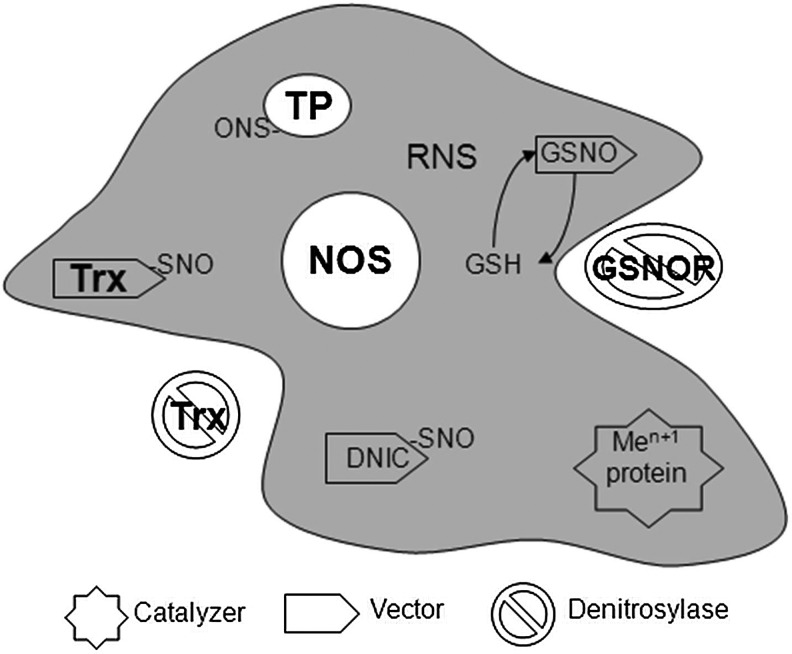
Integration of several factors affecting short-range S-nitrosylation signaling. The short-range S-nitrosylation signaling range of action shadowed in gray (see also Fig. 1) becomes more complex when other factors are included. In addition to catalyzed RNS formation that could be exerted by membranes (not shown), some metal proteins are also catalyzers of S-nitrosylation formation, expanding the range of action. Transnitrosylases (including Trx) and other LMM vectors such as GSNO or DNIC can also selectively extend it to their targets. On the other hand, denitrosylases such as Trx or GSNOR, limit the influence of S-nitrosylation in certain areas and/or in certain protein targets.

References

    1. Aarts M. Liu Y. Liu L. Besshoh S. Arundine M. Gurd JW. Wang YT. Salter MW. Tymianski M. Treatment of ischemic brain damage by perturbing NMDA receptor- PSD-95 protein interactions. Science. 2002;298:846–850. - PubMed
    1. Aarts MM. Tymianski M. Molecular mechanisms underlying specificity of excitotoxic signaling in neurons. Curr Mol Med. 2004;4:137–147. - PubMed
    1. Adachi T. Weisbrod RM. Pimentel DR. Ying J. Sharov VS. Schoneich C. Cohen RA. S-glutathiolation by peroxynitrite activates SERCA during arterial relaxation by nitric oxide. Nat Med. 2004;10:1200–1207. - PubMed
    1. Ahern GP. Klyachko VA. Jackson MB. cGMP and S-nitrosylation: Two routes for modulation of neuronal excitability by NO. Trends Neurosci. 2002;25:510–517. - PubMed
    1. Anand P. Stamler JS. Enzymatic mechanisms regulating protein S-nitrosylation: Implications in health and disease. J Mol Med (Berl) 2012;90:233–244. - PMC - PubMed

Publication types

LinkOut - more resources