


BMI can influence adult males' and females' airway hyperresponsiveness differently
- PMID: 23157852
- PMCID: PMC3529699
- DOI: 10.1186/2049-6958-7-45
BMI can influence adult males' and females' airway hyperresponsiveness differently
Abstract
Background: Epidemiological data indicate that obesity is a risk factor for asthma, but scientific literature is still debating the association between changes in body mass index (BMI) and airway hyperresponsiveness (AHR).
Methods: This study aimed at evaluating the influence of BMI on AHR, in outpatients with symptoms suggestive of asthma.4,217 consecutive adult subjects (2,439 M; mean age: 38.2±14.9 yrs; median FEV1 % predicted: 100 [IQR:91.88-107.97] and FEV1/FVC % predicted: 85.77% [IQR:81.1-90.05]), performed a methacholine challenge test for suspected asthma. Subjects with PD20 < 200 or 200 < PD20 < 800 or PD20 > 800 were considered affected by severe, moderate or mild AHR, respectively.
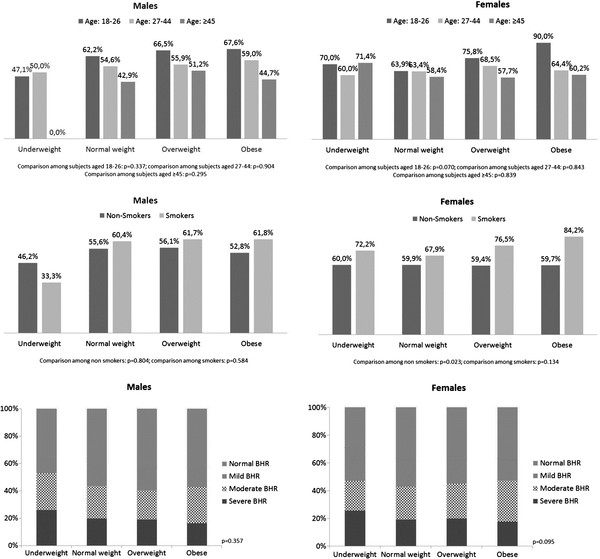
Results: A total of 2,520 subjects (60% of all cases) had a PD20 < 3,200 μg, with a median PD20 of 366 μg [IQR:168-1010.5]; 759, 997 and 764 patients were affected by mild, moderate and severe AHR, respectively. BMI was not associated with increasing AHR in males. On the contrary, obese females were at risk for AHR only when those with moderate AHR were considered (OR: 1.772 [1.250-2.512], p = 0.001). A significant reduction of FEV1/FVC for unit of BMI increase was found in moderate AHR, both in males (β = -0.255; p =0.023) and in females (β = -0.451; p =0.017).
Conclusions: Our findings indicate that obesity influences AHR only in females with a moderate AHR level. This influence may be mediated by obesity-associated changes in baseline lung function.
Figures
References
LinkOut - more resources
Full Text Sources
