. 2013 Mar;144(3):580-590.e7.
doi: 10.1053/j.gastro.2012.11.022. Epub 2012 Nov 15.

Weight-independent effects of roux-en-Y gastric bypass on glucose homeostasis via melanocortin-4 receptors in mice and humans

Affiliations

Weight-independent effects of roux-en-Y gastric bypass on glucose homeostasis via melanocortin-4 receptors in mice and humans

Juliet F Zechner et al. Gastroenterology. 2013 Mar.

Abstract

Background & aims: Roux-en-Y gastric bypass (RYGB) improves glucose homeostasis independently of changes in body weight by unknown mechanisms. Melanocortin-4 receptors (MC4R) have weight-independent effects on glucose homeostasis, via autonomic neurons, and also might contribute to weight loss after RYGB. We investigated whether MC4Rs mediate effects of RYGB, such as its weight-independent effects on glucose homeostasis, in mice and humans.

Methods: We studied C57BL/6 mice with diet-induced obesity, MC4R-deficient mice, and mice that re-express MC4R specifically in autonomic neurons after RYGB or sham surgeries. We also sequenced the MC4R locus in patients undergoing RYGB to investigate diabetes resolution in carriers of rare MC4R variants.

Results: MC4Rs in autonomic brainstem neurons (including the parasympathetic dorsal motor vagus) mediated improved glucose homeostasis independent of changes in body weight. In contrast, MC4Rs in cholinergic preganglionic motor neurons (sympathetic and parasympathetic) mediated RYGB-induced increased energy expenditure and weight loss. Increased energy expenditure after RYGB is the predominant mechanism of weight loss and confers resistance to weight gain from a high-fat diet, the effects of which are MC4R-dependent. MC4R-dependent effects of RYGB still occurred in mice with Mc4r haplosufficiency, and early stage diabetes resolved at a similar rate in patients with rare variants of MC4R and noncarriers. However, carriers of MC4R (I251L), a rare variant associated with increased weight loss after RYGB and increased basal activity in vitro, were more likely to have early and weight-independent resolution of diabetes than noncarriers, indicating a role for MC4Rs in the effects of RYGB.

Conclusions: MC4Rs in autonomic neurons mediate beneficial effects of RYGB, including weight-independent improved glucose homeostasis, in mice and humans.


Conflict of interest statement

The authors declare no conflicts of interest.

Figures
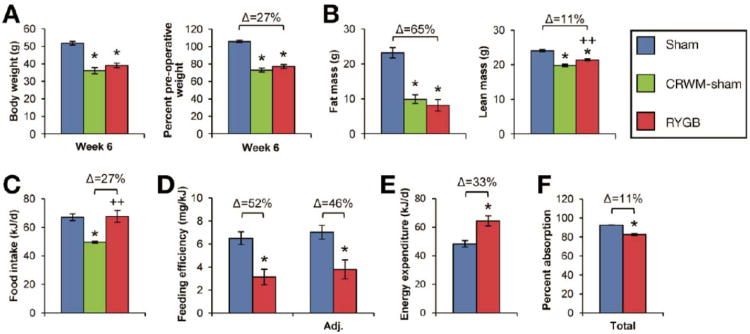
Figure 1
Figure 1. RYGB induces weight loss in DIO mice
(A) Total body weight (left) during post-operative week 6 and expressed as a percentage of pre-operative weight (right) in RYGB-treated (red), Sham (blue), and calorie-restricted, weight-matched Sham mice (CRWM-Sham, in green) (n=27, RYGB; n=29, Sham; n=12, CRWM-Sham). (B) Reduced fat and lean mass in RYGB and CRWM-Sham mice (n=4/group). (C) RYGB did not reduce food intake (n=11-25/group). Daily calorie restriction required to weight-match CRWM-Sham mice (n=12) to RYGB mice is shown in green. (D) RYGB reduced feeding efficiency (weight gain per kJ consumed). Feeding efficiency remained substantially reduced after adjusting for fecal energy losses (Adj. feeding efficiency)(n=11-25/group). (E) Energy expenditure was increased by 33% after RYGB (n=11-25/group). (F) Calorie absorption was slightly reduced after RYGB (n=8/group). *p<.05 vs. Sham, ++p<.05 vs. CRWM-Sham.
Figure 2
Figure 2. RYGB improves hepatic glucose homeostasis in DIO mice
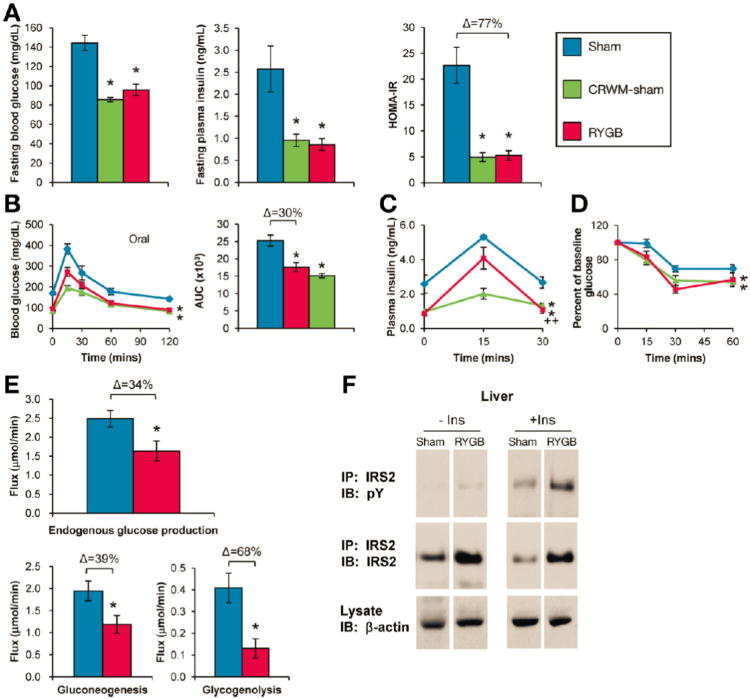
(A) RYGB reduced fasting glucose (left), fasting insulin (middle), and HOMA-IR (right) (n=4-11/group). (B) RYGB improved oral glucose tolerance, (C) reduced glucose-stimulated plasma insulin, and (D) improved insulin tolerance, presented as % of baseline glucose to control for differences in baseline glucose (n=5-6/group). (E) RYGB reduced basal endogenous glucose production, gluconeogenesis, and glycogenolysis as measured during week 6 using in vivo NMR metabolic flux analysis (n=5-9/group). (F) RYGB increased insulin-stimulated IRS2 tyrosine phosphorylation and protein expression (n=4/group). IP, immunoprecipitate; IB, immunoblot. *p<.05 vs. Sham, ++p<.05 vs. CRWM-Sham.
Figure 3
Figure 3. MC4Rs in autonomic neurons mediate effects of RYGB on energy expenditure and body weight
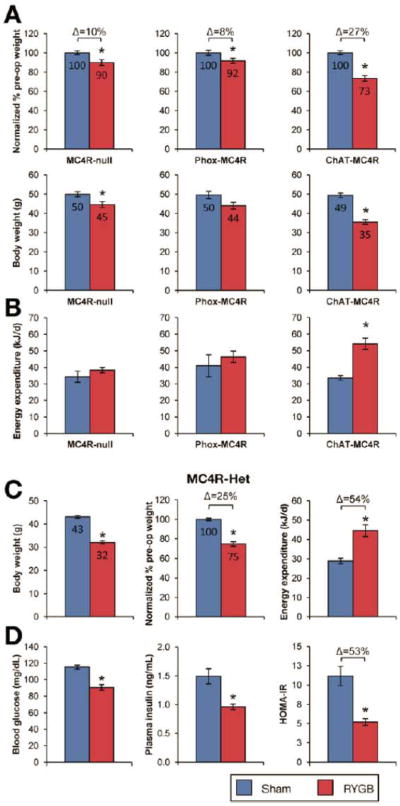
(A) RYGB-induced weight loss was attenuated in both MC4R-null (left) and Phox-MC4R mice (middle). In contrast, RYGB induced substantial weight reduction in ChAT-MC4R mice (right). The weight reduction observed in ChAT-MC4R mice was comparable to that seen in DIO mice (See Supplemental Figure 3). Body weight is presented as total (bottom) and also expressed as percentage of pre-operative weight (top), to facilitate comparison of the relative effects of RYGB across genotypes (n=22-24/group, MC4R-null; n=6-22/group, Phox-MC4R and ChAT-MC4R). (B) RYGB failed to increase energy expenditure in MC4R-null and Phox-MC4R mice (n=10-25/group, MC4R-null; n=6-22/group, Phox-MC4R). In contrast, RYGB increased energy expenditure in ChAT-MC4R mice, consistent with their weight loss (n=6-22/group, ChAT-MC4R mice). (C) RYGB reduced body weight of obese MC4R-Het mice by 25% during week 6 (n=7-10/group). Consistent with their weight reduction after RYGB, energy expenditure was increased in MC4R-Het mice (n=7-10). (D) RYGB improved fasting glucose, fasting insulin, and HOMA-IR in MC4R-Het mice (n=7-10). *p<.05 vs. Sham.
Figure 4
Figure 4. MC4Rs in parasympathetic vagal motor neurons mediate effects of RYGB on glucose homeostasis independent of changes in body weight
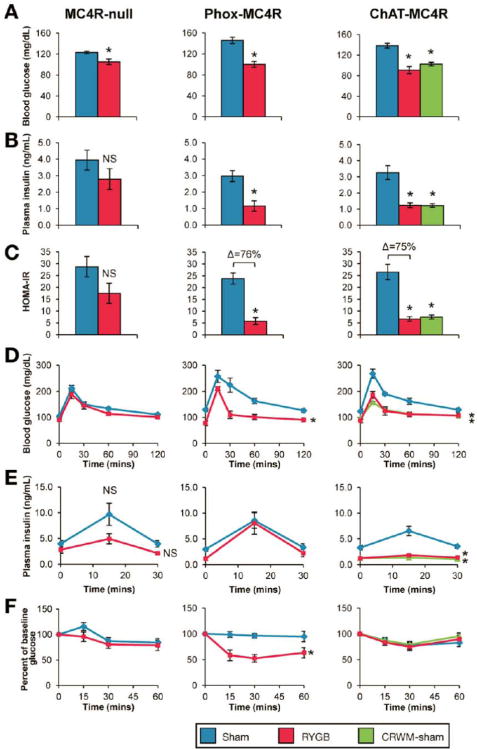
(A-F, left panels) RYGB significantly reduced fasting glucose in MC4R-null mice, but failed to produce statistically-significant improvements in other measures of glucose homeostasis: insulin (B), HOMA-IR (C), glucose tolerance (D), glucose-stimulated plasma insulin (E), and insulin tolerance (F), presented as % of baseline glucose to control for differences in baseline glucose (n=6-14/group). (A-F, middle panels) In contrast, RYGB reduced fasting glucose (A) and insulin (B), and improved HOMA-IR (C), oral glucose tolerance (D), and insulin tolerance (F) in Phox-MC4R mice, despite a similar blunted weight-reduction as seen in MC4R-null mice. RYGB did not reduce their glucose-stimulated plasma insulin (n=6-7/group). (A-F, right panels) Consistent with their substantial weight reduction, fasting glucose (A), fasting plasma insulin (B), and glucose-stimulated plasma insulin (C) were reduced and oral glucose tolerance improved (D) in RYGB-treated ChAT-MC4R mice and CRWM-Sham ChAT-MC4R mice (n=6-7/group). *p<.05 vs. Sham.
Figure 5
Figure 5. RYGB induces resistance to HFD-induced weight-gain
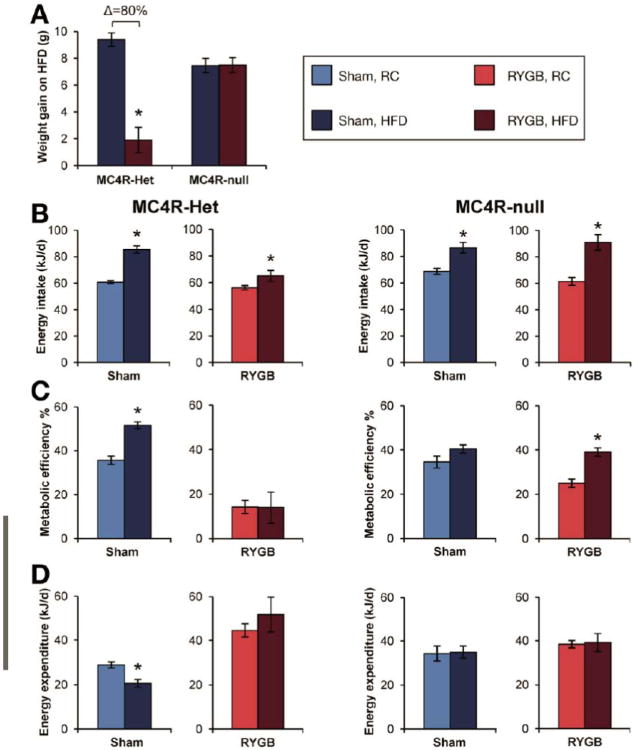
(A) RYGB-treated MC4R-Het mice fail to gain weight upon challenge with HFD for 8 days compared to Sham mice. In contrast, Sham- and RYGB-treated MC4R-null mice gained substantial and equivalent weight (n=4-11/group) (B) Food intake was increased on HFD in RYGB-treated and Sham-operated mice of both genotypes (n=4-11/group). (C and D) Sham-operated MC4R-Het and MC4R-null mice and RYGB-treated MC4R-null mice assimilate all excess consumed energy on HFD as body mass at an elevated metabolic efficiency. Energy expenditure is reduced in Sham-operated MC4R-Het mice as a compensation for their weight gain on HFD. In contrast, RYGB-treated MC4R-Het mice fail to increase their metabolic efficiency on HFD. In addition, their elevated energy expenditure persists and remains elevated versus Sham MC4R-Het mice (n=4-11/group). *p<.05 RYGB vs. Sham or HFD vs. RC.
Figure 6
Figure 6. MC4Rs mediate beneficial effects of RYGB on glucose homeostasis in humans with rare MC4R variants
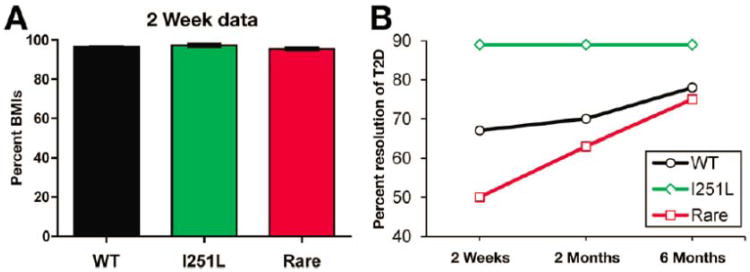
(A) Post-operative weight, expressed as a percentage of pre-operative BMI (%BMIs), was equivalent in MC4R(I251L) carriers (green; n=26), rare variant carriers linked to obesity (red; n=18) and non-carriers (black; n=1399) at two weeks post-operative (range 10-20 days). (B) Resolution of type 2 diabetes (T2D), defined as cessation of all anti-diabetic medications, in carriers of the MC4R(I251L) variant (green; 8 of 9 patients), carriers of rare MC4R variants (red; 4 of 8) and non-carriers (black; 399 of 597) at 2 weeks, 2 months, and 6 months after RYGB.

Comment in

References

    1. Schauer PR, Burguera B, Ikramuddin S, et al. Effect of laparoscopic Roux-en Y gastric bypass on type 2 diabetes mellitus. Ann Surg. 2003;238:467–84. discussion 84-5. - PMC - PubMed
    1. Wickremesekera K, Miller G, Naotunne TD, et al. Loss of insulin resistance after Roux-en-Y gastric bypass surgery: a time course study. Obes Surg. 2005;15:474–481. - PubMed
    1. Scott WR, Batterham RL. Roux-en-Y gastric bypass and laparoscopic sleeve gastrectomy: understanding weight loss and improvements in type 2 diabetes after bariatric surgery. Am J Physiol Regul Integr Comp Physiol. 2011;301:R15–27. - PubMed
    1. Nestoridi E, Kvas S, Kucharczyk J, et al. Resting Energy Expenditure and Energetic Cost of Feeding Are Augmented after Roux-en-Y Gastric Bypass in Obese Mice. Endocrinology. 2012;153:2234–44. - PubMed
    1. Hatoum IJ, Stylopoulos N, Vanhoose AM, et al. Melanocortin-4 Receptor Signaling Is Required for Weight Loss after Gastric Bypass Surgery. J Clin Endocrinol Metab. 2012;97 - PMC - PubMed

Publication types

Substances