. 2013 Jan;50(1):25-33.
doi: 10.1136/jmedgenet-2012-101085. Epub 2012 Nov 17.

Identification of a functional variant in the KIF5A-CYP27B1-METTL1-FAM119B locus associated with multiple sclerosis

Affiliations
Free PMC article

Identification of a functional variant in the KIF5A-CYP27B1-METTL1-FAM119B locus associated with multiple sclerosis

Antonio Alcina et al. J Med Genet. 2013 Jan.
Free PMC article

Abstract

Background and aim: Several studies have highlighted the association of the 12q13.3-12q14.1 region with coeliac disease, type 1 diabetes, rheumatoid arthritis and multiple sclerosis (MS); however, the causal variants underlying diseases are still unclear. The authors sought to identify the functional variant of this region associated with MS.

Methods: Tag-single nucleotide polymorphism (SNP) analysis of the associated region encoding 15 genes was performed in 2876 MS patients and 2910 healthy Caucasian controls together with expression regulation analyses.

Results: rs6581155, which tagged 18 variants within a region where 9 genes map, was sufficient to model the association. This SNP was in total linkage disequilibrium (LD) with other polymorphisms that associated with the expression levels of FAM119B, AVIL, TSFM, TSPAN31 and CYP27B1 genes in different expression quantitative trait loci studies. Functional annotations from Encyclopedia of DNA Elements (ENCODE) showed that six out of these rs6581155-tagged-SNPs were located in regions with regulatory potential and only one of them, rs10877013, exhibited allele-dependent (ratio A/G=9.5-fold) and orientation-dependent (forward/reverse=2.7-fold) enhancer activity as determined by luciferase reporter assays. This enhancer is located in a region where a long-range chromatin interaction among the promoters and promoter-enhancer of several genes has been described, possibly affecting their expression simultaneously.

Conclusions: This study determines a functional variant which alters the enhancer activity of a regulatory element in the locus affecting the expression of several genes and explains the association of the 12q13.3-12q14.1 region with MS.


Figures
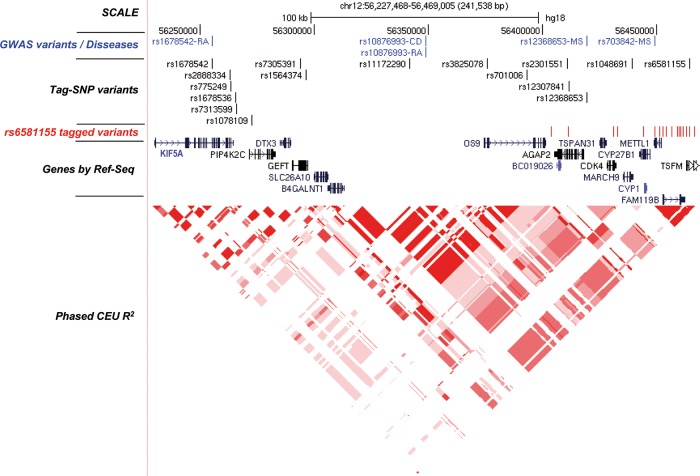
Figure 1
Figure 1
Scheme of the 12q13.3–12q14.1 region. The illustration shows from top to bottom the following parts as indicated : Scale and chromosomal position (B36/gh18); (in blue) diseases-associated variants as reported in different genome-wide association study (RA, rheumatoid arthritis; CD, coeliac disease; MS, multiple sclerosis); Tag-SNPs analysed in the present work; (in red) MS-associated rs6581155-tagged variants with r2≥0.8 and a minor-allele frequency <0.1; Ref-Seq genes present in the region; the LD structure represented by r-square for the CEU population.
Figure 2
Figure 2
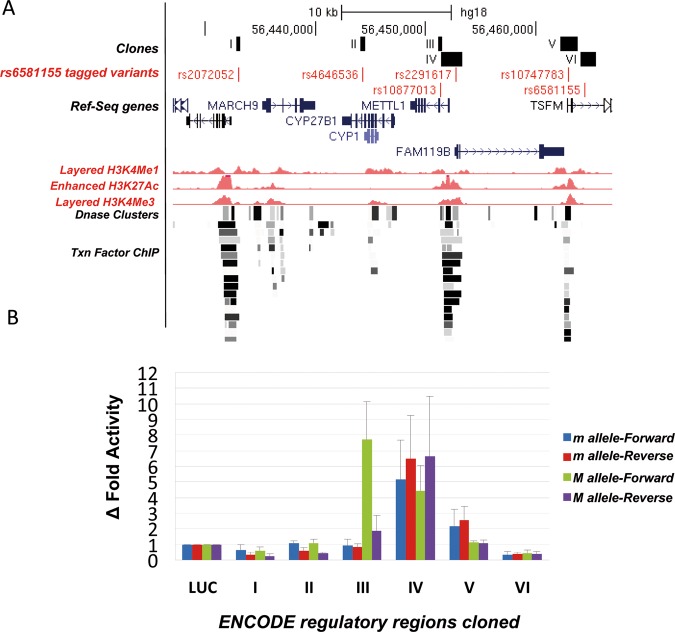
Enhancer-suppressor activity of the rs6581155-tagged variants. (A) Schematic illustration to show the localisation of the six tagged SNPs (in red) in potential regulatory regions (in black, I–VI) as indicated by ENCODE for the GM12878 lymphoblastoid cell line and the genes present in the region: Enhancer H3K4Me1 track shows where modification of histone proteins is suggestive of enhancer; Promoter H3K4Me3 track shows a histone mark associated with promoters; Layered H3K4Me3 track shows histone mark associated with promoters that are active or poised to be activated; DNase Clusters track shows regions where chromatin is hypersensitive to DNase I enzyme; Txn Factor ChIP track shows DNA regions where transcription factors bind to DNA as assayed by chromatin immunoprecipitation (ChIP) with antibodies specific to the transcription factor followed by sequencing of the precipitated DNA (ChIP-Seq). (B) Δ Fold luciferase activity respect to the empty vector of the different constructs corresponding to the six regions (I–VI) with potential regulatory activity, containing the rs6581155 tagged polymorphisms transfected into Raji B cells. Four clones for each region bearing the different alleles (allele m, minor and M, major) and in both orientations (Forward and Reverse) from three independent transfection experiments are represented. Luciferase activity levels are referred to the level of the control plasmid containing only the basic promoter and the Renilla activity.
Figure 3
Figure 3
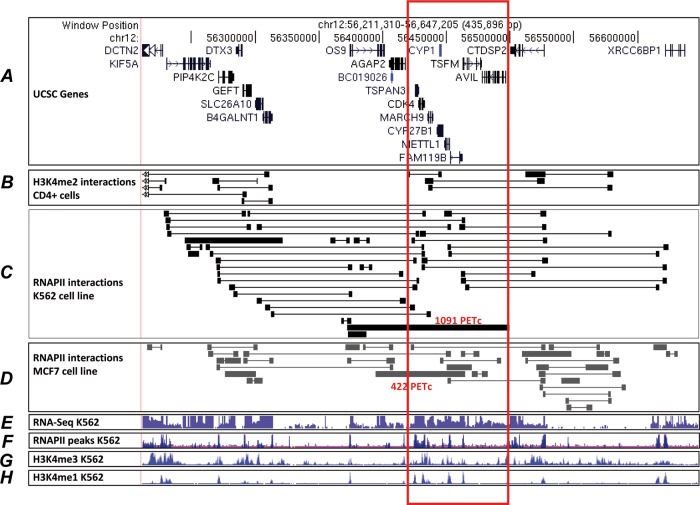
Datasets on Long-Range Chromatin Interaction with Paired-End-Tag sequencing (ChIA-PET) in the studied region. (A) Coordinates of chr12 in B37 and known genes by University of California Santa Cruz (UCSC) browser. (B) H3K4me2 ChIA-PET data obtained from CD4 T cells, data from Chepelev et al. (C) RNAPII ChIA-PET data obtained in K562 cells (data from Li et al36) In red, the number of the PET-counts (PETc) of the most frequent interactions is indicated. (D) RNAPII ChIA-PET data obtained in MCF7 cells. The most frequent interactions are indicated in red. (E) ENCODE information on transcription levels assayed by sequencing of polyadenylated RNA from K562 cells. (F) ENCODE information on the RNAPII binding sites by ChIP-seq. (G) H3K4Me3 histone mark in K562 cells associated with promoters. (H) H3K4Me1 modification of histone proteins in K562 cells, suggestive of enhancer and, to a lesser extent, other regulatory activity.

References

    1. Hauser SL, Oksenberg JR. The neurobiology of multiple sclerosis: genes, inflammation, and neurodegeneration. Neuron 2009;52:61–76 - PubMed
    1. McElroy JP, Oksenberg JR. Multiple sclerosis genetics. Curr Top Microbiol Immunol 2008;318:45–72 - PubMed
    1. Ramagopalan SV, Knight JC, Ebers GC. Multiple sclerosis and the major histocompatibility complex. Curr Opin Neurol 2009;22:219–25 - PubMed
    1. Manolio TA, Collins FS, Cox NJ, Goldstein DB, Hindorff LA, Hunter DJ, McCarthy MI, Ramos EM, Cardon LR, Chakravarti A, Cho JH, Guttmacher AE, Kong A, Kruglyak L, Mardis E, Rotimi CN, Slatkin M, Valle D, Whittemore AS, Boehnke M, Clark AG, Eichler EE, Gibson G, Haines JL, Mackay TF, McCarroll SA, Visscher PM. Finding the missing heritability of complex diseases. Nature 2009;461:747–53 - PMC - PubMed
    1. Bomprezzi R, Kovanen PE, Martin R. New approaches to investigating heterogeneity in complex traits. J Med Genet 2003;40:553–9 - PMC - PubMed

Publication types

MeSH terms