


Methylphenidate enhances executive function and optimizes prefrontal function in both health and cocaine addiction
- PMID: 23162047
- PMCID: PMC3920764
- DOI: 10.1093/cercor/bhs345
Methylphenidate enhances executive function and optimizes prefrontal function in both health and cocaine addiction
Abstract
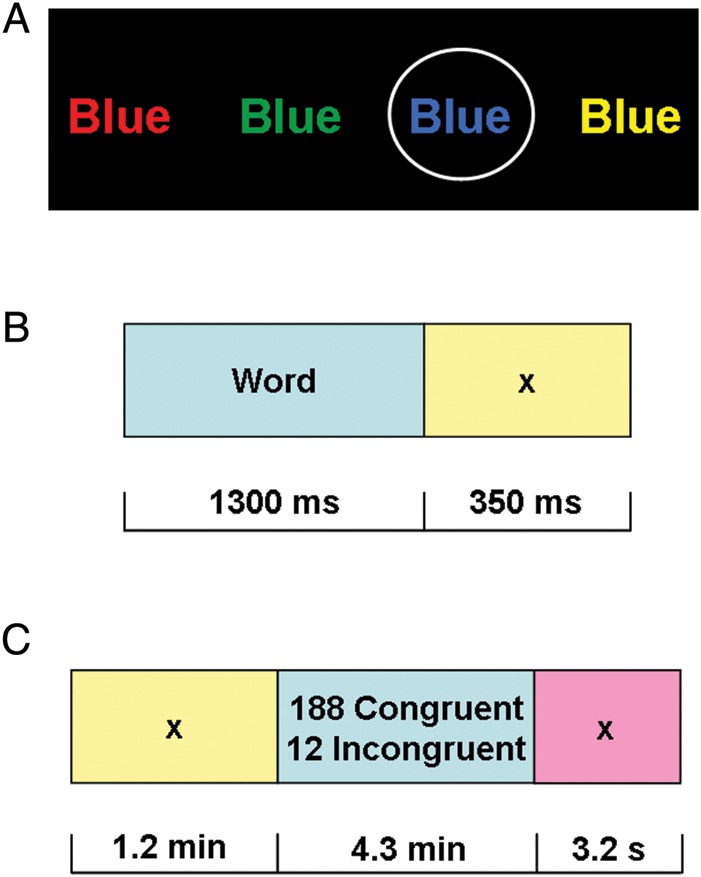
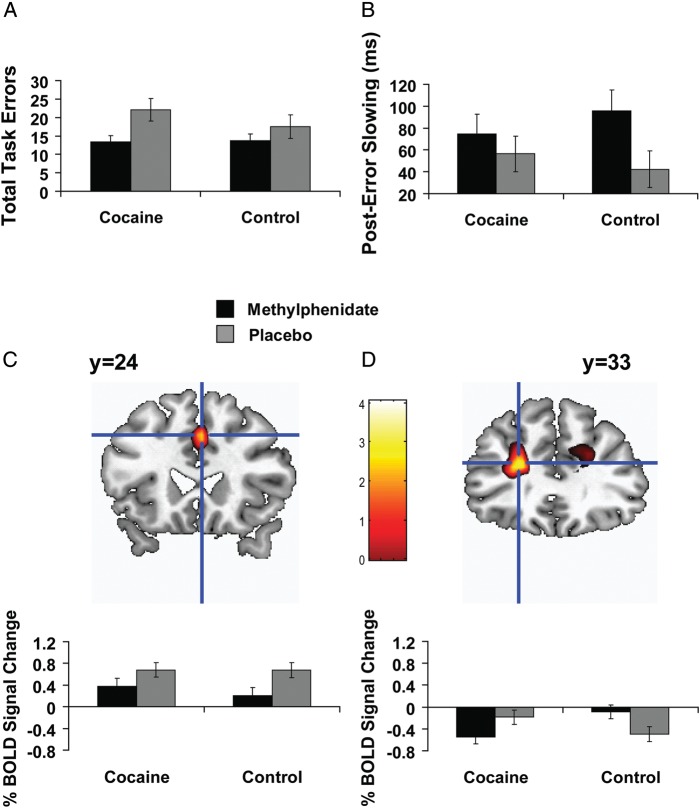
Previous studies have suggested dopamine to be involved in error monitoring/processing, possibly through impact on reinforcement learning. The current study tested whether methylphenidate (MPH), an indirect dopamine agonist, modulates brain and behavioral responses to error, and whether such modulation is more pronounced in cocaine-addicted individuals, in whom dopamine neurotransmission is disrupted. After receiving oral MPH (20 mg) or placebo (counterbalanced), 15 healthy human volunteers and 16 cocaine-addicted individuals completed a task of executive function (the Stroop color word) during functional magnetic resonance imaging (fMRI). During MPH, despite not showing differences on percent accuracy and reaction time, all subjects committed fewer total errors and slowed down more after committing errors, suggestive of more careful responding. In parallel, during MPH all subjects showed reduced dorsal anterior cingulate cortex response to the fMRI contrast error>correct. In the cocaine subjects only, MPH also reduced error>correct activity in the dorsolateral prefrontal cortex (controls instead showed lower error>correct response in this region during placebo). Taken together, MPH modulated dopaminergically innervated prefrontal cortical areas involved in error-related processing, and such modulation was accentuated in the cocaine subjects. These results are consistent with a dopaminergic contribution to error-related processing during a cognitive control task.
Keywords: Stroop; anterior cingulate cortex; cerebellum; cocaine addiction; dopamine; dorsolateral prefrontal cortex; executive function; fMRI; methylphenidate; norepinephrine.
Figures
References
-
- Adler RJ. The Geometry of Random Fields. Chichester: John Wiley & Sons; 1981.
-
- Arnsten AF. Toward a new understanding of attention-deficit hyperactivity disorder pathophysiology: an important role for prefrontal cortex dysfunction. CNS Drugs. 2009;23(Suppl 1):33–41. doi:10.2165/00023210-200923000-00005. - DOI - PubMed
-
- Ashburner J, Neelin P, Collins DL, Evans A, Friston K. Incorporating prior knowledge into image registration. Neuroimage. 1997;6:344–352. doi:10.1006/nimg.1997.0299. - DOI - PubMed
-
- Azizian A, Nestor LJ, Payer D, Monterosso JR, Brody AL, London ED. Smoking reduces conflict-related anterior cingulate activity in abstinent cigarette smokers performing a Stroop task. Neuropsychopharmacology. 2010;35:775–782. doi:10.1038/npp.2009.186. - DOI - PMC - PubMed
-
- Barnes JJ, Dean AJ, Nandam LS, O'Connell RG, Bellgrove MA. The molecular genetics of executive function: role of monoamine system genes. Biol Psychiatry. 2011;69:e127–143. doi:10.1016/j.biopsych.2010.12.040. - DOI - PubMed
Publication types
MeSH terms
Substances
Grants and funding
LinkOut - more resources
Full Text Sources
Medical
