


A retrospective analysis of risk factors for meniscal co-morbidities in anterior cruciate ligament injuries
- PMID: 23162151
- PMCID: PMC3491792
- DOI: 10.4103/0019-5413.101038
A retrospective analysis of risk factors for meniscal co-morbidities in anterior cruciate ligament injuries
Abstract
Background: The association of meniscal cartilage injury with anterior cruciate ligament (ACL) injury is well documented in literature. The aim of this study was to examine the relative risk factors for meniscal pathology at the time of arthroscopic ACL reconstruction.
Materials and methods: A review of the case records including both in-patient and out-patient charts of all patients who underwent arthroscopic ACL reconstruction during the preceding 3 years was performed by either of the authors. The relative incidences of associated meniscal pathologies were analyzed in correlation with age, side of injury, time to surgery, mode of injury, and gender as the risk factors. Statistical analysis was performed to obtain individual data correlation.
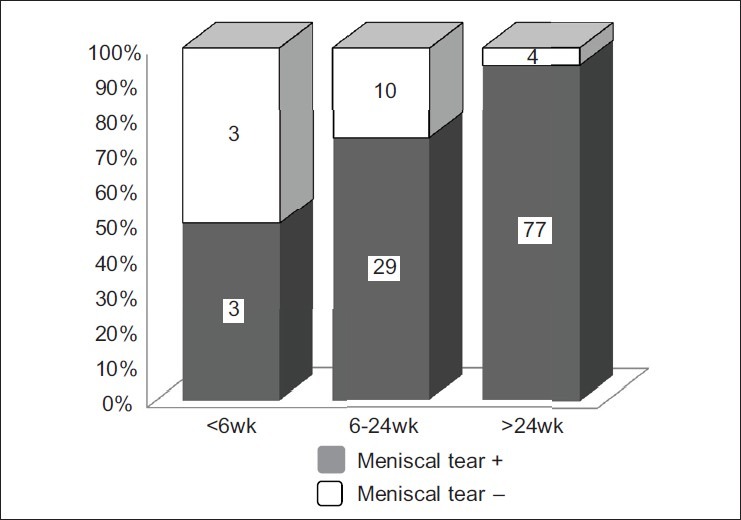
Results: A total of 192 patients underwent ACL reconstruction during the 3-year time frame. Of these, complete data sets were available for 129 patients. Analysis revealed that the only factor that was statistically significant in raising the risk of meniscal pathology was the time to surgery (P = 0.001). There was a significant increase in medial, lateral, and both meniscal tears noted in cases operated beyond 24 weeks. Further, the incidence of medial meniscal tears as well as lateral meniscal tears increased with delay in presentation for surgery (P = 0.004). Mode of injury, age at presentation, sex, and side were not significantly associated with an increased incidence of meniscal pathology.
Conclusion: The single factor that significantly affects incidence of meniscal co-morbidity in ACL injury is the delay in presentation (i.e. the time to surgery). The incidence of lateral meniscal tears as well as medial meniscal tears increased with delay in surgery. This should guide us toward recommending all patients irrespective of age, gender, or mode of injury to undergo early reconstruction, thereby reducing the likelihood of developing meniscal pathology.
Keywords: Anterior cruciate ligament reconstruction; meniscal tear; time to surgery.
Conflict of interest statement
Figures

References
-
- Bellabarba C, Bush-Joseph CA, Bach BR., Jr Patterns of meniscal injury in the anterior cruciate-deficient knee: A review of the literature. 1997;26:18-23. Am J Orthop. 1997;26:18–23. [Last cited in 2011 Dec 19] - PubMed
-
- Shelbourne KD, Gray T. Minimum 10-year results after anterior cruciate ligament reconstruction: How the loss of normal knee motion compounds other factors related to the development of osteoarthritis after surgery. 2009;37:471-80. Am J Sports Med. 2009;37:471–80. [Last cited in 2011 Dec 19] - PubMed
-
- Church S, Keating JF. Reconstruction of the anterior cruciate ligament: Timing of surgery and the incidence of meniscal tears and degenerative change. J Bone Joint Surg Br. 2005;87:1639–42. [Last cited in 2011 Dec 19] - PubMed
-
- De Roeck NJ, Lang-Stevenson A. Meniscal tears sustained awaiting anterior cruciate ligament reconstruction. Injury. 2003;34:343–5. [Last cited in 2011 Dec 19] - PubMed
-
- Freedman KB, D’Amato MJ, Nedeff DD, Kaz A, Bach BR., Jr Arthroscopic anterior cruciate ligament reconstruction: A metaanalysis comparing patellar tendon and hamstring tendon autografts. Am J Sports Med. 2003;31:2–11. [Last cited in 2011 Dec 19] - PubMed
LinkOut - more resources
Full Text Sources