doi: 10.1371/journal.pgen.1003096.
Epub 2012 Nov 8.
The Covariate's Dilemma
Affiliations
- PMID: 23162385
- PMCID: PMC3497901
- DOI: 10.1371/journal.pgen.1003096
Item in Clipboard
The Covariate's Dilemma
PLoS Genet.
2012.
No abstract available
Conflict of interest statement
The authors have declared that no competing interests exist.
Figures
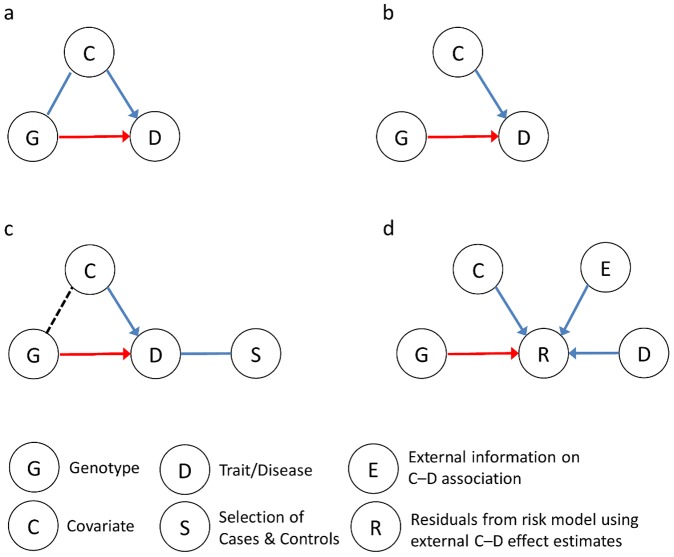
(a) The covariate C is a confounder associated with both the trait D and the
gene G but is not an intermediate on the causal path of interest between G
and D. The G–D association should be assessed while controlling C.
Omitting C from the analysis of the G–D association can lead to
misattribution of a C–D effect to G and false discovery or biased
estimates of a G–D effect. (b) The covariate C is independently
associated with the trait D but not with gene G (so C is not a confounder).
If the trait is quantitative or the study subjects are randomly ascertained,
including C in a linear or logistic regression model will increase power to
detect the G–D association. (c) If the trait is binary and the
subjects are ascertained based on case-control status, the probability of
selection (S) depends on G and C and induces a correlation between them.
Then including C in a logistic regression model can inflate the G–D
association's standard error, reducing power. Omitting C provides the
most potential gain in power when C has a strong effect on D, and when D is
less common . (d) In Zaitlen et al.'s new approach for
evaluating G–D associations with case-control data, a risk model for D
is developed from external information about the C–D association and
observed C and D levels. Residuals from this model, R, distinguish high- and
low-risk cases and controls. Then testing for G–R associations
assesses genetic effects unexplained by C in a potentially more powerful
manner than conventional logistic regression.
References
-
- Pirinen M, Donnelly P, Spencer CCA (2012) Including known covariates can reduce power to detect genetic effects in case-control studies. Nat Genet 44: 848–851. - PubMed
-
- Robinson LD, Jewell NP (1991) Some surprising results about covariate adjustment in logistic regression models. Int Stat Rev 59: 227–240.
-
- Neuhaus JM, Jewell NP (1993) A geometrical approach to assess bias due to omitted covariates in generalized linear models. Biometrika 80: 807–815.
-
- Neuhaus JM (1998) Estimation efficiency with omitted covariates in generalized linear models. J Am Stat Assoc 93: 1124–1129.
-
- Kuo CL, Feingold E (2010) What's the best statistic for a simple test of genetic association in a case-control study? Genet Epidemiol 34: 246–253. - PubMed
Publication types
MeSH terms
Grants and funding
LinkOut - more resources
Full Text Sources