Anesthesia for thoracic surgery: a survey of middle eastern practice
- PMID: 23162388
- PMCID: PMC3498653
- DOI: 10.4103/1658-354X.101196
Anesthesia for thoracic surgery: a survey of middle eastern practice
Erratum in
- Saudi J Anaesth. 2012 Oct-Dec;6(4):372. Al-Haddabi, Maida [added]
Abstract
Purpose: The main objective of this survey is to describe the current practice of thoracic anesthesia in the Middle Eastern (ME) region.
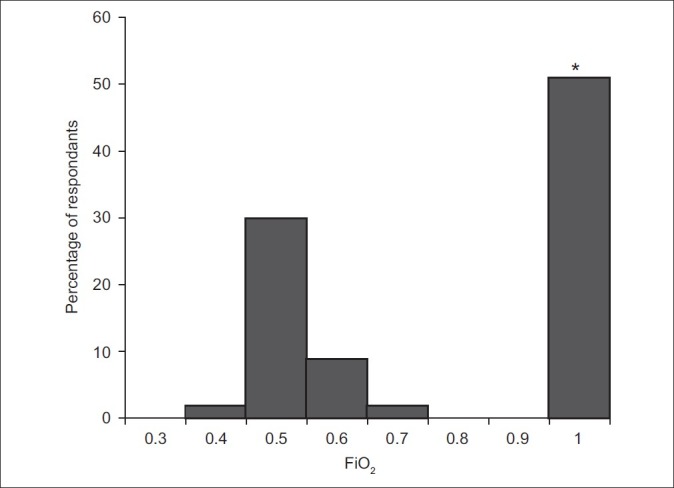
Methods: A prospective online survey. An invitation to participate was e-mailed to all members of the ME thoracic-anaesthesia group. A total of 58 members participated in the survey from 19 institutions in the Middle East. Questions concerned ventilation strategies during one-lung ventilation (OLV), anesthesia regimen, mode of postoperative analgesia, use of lung isolation techniques, and use of i.v. fluids.
Results: Volume-controlled ventilation was favored over pressure-controlled ventilation (62% vs 38% of respondents, P<0.05); 43% report the routine use of positive end-expiratory pressure. One hundred percent of respondents report using double-lumen tube (DLT) as a first choice airway to establish OLV. Nearly a third of respondents, 31.1%, report never using bronchial blocker (BB) in their thoracic anesthesia practice. Failure to pass a DLT and difficult airway are the most commonly cited indications for BB use. Regarding postoperative analgesia, the majority 61.8% favor thoracic epidural analgesia over other techniques (P<0.05).
Conclusions: Our survey provides a contemporary snapshot of the ME thoracic anesthetic practice.
Keywords: Middle east; survey; thoracic anesthesia.
Conflict of interest statement
Figures
References
-
- Karazai W, Schwarzkopf K. Hypoxemia during one-lung ventilation. Anesthesiology. 2009;110:1402–1. - PubMed
-
- Licker M, de Perrot M, Spiliopoulos A, Robert J, Diaper J, Chevalley C, et al. Risk factors for acute lung injury after thoracic surgery for lung cancer. Anesth Analg. 2003;97:1558–65. - PubMed
-
- Ng A, Swanevelder J. Hypoxemia associated with one-lung anaesthesia: New discoveries in ventilation and perfusion. Br J Anaesth. 2011;106:761–3. - PubMed
-
- Michelet P, Roch A, Brousse D, D’Journo XB, Bregeon F, Lambert D, et al. Effects of PEEP on oxygenation and respiratory mechanics during one-lung ventilation. Br J Anaesth. 2005;95:267–73. - PubMed
-
- El-Tahan MR, El Ghoneimy YF, Regal MA, El Emam H. Comparative study of the non-dependent continuous positive pressure ventilation and high-frequency positive-pressure ventilation during one-lung ventilation for video-assisted thoracoscopic surgery. Interact Cardiovasc Thorac Surg. 2011;12:899–902. - PubMed