


Effects of social support by a dog on stress modulation in male children with insecure attachment
- PMID: 23162482
- PMCID: PMC3498889
- DOI: 10.3389/fpsyg.2012.00352
Effects of social support by a dog on stress modulation in male children with insecure attachment
Abstract
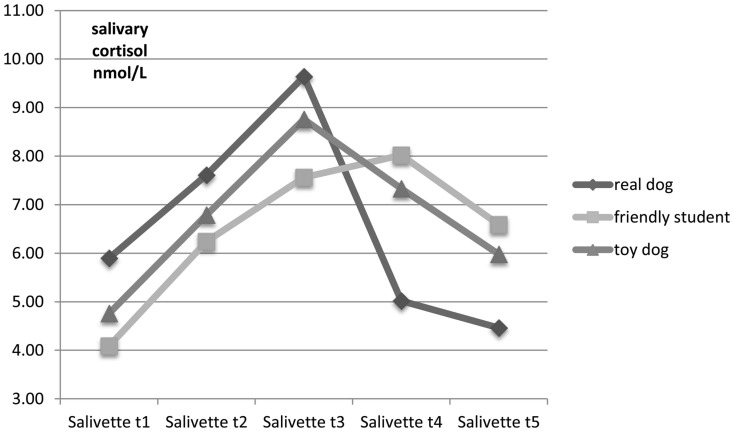
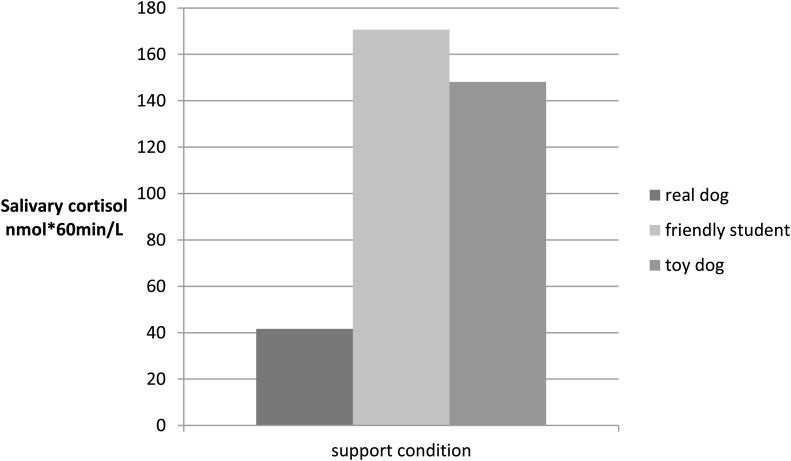
Up to 90% of children with special education needs and about 40% of children in the general population show insecure or disorganized attachment patterns, which are linked to a diminished ability to use social support by others for the regulation of stress. The aim of the study was to investigate if children with insecure-avoidant/disorganized attachment can profit more from social support by a dog compared to a friendly human during a stressful task. We investigated 47 male children (age 7-11) with insecure-avoidant or disorganized attachment. Social stress was elicited via the Trier Social Stress Test for Children (TSST-C). For one group of children a friendly therapy-dog (n = 24) was present, for one control group a friendly human (n = 10) and for the other control group a toy dog (n = 13). Stress levels of the children were measured via salivary cortisol at five times (t1-t5) before, during, and after the TSST-C and subjective reports. The physiological stress response was significantly lower in the dog condition in comparison to the two other support conditions at t4, t5 and the overall stress reaction from t1 to t5 (Area Under the Curve increase; Kruskal-Wallis H-Test, pairwise post hoc comparisons via Mann-Whitney U-Tests). Cortisol levels correlated negatively (r(s)) with the amount of physical contact between the child and dog. We conclude that male children with insecure-avoidant or disorganized attachment profit more from the presence of a therapy-dog than of a friendly human under social stress. Our findings support the assumption that the increasing practice of animal-assisted education is reasonable and that dogs can be helpful assistants in education/special education, since stress interferes with learning and performance in students.
Keywords: attachment; children; cortisol; human-dog interaction; social support; stress regulation.
Figures
References
-
- Ainsworth M. D. S. (1963). “The development of infant-mother interaction among the Ganda,” in Determinants of Infant Behavior, ed. Foss B. M. (New York: Wiley; ), 67–104
-
- Ainsworth M. D. S. (1972). “Attachment and dependency: a comparison,” in Attachment and Dependency, ed. Gerwitz J. L. (Washington: Winston; ), 97–137
-
- Ainsworth M. D. S. (1991). “Attachment and other affectional bonds across the life cycle,” in Attachment Across the Life Cycle, eds Parkes C. M., Stevenson-Hinde J., Marris P. (New York: Routledge; ), 33–51
-
- Ainsworth M. D. S., Bell S. M., Stayton D. J. (1971). “Individual differences in strange-situation behavior of one-year-olds,” in The Origins Of Human Social Relations, ed. Schaffer H. R. (New York: Academic Press; ), 17–52
-
- Ainsworth M. D. S., Blehar M. C., Waters E., Wall S. (1978). Patterns of attachment: a psychological study of the strange situation. Hillsdale, NY: Erlenbaum
Grants and funding
LinkOut - more resources
Full Text Sources
Medical
