


Age, academic performance, and stimulant prescribing for ADHD: a nationwide cohort study
- PMID: 23166340
- PMCID: PMC3507253
- DOI: 10.1542/peds.2012-0689
Age, academic performance, and stimulant prescribing for ADHD: a nationwide cohort study
Abstract
Background: We evaluated whether younger age in class is associated with poorer academic performance and an increased risk of being prescribed stimulants for attention-deficit/hyperactivity disorder (ADHD).
Methods: This was a nationwide population-based cohort study, linking data from national registries of prescribed drugs and standardized scholastic examinations. The study population comprised all children born in 1994-1996 who took standardized tests in Iceland at ages 9 and 12 (n = 11 785). We estimated risks of receiving low test scores (0-10th percentile) and being prescribed stimulants for ADHD. Comparisons were made according to children's relative age in class.
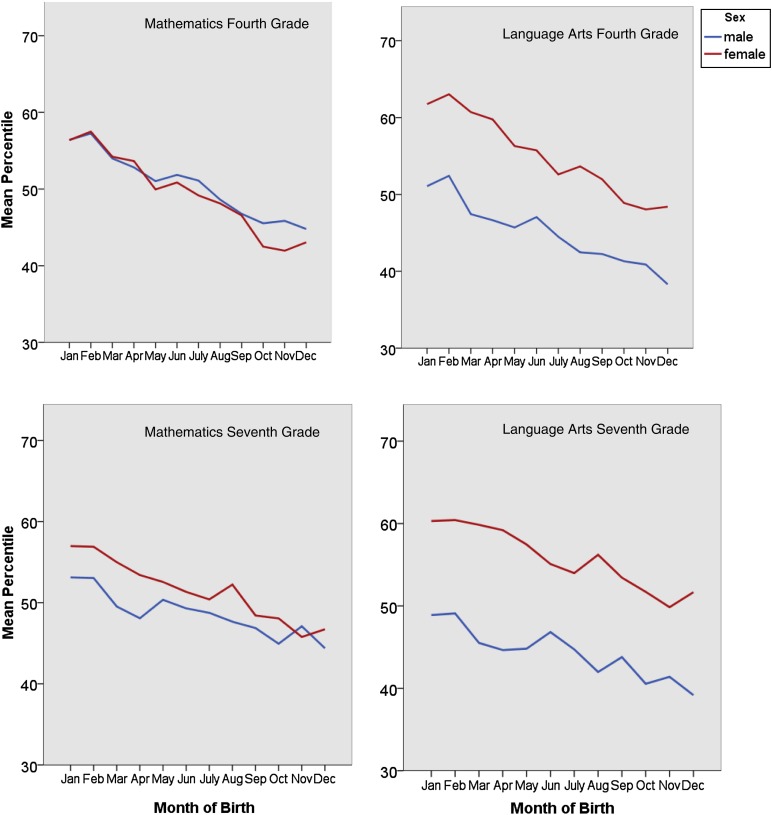
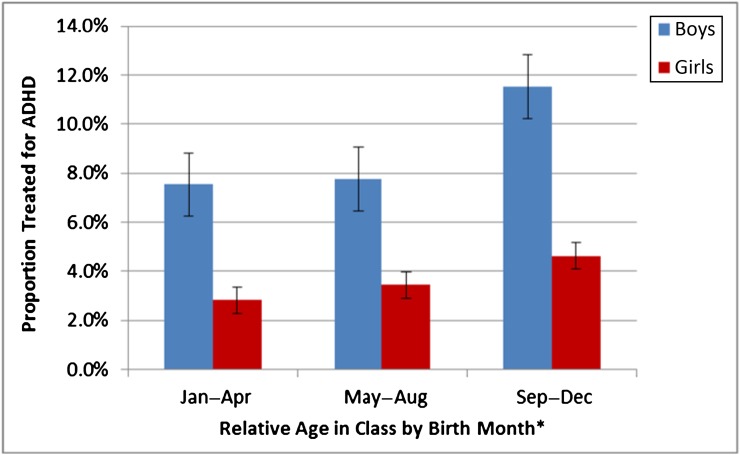
Results: Mean test scores in mathematics and language arts were lowest among the youngest children in the fourth grade, although the gap attenuated in the seventh grade. Compared with the oldest third, those in the youngest third of class had an increased relative risk of receiving a low test score at age 9 for mathematics (1.9; 95% confidence interval [CI] 1.6-2.2) and language arts (1.8; 95% CI 1.6-2.1), whereas at age 12, the relative risk was 1.6 in both subjects. Children in the youngest third of class were 50% more likely (1.5; 95% CI 1.3-1.8) than those in the oldest third to be prescribed stimulants between ages 7 and 14.
Conclusions: Relative age among classmates affects children's academic performance into puberty, as well as their risk of being prescribed stimulants for ADHD. This should be taken into account when evaluating children's performance and behavior in school to prevent unnecessary stimulant treatment.
Figures
References
-
- National Center for Education Statistics. Digest of education statistics: 2010. 2011. Available at: http://nces.ed.gov/programs/digest. Accessed December 1, 2011
-
- West J, Denton K, Germino-Hausken E. America’s Kindergartners: Findings From the Early Childhood Longitudinal Study, Kindergarten Class of 1998–99, Fall 1998. Washington, DC: : National Center for Education Statistics ; 2000
-
- Oshima T, Domaleski CS. Academic performance gap between summer-birthday and fall-birthday children in grades K–8. J Educ Res. 2006;99(4):212–217
-
- Stipek D. At what age should children enter kindergarten? A question for policy makers and parents. SRCD Social Policy Report 2002;16(2):3–16
-
- Bedard K, Dhuey E. The persistence of early childhood maturity: international evidence of long-run age effects. Q J Econ. 2006;121(4):1437–1472
Publication types
MeSH terms
Substances
Grants and funding
LinkOut - more resources
Full Text Sources
Medical
Miscellaneous
