Review
. 2013 Jan 5;368(1609):20110328.
doi: 10.1098/rstb.2011.0328.

DNA methylation dynamics during the mammalian life cycle

Affiliations
Review

DNA methylation dynamics during the mammalian life cycle

Jamie A Hackett et al. Philos Trans R Soc Lond B Biol Sci. .

Abstract

DNA methylation is dynamically remodelled during the mammalian life cycle through distinct phases of reprogramming and de novo methylation. These events enable the acquisition of cellular potential followed by the maintenance of lineage-restricted cell identity, respectively, a process that defines the life cycle through successive generations. DNA methylation contributes to the epigenetic regulation of many key developmental processes including genomic imprinting, X-inactivation, genome stability and gene regulation. Emerging sequencing technologies have led to recent insights into the dynamic distribution of DNA methylation during development and the role of this epigenetic mark within distinct genomic contexts, such as at promoters, exons or imprinted control regions. Additionally, there is a better understanding of the mechanistic basis of DNA demethylation during epigenetic reprogramming in primordial germ cells and during pre-implantation development. Here, we discuss our current understanding of the developmental roles and dynamics of this key epigenetic system.


Figures
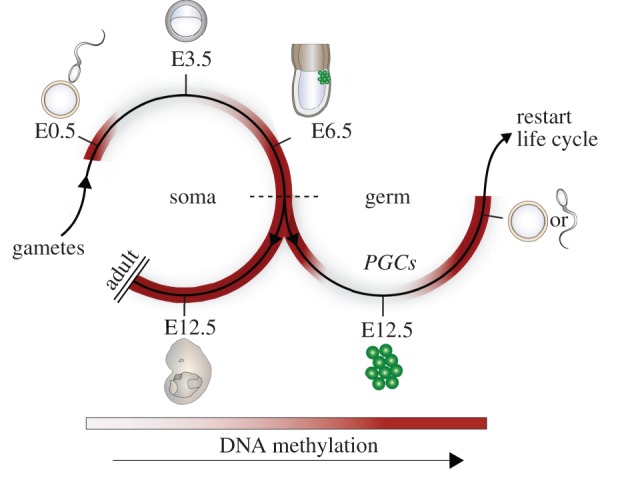
Figure 1.
Figure 1.
Global DNA methylation dynamics during the life cycle. Upon fertilization genome-wide DNA demethylation occurs in the zygote by conversion to 5hmC on the paternally derived genome and direct passive 5mC depletion of the maternally derived genome. The low-point of global methylation occurs at approximately E3.5 in the ICM, after which global re-methylation begins and reaches near completion by E6.5. At approximately E6.5, cells either continue to develop towards a somatic fate (left) or are specified as primordial germ cells (PGCs—right). Somatic fated cells acquire distinct methylomes according to their lineage but maintain high global levels of DNA methylation. PGCs initiate a phase of comprehensive DNA demethylation, which is complete by approximately  E12.5, and which enables subsequent establishment of a unique gamete-specific methylome during gametogenesis. Mature gametes can then fuse to form the zygote and initiate a new life cycle. ICM, inner cell mass.
Figure 2.
Figure 2.
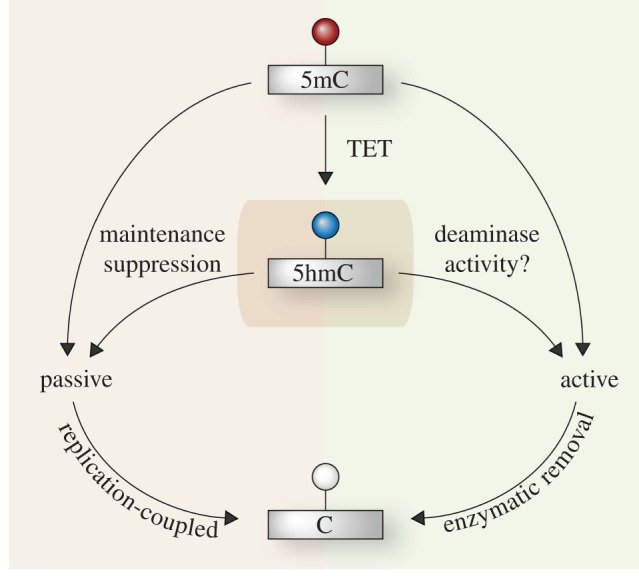
Mechanisms of DNA demethylation. Cytosine methylation (5mC) can be demethylated towards unmodified cytosine (C) through several potential mechanisms that can be broadly described as passive (left) or active (right). Passive demethylation occurs via replication-coupled dilution owing to a lack of re-establishment of DNA modification on the new daughter strand after DNA synthesis. Active erasure occurs through direct enzymatic removal of a DNA modification independent of DNA replication, and can involve a deamination reaction. Conversion to 5-hydroxymethylcytosine (5hmC) by TET proteins is likely a hub for demethylation (central box) and can lead to either passive or active erasure of DNA methylation. Additionally, 5hmC can be further modified to 5fC and 5caC (not shown), which can subsequently be actively or passively erased. 5mC can also be directly depleted passively, and potentially actively following deamination without conversion to 5hmC (upper arrows).
Figure 3.
Figure 3.
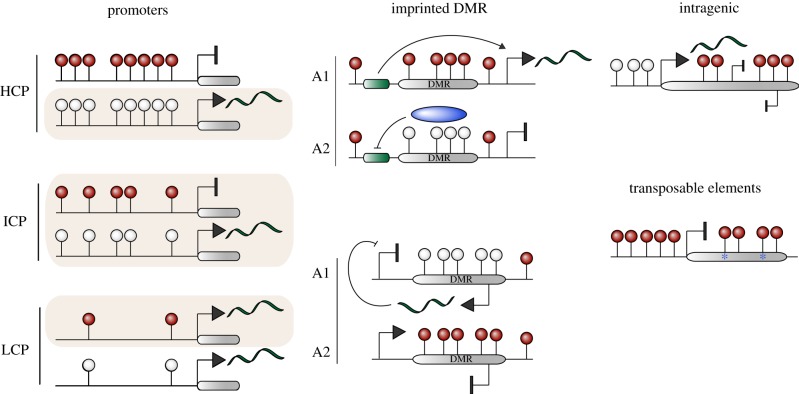
Distribution and roles of DNA methylation. The distribution of DNA methylation varies according to genomic landmarks. High-CpG density promoters (HCP) are usually hypomethylated, low CpG-density promoters (LCP) are usually methylated, and intermediate CpG-density promoters (ICP) can be either methylated or unmethylated (shown as shaded). In general, methylation only has a significant transcriptional effect at HCPs and ICPs, whereas methylation at LCPs does not correlate with repression. Note also that the absence of methylation only generates a permissive state for transcription and does not necessarily result in gene activity. Imprinted loci are methylated on one allele and hypomethylated on the other. This can have allele-specific effects by either modulating interactions between enhancers (green) and promoters (upper imprinted gene) or regulating expression of an antisense ncRNA, which silences genes in cis (lower imprinted gene). Gene bodies are generally hypermethylated, which may function to repress cryptic internal promoters. Transposable elements are usually highly methylated in the promoter and coding regions, which silences their expression and can lead to their mutation and inactivation through cytosine deamination (asterisks), respectively. A1/A2: Allele 1 and Allele 2. DMR, differentially methylated region.

References

    1. Reik W. 2007. Stability and flexibility of epigenetic gene regulation in mammalian development. Nature 447, 425–43210.1038/nature05918 (doi:10.1038/nature05918) - DOI - DOI - PubMed
    1. Surani MA, Hayashi K, Hajkova P. 2007. Genetic and epigenetic regulators of pluripotency. Cell 128, 747–76210.1016/j.cell.2007.02.010 (doi:10.1016/j.cell.2007.02.010) - DOI - DOI - PubMed
    1. Bird A. 2002. DNA methylation patterns and epigenetic memory. Genes Dev. 16, 6–2110.1101/gad.947102 (doi:10.1101/gad.947102) - DOI - DOI - PubMed
    1. Okano M, Bell DW, Haber DA, Li E. 1999. DNA methyltransferases Dnmt3a and Dnmt3b are essential for de novo methylation and mammalian development. Cell 99, 247–25710.1016/S0092-8674(00)81656-6 (doi:10.1016/S0092-8674(00)81656-6) - DOI - DOI - PubMed
    1. Li E, Bestor TH, Jaenisch R. 1992. Targeted mutation of the DNA methyltransferase gene results in embryonic lethality. Cell 69, 915–92610.1016/0092-8674(92)90611-F (doi:10.1016/0092-8674(92)90611-F) - DOI - DOI - PubMed

LinkOut - more resources