Clinical predictors of survival in idiopathic pulmonary fibrosis
- PMID: 23166549
- PMCID: PMC3492401
- DOI: 10.4046/trd.2012.73.3.162
Clinical predictors of survival in idiopathic pulmonary fibrosis
Abstract
Background: Idiopathic pulmonary fibrosis (IPF) is a progressive disease. Effective treatment is not currently available and the prognosis is poor. The aim of our study was to identify clinical predictors of survival in patients with IPF.
Methods: By using medical record database of a university hospital, we reviewed the records of patients who had been diagnosed as having IPF from January 1996 through December 2007.
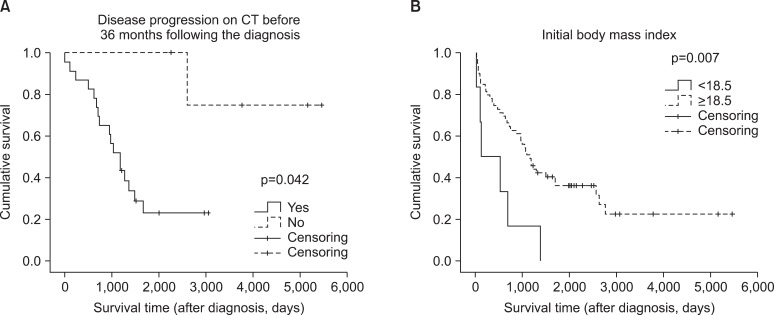
Results: Among 89 patients considered as having interstitial lung disease (ILD) on computed tomography (CT) of the chest, 22 were excluded because of the diagnosis of other ILDs or connective tissue disease, and finally, 67 met the criteria of IPF. The mean age at the diagnosis of IPF was 70 years (range, 41~87 years) and 43 (64%) were male. The mean survival time following the diagnosis of IPF was 40 months (range, 0~179 months). Among them, 28 cases were diagnosed as the progressive state of IPF on the follow-up CT examination, and the mean duration between diagnosis of IPF and progression was 31 months. Multivariate analysis using Cox regression model revealed that body mass index (BMI) less than 18.5 kg/m(2) (p=0.030; hazard ratio [HR], 12.085; 95% confidence interval [CI], 1.277~114.331) and CT progression before 36 months from the diagnosis of IPF (p=0.042; HR, 13.564; 95% CI, 1.101~167.166) were independently associated with mortality.
Conclusion: Since low BMI at the diagnosis of IPF and progression on follow-up CT were associated with poor prognosis, IPF patients with low BMI and/or progression before 36 months following the diagnosis should be closely monitored.
Keywords: Body Mass Index; Disease Progression; Idiopathic Pulmonary Fibrosis.
Figures
References
-
- American Thoracic Society; European Respiratory Society. American Thoracic Society/European Respiratory Society International Multidisciplinary Consensus Classification of the Idiopathic Interstitial Pneumonias. This joint statement of the American Thoracic Society (ATS), and the European Respiratory Society (ERS) was adopted by the ATS board of directors, June 2001 and by the ERS Executive Committee, June 2001. Am J Respir Crit Care Med. 2002;165:277–304. - PubMed
-
- American Thoracic Society. Standardization of Spirometry, 1994 Update. Am J Respir Crit Care Med. 1995;152:1107–1136. - PubMed
-
- Nagai S, Nagao T, Kitaichi M, Izumi T. Clinical courses of asymptomatic cases with idiopathic pulmonary fibrosis and a histology of usual interstitial pneumonia. Eur Respir J. 1998;11:131s.
LinkOut - more resources
Full Text Sources
Miscellaneous