


Prevention of Parent to Child Transmission (PPTCT) program data in India: an emerging data set for appraising the HIV epidemic
- PMID: 23166595
- PMCID: PMC3499509
- DOI: 10.1371/journal.pone.0048827
Prevention of Parent to Child Transmission (PPTCT) program data in India: an emerging data set for appraising the HIV epidemic
Abstract
Background: Evidence based resource allocation and decentralized planning of an effective HIV/AIDS response requires reliable information on levels and trends of HIV at national and sub-national geographic levels. HIV sentinel surveillance data from antenatal clinics (HSS-ANC) has been an important data source to assess the HIV/AIDS epidemic in India, but has a number of limitations. We assess the value of Prevention of Parent to Child Transmission (PPTCT) programme data to appraise the HIV epidemic in India.
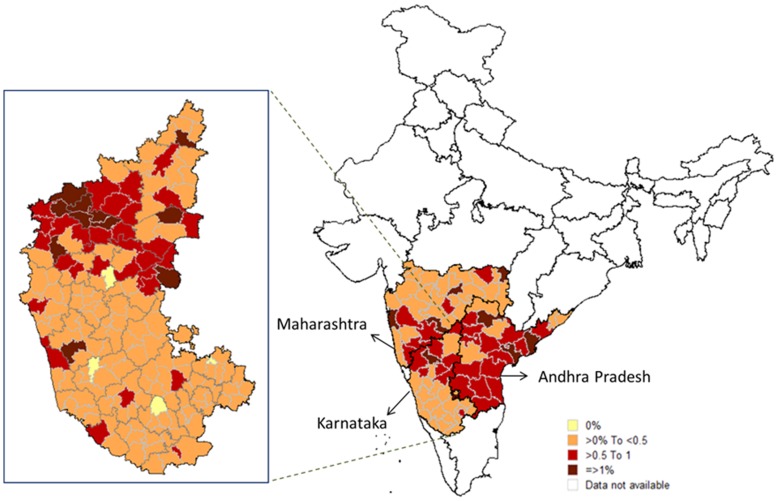
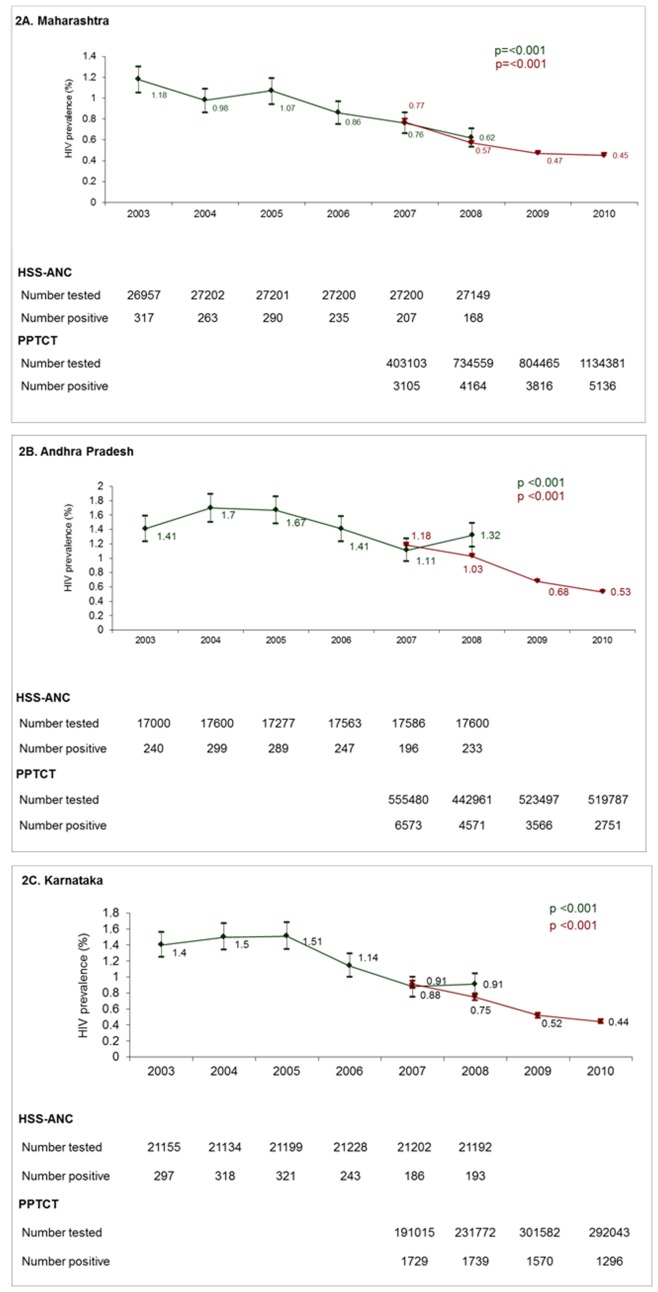
Methods/findings: HIV data from PPTCT sites were compared to HSS-ANC and general population level surveys at various geographic levels in the states of Karnataka, Maharashtra and Andhra Pradesh. Chi-square tests were used to ascertain statistical significance. PPTCT HIV prevalence was significantly lower than HSS-ANC HIV prevalence (0.92% vs. 1.22% in Andhra Pradesh, 0.65% vs. 0.89% in Karnataka, 0.52% vs. 0.60% in Maharashtra, p<0.001 for all three states). In all three states, HIV prevalence from PPTCT centres that were part of the sentinel surveillance was comparable to HSS-ANC prevalence but significantly higher than PPTCT centres that were not part of the sentinel surveillance. HIV prevalence from PPTCT data was comparable to that from general population surveys. In all three states, significant declines in HIV prevalence between 2007 and 2010 were observed with the PPTCT data set. District level analyses of HIV trends and sub-district level analysis of HIV prevalence were possible using the PPTCT and not the HSS-ANC data sets.
Conclusion: HIV prevalence from PPTCT may be a better proxy for general population prevalence than HSS-ANC. PPTCT data allow for analysis of HIV prevalence and trends at smaller geographic units, which is important for decentralized planning of HIV/AIDS programming. With further improvements to the system, India could replace its HSS-ANC with PPTCT programme data for surveillance.
Conflict of interest statement
Figures
References
-
- Bautista-Arredondo S, Gadsden P, Harris JE, Bertozzi SM (2008) Optimizing resource allocation for HIV/AIDS prevention programmes: an analytical framework. Aids 22 Suppl 1S67–74. - PubMed
-
- Wilson D, Halperin DT (2008) “Know your epidemic, know your response”: a useful approach, if we get it right. Lancet 372: 423–426. - PubMed
-
- National AIDS Control Organization (NACO), Ministry of Health and Family Welfare, Government of India (1998) Annual sentinel surveillance for HIV infection - A country report on monitoring of surveillance activities and supervisory visits of HIV infections in the country. New Delhi.
-
- World Health Organization and Joint United Nations Programmes on HIV/AIDS (2011) Guidelines for Second Generation HIV Surveillance: an update: know your epidemic; Geneva. - PubMed
-
- Arora P, Kumar R, Bhattacharya M, Nagelkerke NJ, Jha P (2008) Trends in HIV incidence in India from 2000 to 2007. Lancet 372: 289–290. - PubMed
Publication types
MeSH terms
LinkOut - more resources
Full Text Sources
Medical
