


Reductions in glucose among postmenopausal women who use and do not use estrogen therapy
- PMID: 23168523
- PMCID: PMC3582709
- DOI: 10.1097/gme.0b013e3182703b73
Reductions in glucose among postmenopausal women who use and do not use estrogen therapy
Abstract
Objective: Among postmenopausal women who do not use estrogen therapy (ET), we have previously reported that intensive lifestyle modification (ILS) leads to increases in sex hormone-binding globulin (SHBG) and that such increases are associated with reductions in fasting plasma glucose (FPG) and 2-hour postchallenge glucose (2HG). Oral ET decreases FPG and increases 2HG while increasing both SHBG and estradiol (E2). It is unknown if ILS reduces glucose among ET users, if changes in SHBG and E2 might mediate any glucose decreases in ET users, and if these patterns differ from those in non-ET users.
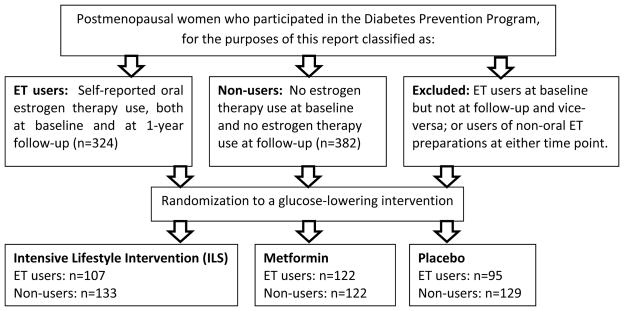
Methods: We conducted a secondary analysis of postmenopausal women in the Diabetes Prevention Program who used ET at baseline and 1-year follow-up (n = 324) and who did not use ET at either time point (n = 382). Participants were randomized to ILS, metformin, or placebo administered at 850 mg BID.
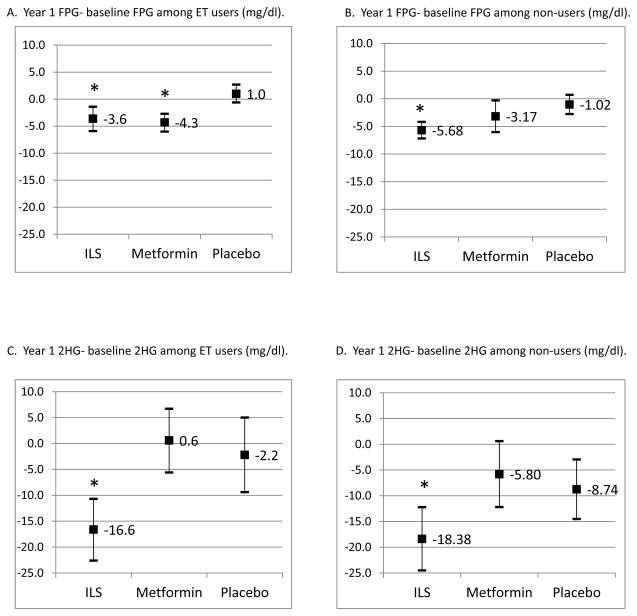
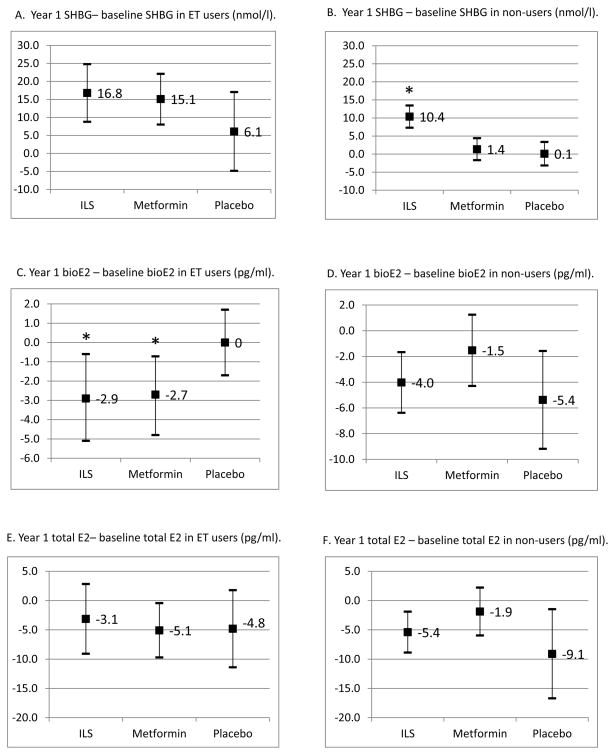
Results: ET users were younger, more often white, and more likely to have had bilateral oophorectomy than non-ET users. Among ET users, ILS reduced FPG (P < 0.01) and 2HG (P < 0.01), and metformin reduced FPG (P < 0.01) but not 2HG (P = 0.56), compared with placebo. Associations between SHBG and total E2 with FPG and 2HG were not significant among women randomized to ILS or metformin. These patterns differed from those observed among women who did not use ET.
Conclusions: We conclude that among glucose-intolerant ET users, interventions to reduce glucose are effective but possibly mediated through different pathways than among women who do not use ET.
Conflict of interest statement
Figures
Comment in
-
Diabetes prevention in postmenopausal women: lifestyle, metformin, and sex steroid intervention revisited.Menopause. 2013 Apr;20(4):365-7. doi: 10.1097/GME.0b013e31828b60ab. Menopause. 2013. PMID: 23921470 No abstract available.
References
-
- Oh J, Barrett-Connor E, Wedick N, Wingard D. Endogenous sex hormones and the development of type 2 diabetes in older men and women: the Rancho Bernardo Study. Diabetes Care. 2002;25:55–60. - PubMed
-
- Ding E, Song Y, Manson J, Rifai N, Buring J, Liu S. Plasma sex steroid hormones and risk of developing type 2 diabetes in women: a prospective study. Diabetologia. 2007;50:2076–84. - PubMed
Publication types
MeSH terms
Substances
Grants and funding
LinkOut - more resources
Full Text Sources
Other Literature Sources
Medical
Miscellaneous
